HARARE — Zimbabwe’s National Railways is seeking to turn a US$115 million financing package into a broader revival of the country’s freight railway, as rising mineral production exposes the economic cost of a rail network operating far below its historical capacity.
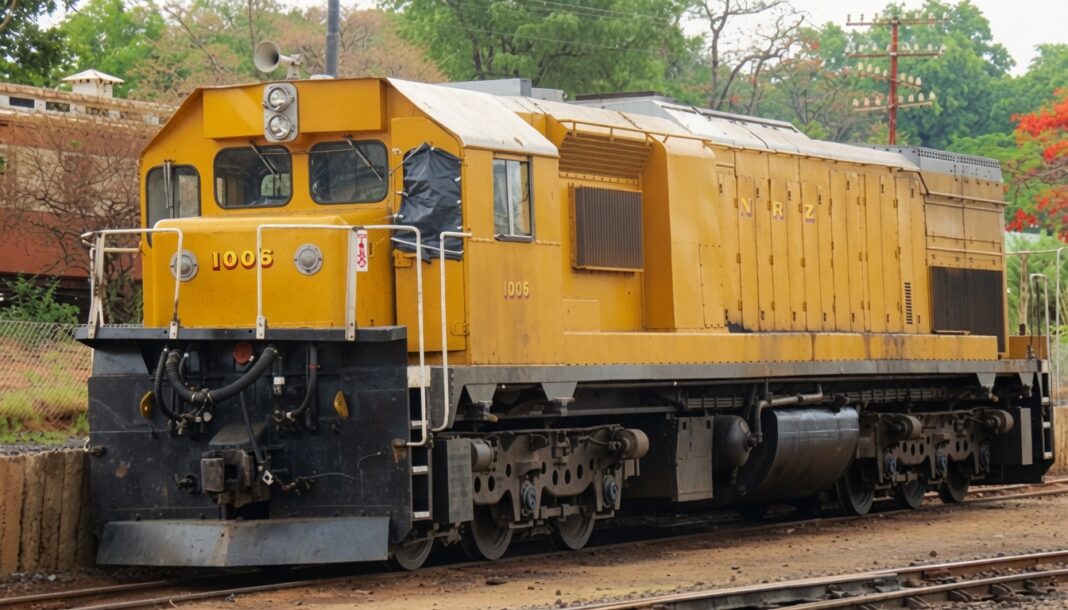
The proposed Afreximbank facility, being negotiated with the support of Mutapa Investment Fund, would finance 10 locomotives, 315 wagons and the rehabilitation of critical railway infrastructure.
The intervention comes as NRZ attempts to rebuild freight volumes after decades of underinvestment left the railway carrying only about 2.03 million tonnes in 2025, compared with 12.4 million tonnes in 1998.
Mining boom creates a logistics test
Analysts who spoke to The Zimbabwe Financial Mail said the investment should be viewed less as a rolling-stock purchase and more as a strategic intervention into Zimbabwe’s wider industrial economy.
Zimbabwe is expanding production of lithium, chrome, ferrochrome, coal and other minerals, creating precisely the type of bulk freight that railways are designed to move efficiently over long distances.
“Zimbabwe cannot sustainably expand mineral production while leaving the logistics system constrained,” one analyst said. “Rail capacity is becoming part of the country’s productive infrastructure, not simply a transport issue.”
The opportunity is particularly significant because bulk mineral exports can generate predictable freight flows, allowing NRZ to plan train capacity around contracted volumes rather than relying entirely on fragmented spot cargo.
From two million tonnes to 12 million
NRZ is targeting approximately 3.01 million tonnes of freight in 2026 and has set an ambitious goal of reaching 12 million tonnes by 2030.
That target would represent almost a sixfold increase from the 2025 base.
Analysts cautioned, however, that locomotives and wagons alone cannot deliver such an expansion.
Track condition, signalling, workshops, wagon turnaround, train scheduling, customer contracts and working capital will all have to improve simultaneously.
“The real investment question is not how many locomotives arrive at NRZ, but how many additional tonnes those locomotives can carry each year and whether the railway can convert that traffic into sustainable cash flow,” another analyst told The Zimbabwe Financial Mail.
Zimbabwe’s road network is carrying the cost
The deterioration of rail capacity has pushed more heavy freight onto Zimbabwe’s roads.
For mining companies, this can increase logistics costs while placing additional pressure on roads and border corridors. A functioning railway could therefore improve the competitiveness of Zimbabwean exports while reducing the wear associated with moving large volumes of bulk cargo by truck.
The economic benefit extends beyond NRZ itself.
Lower transport costs can improve the economics of mines, manufacturers, agricultural producers and fuel distributors, while more reliable rail connections can make Zimbabwe more attractive as a regional transit corridor.
Regional corridor opportunity
Zimbabwe also occupies an important geographical position between mineral-producing economies to the north and ports in South Africa and Mozambique.
That gives NRZ an opportunity to develop beyond a purely domestic freight operator and capture more regional transit traffic.
But analysts warned that regional freight is commercially mobile.
Cargo owners can redirect shipments towards alternative corridors when rail reliability deteriorates, making service quality as important as physical network capacity.
The railway therefore needs to compete on reliability, turnaround times and cost rather than assuming that its geographical position automatically guarantees freight.
Customer-backed investment could accelerate recovery
NRZ has already demonstrated the potential of partnerships with major freight users.
The railway has commissioned refurbished locomotives and wagons through a partnership with Zimasco, while leased locomotives from Sheltam have helped address immediate traction shortages. Mutapa has also outlined a separate US$6 million programme for wagon refurbishment and maintenance equipment.
Analysts said such arrangements could become increasingly important as Zimbabwe seeks to rebuild infrastructure without placing the entire financing burden on the state.
Mining companies with predictable freight requirements could potentially support dedicated rolling stock or contracted rail capacity, aligning private investment with guaranteed cargo demand.
Debt sustainability remains crucial
The proposed US$115 million facility nevertheless raises an important financial question: can increased freight volumes generate sufficient cash to service the borrowing while maintaining the railway?
NRZ’s historical financial difficulties mean that capital expenditure must translate into measurable improvements in operating performance.
The critical indicators will include locomotive availability, wagon utilisation, tonnes moved per train, wagon turnaround times, revenue per tonne and the speed at which customers settle their bills.
“Rail recapitalisation becomes economically meaningful when the assets begin paying for themselves through higher utilisation,” an analyst said. “The objective must be a virtuous cycle in which more freight generates more cash, and that cash finances further rehabilitation.”
Bigger rehabilitation still required
The Afreximbank facility is significant, but it is not large enough to resolve all of NRZ’s infrastructure constraints.
Government has also been discussing a much broader rehabilitation programme with China Railway International Group, estimated at about US$600 million, covering tracks, signalling, rolling stock and other infrastructure.
That suggests the US$115 million programme should be viewed as an important first phase of a much larger railway reconstruction rather than a complete solution.
Its success will depend on whether the initial investment restores enough capacity to attract additional freight and strengthen NRZ’s financial position.
A test for Zimbabwe’s industrial strategy
The railway revival comes at a critical moment for Zimbabwe.
The country is seeking to increase mineral production, attract investment into processing and expand exports while simultaneously improving its foreign-exchange position.
Those ambitions require infrastructure capable of moving commodities efficiently from mine to processor and ultimately to export markets.
A stronger NRZ could therefore become an important component of Zimbabwe’s industrial strategy.
The immediate challenge is to convert ageing infrastructure and insufficient rolling stock into a commercially viable freight system.
Zimbabwe once moved more than 12 million tonnes of freight annually. Returning to that scale would require more than new locomotives: it would require disciplined capital allocation, reliable infrastructure, long-term freight contracts and management focused relentlessly on asset utilisation.
For NRZ, the US$115 million financing proposal is therefore not simply a railway investment. It is a test of whether Zimbabwe can rebuild the logistics infrastructure needed to support its next phase of mining and industrial growth.