HARARE — Air Zimbabwe has begun an internal review of its operational performance as the national carrier moves towards a broader assessment of progress under its 2026–2030 strategy, with management facing the task of translating an ambitious recovery programme into measurable operational and commercial results.
The airline’s management team recently convened to examine operational performance ahead of the scheduled Strategy Review, which will assess the carrier’s progress against the objectives set out in the Air Zimbabwe Strategy 2026–2030.
The review comes at an important juncture for the state-owned airline, which has been pursuing a phased turnaround built around network development, fleet renewal, operational efficiency, financial sustainability and improved customer service.
Chief executive officer Edmund Makona told the management meeting that the exercise should go beyond a routine assessment of financial figures and operational activities, arguing that management needed to establish whether the airline remained on course to fulfil its mandate.
The emphasis on execution is significant for an airline whose recovery ambitions have increasingly moved from restructuring existing operations towards rebuilding international connectivity.
Air Zimbabwe returned to the global distribution system in July following an agreement with Travelport, giving travel agencies access to its inventory internationally for the first time in more than a decade. The development coincided with the carrier’s return to the Harare-London Gatwick market, substantially raising the commercial stakes around its turnaround programme.
An airline industry expert speaking to The Zimbabwe Financial Mail said the performance review was particularly important because airline turnarounds ultimately had to be measured through operational metrics rather than strategic declarations.
“An airline strategy only becomes meaningful when it translates into aircraft utilisation, schedule reliability, passenger numbers, load factors, route profitability, cash generation and customer retention,” the expert said.
The analyst said Air Zimbabwe’s immediate challenge was to establish whether the new network and fleet initiatives were producing sufficient commercial returns to support the airline’s longer-term ambitions.
“Expansion can create the appearance of growth while simultaneously putting pressure on cash flows. The discipline required now is to determine which routes, aircraft and services are economically sustainable and which ones require restructuring,” the analyst said.
That assessment is particularly relevant as Air Zimbabwe seeks to rebuild its international footprint while strengthening domestic and regional operations.
Makona has previously advocated a phased “crawl, walk and run” approach to the airline’s recovery, with the strategy initially centred on strengthening domestic and regional operations before expanding internationally.
The carrier’s current strategy represents a considerably more ambitious phase of that recovery.
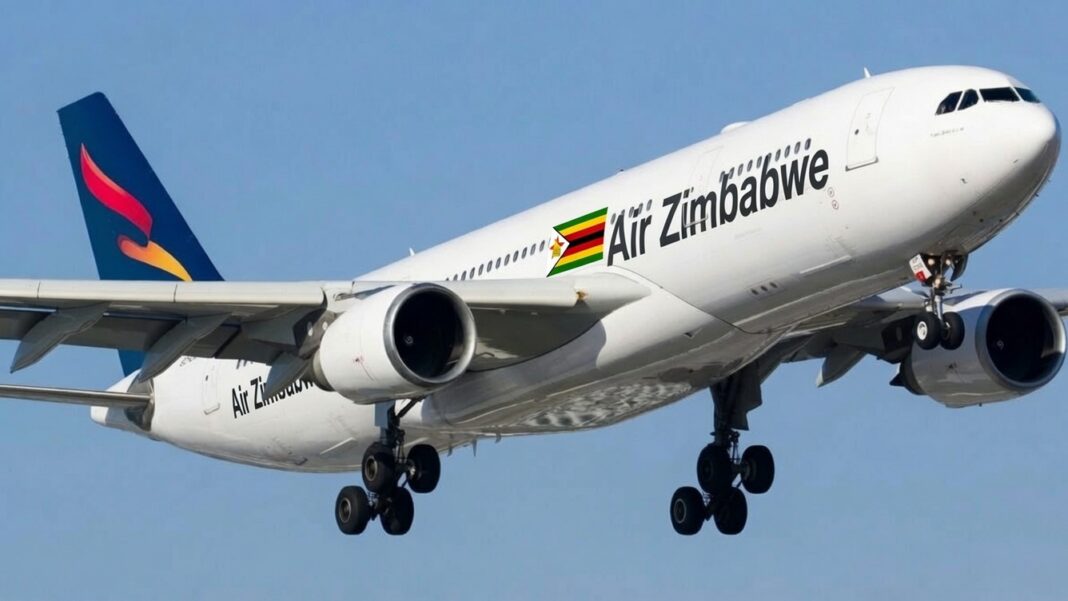
The relaunch of the Harare-London service, supported by an Airbus A330-300 operating under an ACMI arrangement with Spain’s Plus Ultra, has placed Air Zimbabwe back into a strategically important long-haul market. The aircraft has 302 seats and dedicated cargo capacity, providing the airline with both passenger and freight opportunities.
A second aviation industry specialist told The Zimbabwe Financial Mail that the strategic review should therefore focus heavily on the economics of the network.
“The question is not simply whether Air Zimbabwe is flying more destinations. It is whether those destinations generate sustainable yields after aircraft leasing, fuel, maintenance, airport charges, crew, distribution and other operating costs,” the specialist said.
He said schedule integrity would also be critical because reliability was one of the most important determinants of customer loyalty in commercial aviation.
“International passengers, corporate travellers and travel agents need confidence that an airline will operate when it says it will. Reliability is itself a commercial asset,” the expert said.
Air Zimbabwe has previously identified punctuality and schedule integrity as central to its customer proposition, alongside the development of its route network, fleet and cargo business.
The airline’s management review is therefore likely to extend beyond individual operational indicators to the wider question of whether the organisation has developed the systems and managerial discipline required to support sustainable growth.
For years, Air Zimbabwe’s difficulties have been associated not only with fleet constraints but also with financial pressures, limited international distribution, operational disruption and the inability to sustain a competitive network.
Recent developments suggest that some of those structural constraints are being addressed.
The return to global distribution through Travelport has improved the airline’s visibility among international travel agencies, while the London route has re-established a direct link between Zimbabwe and one of its most strategically important overseas markets.
But the next challenge is monetising that infrastructure.
An aviation expert told The Zimbabwe Financial Mail that the carrier’s strategy should increasingly be judged by its ability to convert connectivity into revenue.
“Zimbabwe has a strong tourism proposition, a sizeable diaspora market and significant potential for business and trade travel. But connectivity only creates economic value when an airline can capture sufficient passenger and cargo demand at commercially viable yields,” the expert said.
The review also comes against a broader transformation in Zimbabwe’s aviation sector, with private carriers expanding capacity and international airlines competing for traffic into and out of the country.
That makes operational efficiency particularly important for Air Zimbabwe. As competition increases, the national carrier can no longer rely solely on its status as the country’s flag carrier to secure market share.
The airline must compete on schedule, reliability, price, network connectivity, service quality and increasingly on the ability to offer seamless international distribution.
Makona has stressed that Air Zimbabwe’s recovery must ultimately support national development by providing safe, reliable and efficient air transport while facilitating trade, tourism and investment.
The 2026–2030 strategy consequently represents more than a corporate turnaround programme. For the government, the airline remains a strategic national asset whose performance has implications for Zimbabwe’s connectivity and tourism ambitions.
The management review provides an opportunity to determine whether that strategic importance is being matched by commercial discipline.
For Air Zimbabwe, the central test entering the next phase of its recovery is no longer simply whether the airline can return aircraft to the skies or reopen routes.
It is whether it can turn those aircraft and routes into a consistently profitable, reliable and commercially sustainable airline.