HARARE — Zimbabwe’s lithium industry is entering a potentially transformative phase, with the value of concentrate sales surging more than fourfold in 2026 despite a comparatively modest increase in volumes, as firmer international prices and an increasingly aggressive beneficiation policy reshape the country’s mineral-export model.
Lithium concentrate sales reached 816,774.35 tonnes worth approximately US$1.247 billion during the period under review, compared with 663,833.13 tonnes valued at about US$243 million during the corresponding period in 2025.
The figures represent a 23 percent increase in volumes but a staggering 413 percent increase in value, highlighting the extent to which the recovery in lithium prices, rather than volumes alone, has driven the industry’s improved performance.
Minerals Marketing Corporation of Zimbabwe (MMCZ) general manager Dr Nomusa Jane Moyo said the increase demonstrated that Zimbabwe was beginning to benefit from an improvement in international lithium prices.
“Zimbabwe is benefiting from the recovery in lithium prices, as reflected in MMCZ’s 2026 sales performance,” Moyo said.
“The substantial growth in value indicates that improved international lithium prices are being captured in current sales and are not merely the result of volumes carried over from the lower-priced market conditions of 2025.”
The scale of the increase is significant. A 23 percent increase in tonnage on its own could not account for a 413 percent jump in sales value, meaning that the overwhelming driver of the improvement has been pricing.
Global spodumene prices have recovered sharply after the severe downturn experienced through 2025, when weaker lithium prices put pressure on producers and reduced the revenue generated from Zimbabwe’s rapidly expanding concentrate exports.
The contrast with last year is particularly striking. Zimbabwe’s spodumene volumes increased by 11 percent in 2025, from 1.014 million tonnes to 1.128 million tonnes, but revenue remained broadly flat at US$513.8 million. Revenue per tonne consequently fell by about 10 percent, from approximately US$507 to US$456.
The latest figures therefore provide an important test of Zimbabwe’s mineral-beneficiation strategy, which seeks to ensure that higher mineral production translates into greater domestic economic value rather than simply larger volumes of unprocessed exports.
From concentrate exports to processing
The Government has progressively tightened its approach to lithium exports as it attempts to force the industry towards domestic processing.
Moyo rejected suggestions that producers had been permitted to export lithium concentrate regardless of international prices, pointing to Statutory Instrument 5 of 2023, which gave Government control over export quotas on a producer-by-producer basis.
The policy was intended to allow miners to generate and mobilise capital for investment in local processing facilities while supporting the transition towards beneficiation.
That policy has since become more stringent.
In February 2026, the Ministry of Mines and Mining Development temporarily suspended lithium concentrate exports amid concerns over leakages and malpractice. The intervention came ahead of the current quota arrangements and the 10 percent export tax on concentrate shipments, which forms part of the Government’s push towards the January 2027 deadline for the prohibition of raw lithium concentrate exports.
The Government has maintained that the January 2027 deadline remains unchanged despite calls from sections of the mining industry for an extension to the middle of next year.
“The prevailing Government position is that the January 2027 deadline remains in force. The Minister has been clear and consistent that it stands,” Moyo said.
She said toll processing, or tolling, would help address the industry’s remaining processing-capacity constraints by allowing producers without their own conversion facilities to process material through operators with existing plants.
Prospect Lithium, for example, has used tolling arrangements as part of the industry’s transition towards greater domestic processing.
Lithium sulphate changes the equation
The emergence of lithium sulphate as an export product could prove more significant for Zimbabwe’s beneficiation strategy than the dramatic increase in concentrate sales.
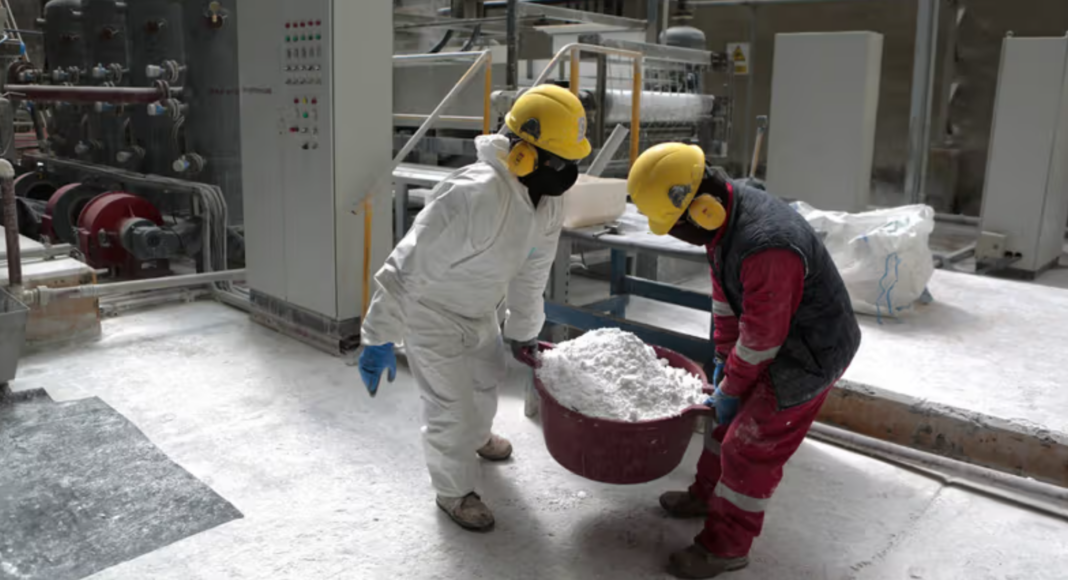
Zimbabwe began exporting lithium sulphate in April, with June data showing the product accounting for 3.89 percent of total mineral export value.
It joins a mineral-export basket dominated by PGM matte at 33.93 percent, spodumene concentrates at 26.57 percent and PGM concentrates at 13.73 percent.
“Lithium sulphate is emerging as a new value-added export mineral commodity,” Moyo said, describing the development as “an important step towards establishing Zimbabwe as a regional hub for battery mineral processing”.
The development reflects a broader attempt to move Zimbabwe beyond the traditional model of exporting minerals at relatively low levels of processing and importing higher-value refined products.
The country has already attracted substantial Chinese-backed investment into lithium processing.
Zhejiang Huayou Cobalt’s approximately US$400 million Prospect Lithium operation at Goromonzi and Sinomine’s US$500 million Bikita operation form the backbone of roughly US$900 million in Chinese-backed lithium-processing investment.
Both are among the relatively small number of operations with sulphate-processing capabilities.
The challenge now is to determine whether those investments can catalyse a wider domestic battery-minerals value chain.
An independent mining economist said the headline growth in lithium revenue should not obscure the more important question of how much value is actually being retained domestically.
“The US$1.2 billion sales figure is impressive, but it remains an export-revenue number,” the economist said.
“What Zimbabwe needs to demonstrate is how much additional value is being created inside the country per tonne of lithium processed.”
That distinction is crucial for a beneficiation policy whose ultimate objective is not simply to increase export receipts but to deepen industrialisation, create manufacturing capacity and retain a greater proportion of mineral wealth within the domestic economy.
Smuggling remains a concern
At the same time, Zimbabwe is attempting to tighten controls over the mineral trade and reduce leakages.
MMCZ’s inaugural Mineral Resource Accounting and Surveillance Market Update recorded 18 suspected smuggling cases between January 1 and August 20, 2026, involving 2,654.88 tonnes of minerals.
Lithium, chrome and silica accounted for the bulk of the cases.
According to Moyo, the offences included movement without valid documentation, falsification or misuse of export documentation, cargo misdeclaration and attempted movement of unbeneficiated mineral ore.
One case at Forbes Border Post in July involved a 33-tonne consignment of lithium spodumene ore travelling on photocopied documentation. The shipment was estimated to be worth approximately US$66,000.
The MMCZ said its increased presence at border posts, working with the Zimbabwe Republic Police, police intelligence, the Criminal Investigation Department’s Minerals, Flora and Fauna Unit, the Zimbabwe Revenue Authority and the Zimbabwe Anti-Corruption Commission, had strengthened surveillance.
The reported cases nevertheless represent only a fraction of formally recorded lithium volumes, highlighting the importance of continued monitoring as mineral exports expand.
Revenue versus domestic value
The sharp rise in lithium exports also raises questions about how much of the industry’s gross export earnings ultimately accrue to the Zimbabwean economy.
MMCZ receives a commission of 0.875 percent of export invoice value, while royalties and taxes are collected by other Government institutions and are not consolidated in MMCZ’s figures.
Zimbabwe imposes a 7 percent royalty on raw lithium ore and concentrate, while a separate 10 percent beneficiation tax on concentrate exports has been in force since February 2026.
Based on 2025 lithium export revenue of US$513.8 million, the 7 percent royalty would imply approximately US$36 million in Government revenue, although that is only a rough calculation and is not an MMCZ-confirmed figure.
The industry’s contribution to public finances could therefore increase materially as export values rise and the beneficiation tax begins to influence producer economics.
For mining companies, however, the policy presents a delicate balance: higher taxes and export restrictions may accelerate investment in processing, but they also increase the capital required to remain competitive during periods of volatile international lithium prices.
Zimbabwe targets lithium leadership
Zimbabwe’s strategic importance in the African lithium market is expected to increase further over the coming years.
The African Energy Chamber’s State of African Energy 2026 report projects Zimbabwe’s lithium output reaching approximately 160,000 tonnes of lithium carbonate equivalent by 2030, putting the country ahead of Mali’s projected 95,000 tonnes.
The Government’s ambition is therefore no longer simply to become a major African lithium producer.
It is increasingly seeking to position Zimbabwe as a regional processing centre for battery minerals.
That strategy will be tested in January 2027, when the concentrate-export deadline takes effect.
Indonesia’s experience with nickel provides a useful precedent. Its restrictions on raw nickel ore exports attracted substantial investment into domestic smelting and processing, but also generated supply disruptions, trade tensions and concerns about the energy intensity of the resulting industrial base.
Zimbabwe faces a similar strategic choice: whether its lithium reserves can become the foundation for a broader industrial ecosystem or remain primarily a source of mineral-export earnings.
For now, the numbers are moving decisively in the right direction. Lithium volumes are rising, prices have recovered and export values have exploded.
But the more consequential measure of success will be whether Zimbabwe can convert that export boom into domestic processing, industrial investment, employment, fiscal revenue and a durable battery-minerals value chain.
MMCZ expects platinum group metals, lithium products, ferrochrome, steel and coke to be among the principal drivers of mineral-export growth during the second half of 2026.