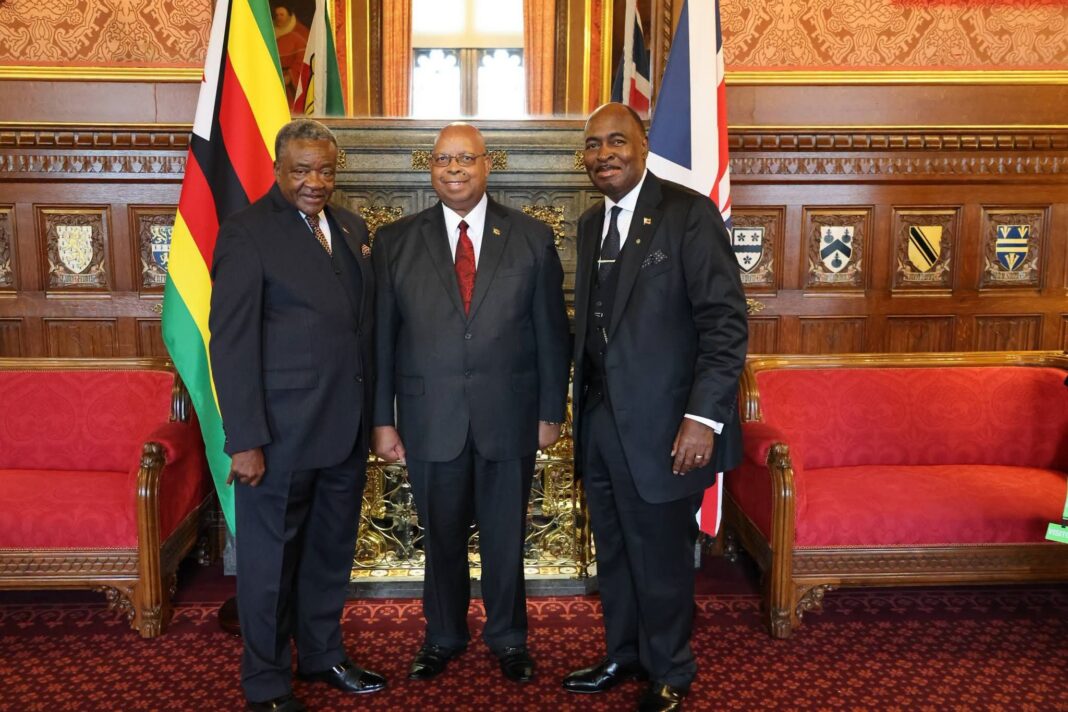
LONDON — Zimbabwe’s efforts to restore diplomatic relations with Britain have gained fresh momentum as Speaker of Parliament Jacob Mudenda undertakes a high-level visit to Westminster, raising expectations of closer bilateral cooperation and renewed prospects for the country’s readmission to the Commonwealth.
The visit forms part of President Emmerson Mnangagwa’s engagement and re-engagement policy, aimed at rebuilding relations with Western governments following more than two decades of diplomatic estrangement.
Mudenda’s programme includes meetings with House of Commons Speaker Sir Lindsay Hoyle, selected parliamentary committee chairpersons, executives of the British Group of the Inter-Parliamentary Union and representatives of the Commonwealth Parliamentary Association.
The delegation will also tour the Palace of Westminster and Lancaster House and observe Prime Minister’s Questions in the House of Commons on Wednesday.
The parliamentary engagement comes amid indications of a gradual thaw in relations between Harare and London, although differences over governance, constitutional reforms and electoral credibility remain obstacles to full diplomatic normalisation.
Commonwealth Return Back in Focus
Zimbabwe withdrew from the Commonwealth in 2003 following disputes over governance and electoral conduct under former President Robert Mugabe. Its application to rejoin the organisation, submitted in 2018, remains unresolved.
Mudenda’s engagement with British parliamentary institutions could strengthen political dialogue, although Commonwealth readmission requires broader agreement among member states and cannot be determined by Britain alone.
The visit also follows the appointment of Britain’s ambassador to Zimbabwe, Gillian Joanna Lever, whose diplomatic engagement is expected to contribute to renewed bilateral discussions.
Mudenda is accompanied by Webster Shamu, chairperson of Parliament’s Portfolio Committee on Foreign Affairs and International Trade, and committee members Noah Mangondo, Vivian Pamella Chitimbe, Consilia Chinanzvavana and Auxcilia Dhanzi.
Economic Opportunities Beyond Diplomacy
For Zimbabwe, improved relations with Britain could carry significant economic benefits, particularly in investment, international banking, trade finance and access to capital.
Britain remains a major global financial centre, and stronger diplomatic ties could encourage British institutional investors to reconsider opportunities in Zimbabwe’s mining, agriculture, energy, tourism and financial services sectors.
Zimbabwe’s substantial mineral resources, including gold, platinum and lithium, offer potential investment opportunities, but concerns over sovereign risk, policy predictability and external debt arrears continue to discourage international capital.
A meaningful diplomatic breakthrough, accompanied by progress in debt resolution and economic reforms, could eventually help reduce Zimbabwe’s sovereign risk premium and improve access to cheaper international credit.
This would be particularly important for domestic banks and manufacturers seeking affordable financing to expand production, modernise equipment and strengthen exports.
The Zimbabwean diaspora in Britain could also benefit from improved bilateral relations through stronger investment networks, professional exchanges and business partnerships.
Diplomacy Faces Its Economic Test
The Westminster visit comes as Zimbabwe seeks to consolidate monetary stability, strengthen confidence in its ZiG currency and attract investment into productive sectors.
While Commonwealth membership would not automatically guarantee preferential trade arrangements or international financing, it could improve Zimbabwe’s diplomatic standing and expand opportunities for economic cooperation.
However, investors will ultimately judge Zimbabwe by the credibility of its institutions, consistency of economic policies and ability to protect capital.
Mudenda’s parliamentary diplomacy therefore represents another step towards rebuilding relations with a historically important economic partner.
Whether the emerging diplomatic goodwill translates into Commonwealth readmission, renewed British investment and cheaper international finance will depend on sustained political engagement and meaningful economic reforms in Harare.
For Zimbabwe, the greater prize is not simply a return to the Commonwealth, but a restoration of international confidence capable of supporting investment, industrial growth and long-term economic recovery.