HARARE — The Zimbabwe Stock Exchange (ZSE) closed Wednesday’s trading session on a positive note, with gains in selected heavyweight counters lifting the benchmark All Share Index by 0.14 percent, even as subdued turnover highlighted persistent liquidity constraints in Zimbabwe’s domestic capital markets.
The local bourse recorded 81 trades worth ZiG6.82 million, while total market capitalisation stood at ZiG110.74 billion, according to official trading statistics for 21 October 2026.
The modest advance contrasted with the performance of the United States dollar-denominated Victoria Falls Stock Exchange (VFEX), whose latest available figures showed a marginal decline in its benchmark index, reflecting the increasingly differentiated investment dynamics of Zimbabwe’s two securities markets.
The ZSE All Share Index finished at 478.86 points, supported by a 0.22 percent rise in the Top 10 Index to 467.40 points and a 0.30 percent increase in the Top 15 Index to 479.03 points.
However, the Mid Cap Index declined by 0.17 percent to 560.52 points, while the Small Cap Index remained unchanged at 100.11 points, suggesting that buying interest was concentrated in a relatively narrow selection of listed equities.
General Beltings and Hippo Valley lead market gains
General Beltings Holdings emerged as Wednesday’s strongest performer, advancing 8.03 percent to 10.9778 ZiG cents, followed closely by sugar producer Hippo Valley Estates, which climbed 8 percent to 1,080 ZiG cents.
ZimRe Holdings gained 6.38 percent to 79.7826 cents, while agricultural producer Ariston Holdings rose 0.87 percent to 13.6031 cents. Seed Co Limited completed the leading gainers, adding 0.81 percent to close at 375.05 cents.
The performance of Hippo Valley and Seed Co underscores the continuing importance of agriculture and its associated value chains to Zimbabwe’s listed corporate sector.
Agricultural companies remain particularly sensitive to irrigation costs, electricity availability, seasonal rainfall patterns, financing conditions and domestic consumer demand.
For industrial companies such as General Beltings, market valuations are also influenced by expectations surrounding manufacturing activity, infrastructure investment and access to affordable working capital.
On the losing side, Dairibord Holdings recorded the sharpest decline, shedding 7.48 percent to close at 550 cents.
First Mutual Holdings slipped 0.07 percent to 350.50 cents, while CBZ Holdings eased 0.03 percent to 3,222.94 cents.
The mixed performance illustrates the selective nature of trading on the ZSE, where individual corporate developments and relatively modest transaction volumes can influence daily price movements.
Financial and industrial stocks support benchmark
Sectoral indices reflected a cautiously positive session.
The Financials Index advanced 0.24 percent to 528.33 points, while the New Industrial Index increased 0.21 percent to 209.36 points.
The Consumer Staples Index rose 0.10 percent, the Agriculture Index gained 0.06 percent and the Materials Index edged up 0.10 percent.
By contrast, the Real Estate Index declined 0.11 percent to 656.46 points, matching the 0.11 percent retreat in the Zimbabwe National Index.
The Mining, Information and Communication Technology, and Consumer Discretionary indices remained unchanged.
One notable feature was the ZSE ETF Index, which registered a 5.47 percent advance to 619.45 points, despite unchanged quoted prices for the four exchange-traded funds included in the supplied market snapshot.
This apparent divergence requires closer examination of the index calculation, constituent weighting and timing of the underlying data before it can be interpreted as evidence of stronger ETF demand.
Real estate investment trusts delivered a similarly mixed picture. Revitus Property Opportunities REIT remained unchanged at 190 cents, while Tigere Property Fund declined 0.37 percent to 105.1449 cents.
For investors seeking to preserve purchasing power, property-backed securities offer exposure to rental income and underlying real estate assets. Nevertheless, their investment performance ultimately depends on occupancy levels, rental collections, property valuations and the liquidity of their listed units.
VFEX slips as US dollar equities face selling pressure
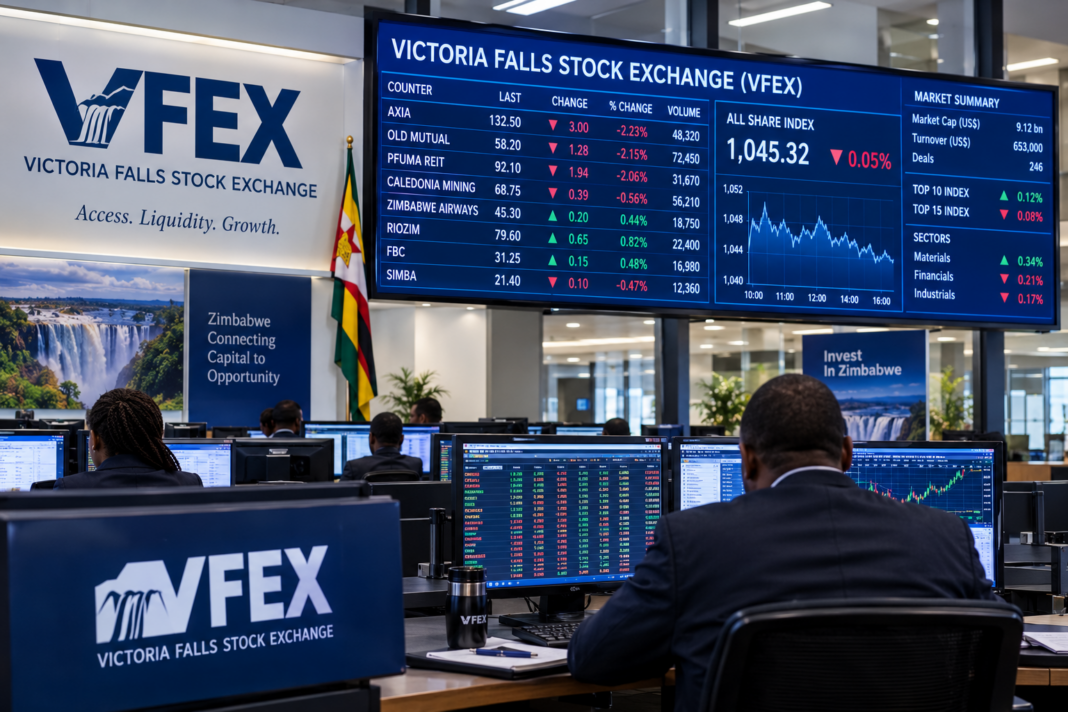
The Victoria Falls Stock Exchange presented a contrasting picture in its latest available trading statistics, dated Tuesday, 20 October.
The VFEX All Share Index declined 0.05 percent to 273.03 points, with market capitalisation standing at approximately US$9.00 billion.
The exchange recorded 246 trades valued at US$652,757.94, highlighting its role as Zimbabwe’s principal platform for trading securities denominated in foreign currency.
Axia Corporation declined 2.23 percent to US$0.1621, while Old Mutual lost 2.15 percent to US$0.8880.
Pfuma Fund retreated 2.06 percent to US$0.1567, First Capital Bank fell 0.88 percent to US$0.1586, and gold producer Caledonia Mining Corporation eased 0.56 percent to US$33.6625.
Although the VFEX recorded more individual trades than the ZSE in the respective sessions, the two exchanges’ turnover figures cannot be compared directly without converting them into a common currency.
Moreover, the ZSE statistics relate to Wednesday, while the VFEX performance figures are from Tuesday, making the comparison indicative rather than a same-day assessment.
Zimbabwe’s monetary transition shapes investment decisions
The contrasting movements on Zimbabwe’s two exchanges come against a broader economic backdrop in which monetary stability, access to credit and investor confidence remain central to corporate valuations.
Zimbabwe’s continued reliance on the US dollar for a substantial proportion of domestic transactions presents a structural challenge for the development of deeper ZiG-denominated financial markets.
While the authorities have sought to strengthen confidence in the local currency through tighter monetary management and reserve accumulation, investors continue to assess the durability of exchange-rate stability and the availability of liquidity.
For domestic equities, a more predictable monetary environment could support longer investment horizons, improve corporate financial planning and encourage institutional investors to increase their exposure to listed securities.
However, monetary stability alone cannot guarantee a sustained stock market recovery.
Corporate earnings growth will also depend on electricity supply, industrial productivity, household purchasing power, access to external financing and the cost of domestic credit.
Zimbabwe’s sovereign risk profile remains another important consideration.
Progress towards resolving external debt arrears and normalising relations with international creditors could eventually reduce the country’s risk premium, potentially allowing domestic financial institutions and businesses to obtain foreign credit on more competitive terms.
Such improvements would be particularly significant for capital-intensive industries, agricultural processors, manufacturers and companies seeking to modernise production facilities.
The benefits, however, would depend on the credibility and implementation of the broader reform programme.
Why market capitalisation does not tell the whole story
Wednesday’s ZSE market capitalisation of ZiG110.74 billion represents the combined quoted value of listed companies rather than the amount of money invested during the trading session.
Daily turnover of ZiG6.82 million was equivalent to approximately 0.0062 percent of the exchange’s total market capitalisation.
Although this ratio is not a comprehensive measure of market liquidity, it illustrates the relatively limited value of shares changing hands compared with the size of the market.
In thinly traded markets, modest buying or selling orders can produce relatively substantial changes in quoted prices without necessarily reflecting a broad reassessment of company fundamentals.
For institutional investors, the distinction between market value and the ability to execute large transactions without significantly affecting prices remains particularly important.
A deeper investor base, greater pension fund participation, more active market-making and improved retail investor access could help strengthen price discovery over time.
The emergence of alternative investment vehicles, including ETFs and real estate investment trusts, also offers opportunities to broaden participation, although their effectiveness depends on sufficient trading activity and transparent valuations.
African investment trends offer lessons for Zimbabwe
The Zimbabwe Mail‘s market analysis suggests that the near-term direction of domestic equities will depend less on isolated daily index gains than on the interaction between monetary liquidity, corporate earnings and investor confidence.
A sustained recovery would require broader participation across the market, rather than advances concentrated in a limited number of large-capitalisation counters.
For Zimbabwe’s policymakers, the longer-term challenge is to transform improving monetary conditions into productive investment, cheaper business financing and higher industrial output.
For listed companies, the immediate priorities remain protecting operating margins, maintaining reliable cash flows and demonstrating that earnings growth can exceed inflation and currency-related risks.
The ZSE’s positive performance on Wednesday therefore offers a measure of resilience, but turnover of just ZiG6.82 million against a market valuation exceeding ZiG110 billion illustrates the distance still to be travelled before Zimbabwe’s capital markets can become a more substantial source of long-term corporate finance.
The market’s next phase will ultimately be judged not simply by rising share prices, but by whether those gains are supported by stronger corporate profitability, deeper liquidity and renewed investment in Zimbabwe’s productive economy.