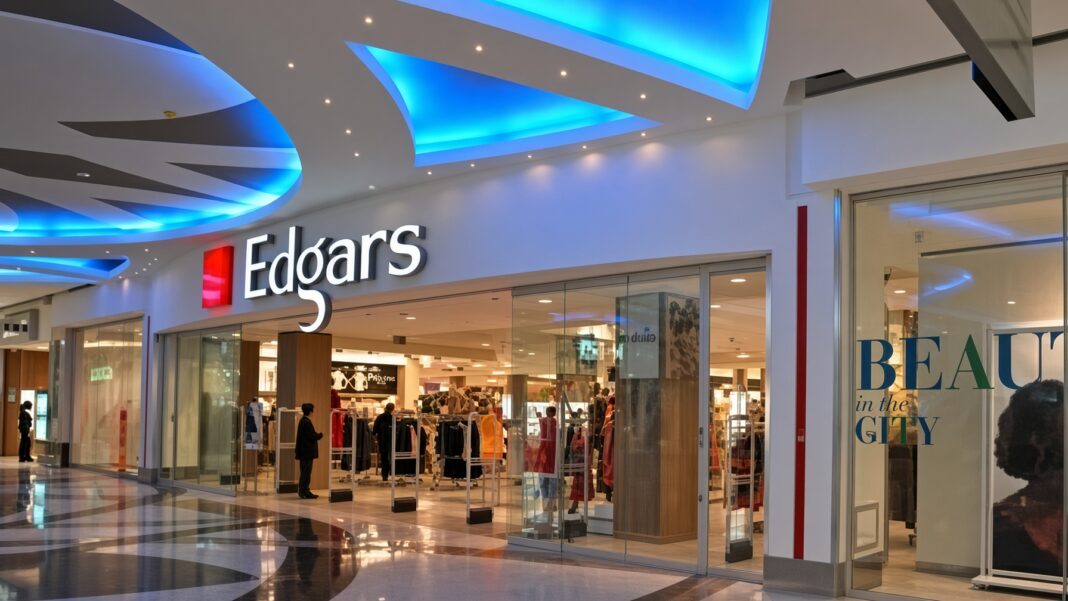
JOHANNESBURG — South African fashion retailer Edgars is preparing a major expansion after years of financial distress, with plans to open 50 stores over two years as its owners pursue a smaller, more profitable retail model that could offer important lessons for Zimbabwe’s clothing industry.
The revival marks a significant reversal for one of southern Africa’s best-known department-store brands, which entered business rescue in 2020 after years of mounting debt, declining competitiveness and financial pressure intensified by the Covid-19 pandemic.
Now controlled by Durban-based Retailability, Edgars is moving away from the sprawling department-store model that once defined its business, introducing smaller outlets designed to reduce rental expenses, improve sales productivity and reach customers in locations where large stores would be uneconomic.
Retailability chief executive Norman Drieselmann said the company’s new-generation stores were performing in line with management expectations.
“The early indications are that we’ve got a model that customers are responding to,” Drieselmann told Business Day TV in an interview published on October 6.
The retailer’s strategy represents a broader transformation taking place across southern Africa’s clothing industry, where traditional department stores face increasing competition from discount chains, online retailers and consumers whose spending is constrained by household costs.
For Zimbabwe, the revival is particularly relevant because the Edgars name has a long history in the country, although the Zimbabwean operation is a separately listed business and is not part of Retailability’s South African turnaround.
From financial collapse to expansion
Founded in Johannesburg in 1929 by brothers Morris and Eli Ross, Edgars developed into one of the region’s most recognisable fashion retail businesses.
Its expansion eventually extended beyond South Africa, including the establishment of its first Zimbabwean store in 1949.
The company’s fortunes deteriorated after its former parent, Edcon, was acquired by American private equity firm Bain Capital in 2007.
The leveraged acquisition left the business exposed to substantial debt obligations at a time when competition from more efficient clothing retailers was intensifying.
Financial pressure worsened during the pandemic, culminating in Edcon entering business rescue in 2020.
Retailability subsequently acquired 130 of Edgars’ 194 stores, taking control of the brand’s South African retail operations and beginning a restructuring programme.
The turnaround involved rationalising store space, reviewing leases, improving merchandising and concentrating the business on fashion, footwear and beauty products.
After years of retrenchment, the company is now preparing to expand.
The planned 50-store rollout represents a departure from the previous strategy of reducing retail space to protect profitability.
Smaller stores, stronger economics
A central feature of Edgars’ recovery has been its decision to reduce the amount of floor space required to operate profitably.
The new stores are being developed at approximately 500 to 600 square metres, significantly smaller than the department stores historically associated with the brand.
Larger existing outlets have also undergone substantial restructuring.
At Walmer Park in Gqeberha, for example, property group Growthpoint announced plans to reduce an Edgars store from approximately 4,680 square metres to 1,982 square metres as part of a shopping-centre redevelopment.
The economic logic is straightforward.
A retailer’s profitability depends not merely on total sales but on the relationship between revenue, gross margins and the costs of generating those sales.
Large stores can become financially burdensome when rental expenses, staffing requirements and inventory commitments exceed the revenue generated by the available space.
Reducing store size can improve sales per square metre while lowering fixed operating costs.
Growthpoint South Africa chief executive Estienne de Klerk said the objective was to provide retailers with appropriately sized premises that improve trading efficiency.
The change reflects a wider shift in commercial property management, where landlords increasingly assess retailers according to sales productivity rather than simply the amount of space occupied.
For Edgars, the challenge has been preserving its established brand identity within a smaller format.
Drieselmann said the redesigned outlets must continue to deliver the shopping experience customers associate with Edgars, despite their reduced dimensions.
The company says its early results indicate that the strategy is working.
Fashion and beauty anchor the recovery
Retailability is concentrating Edgars’ competitive strategy on fashion and beauty, areas where management believes the brand retains customer recognition and opportunities to expand market share.
Beauty products are particularly important because they can generate more frequent customer visits than clothing purchases.
A consumer may purchase apparel only periodically but return more regularly for cosmetics, fragrances and personal-care products.
This can increase store traffic and improve the productivity of retail space.
The strategy also allows Edgars to differentiate itself from discount chains whose competitive advantage depends primarily on price, scale and extensive distribution networks.
However, Edgars faces formidable competition.
South African retail group Pepkor, whose brands include Pep and Ackermans, reported 6,657 stores at the end of March 2026.
The group generated revenue equivalent to approximately US$3.3 billion during the six months ended March 31, using an indicative exchange rate of R16.5 to the US dollar.
Pepkor’s scale gives it substantial advantages in procurement, distribution, customer access and operating efficiency.
The group has also expanded beyond conventional clothing retail into financial services and mobile-device distribution.
Its FoneYam cellular rental business recorded strong customer growth, while its retail network provides an extensive platform for distributing mobile phones and related services.
Drieselmann acknowledged the difficulty of competing directly with Pepkor in cellular retailing, where distribution scale is particularly important.
For Edgars, management appears to be prioritising categories in which the brand can compete through product selection, customer experience and its established position in fashion.
Zimbabwe’s Edgars faces a parallel retail transformation
The developments in South Africa carry particular significance for Zimbabwe, where Edgars Stores Limited operates its own clothing retail business and is listed on the Victoria Falls Stock Exchange.
The Zimbabwean company migrated from the Zimbabwe Stock Exchange to the US-dollar-denominated VFEX in April 2024.
Its retail operations include Edgars, Jet and Express, alongside manufacturing activities associated with the Carousel business.
Unlike the South African Edgars business acquired by Retailability, the Zimbabwean operation has its own shareholders, management and financial reporting obligations.
Nevertheless, both businesses face similar commercial pressures.
These include changing consumer spending patterns, competition from imported clothing, the growth of informal retailing and the need to control occupancy and operating costs.
Zimbabwe’s economic structure introduces additional complications.
A substantial proportion of retail transactions takes place in US dollars, while businesses must manage costs, working capital and customer credit within a multicurrency financial environment.
For formal clothing retailers, this creates a delicate balance between maintaining affordable prices and covering expenses such as rent, electricity, staffing and imported merchandise.
Zimbabwean retailer expands its footprint
Edgars Stores Limited’s latest published annual report indicates that its Zimbabwean retail network expanded from 68 stores at the beginning of 2025 to 77 stores at the end of the financial year ending January 2026.
The group also reported that annual rental payments increased from approximately US$3.9 million to US$4.4 million.
The increase illustrates the financial implications of expanding a physical retail network.
Additional stores can improve geographic coverage and sales opportunities, but they also create recurring commitments that must be supported by sufficient customer demand.
The Zimbabwean group’s reporting identifies staffing and rentals as important determinants of store profitability, with management reviewing the performance of individual outlets.
This approach is consistent with the commercial logic underpinning Retailability’s South African restructuring.
The common lesson is that retail expansion becomes more sustainable when each outlet is evaluated according to its ability to generate an adequate return on the capital and operating expenditure committed to it.
Local manufacturing offers a different opportunity
Zimbabwe’s Edgars also has an important distinction from many conventional clothing retailers: its exposure to domestic garment manufacturing.
Through Carousel, the company has sought to increase locally manufactured merchandise and reduce reliance on imported products.
Its published annual report indicates that factory production increased from approximately 305,518 units to 448,646 units between the 2024 and 2025 financial periods.
This represents growth of approximately 46.8%.
The development is significant because greater domestic sourcing can potentially strengthen linkages between retail demand and Zimbabwe’s manufacturing sector.
Local production can support employment, reduce certain import-related costs and shorten supply chains where production is commercially competitive.
However, the benefits depend on reliable electricity, access to raw materials, efficient manufacturing operations and the ability to compete with imported clothing on both quality and price.
Zimbabwe’s garment manufacturers also face competition from regional suppliers, Asian imports and informal traders.
For retailers, the commercial challenge is therefore to balance local sourcing ambitions with consumer expectations around affordability, fashion and product availability.
Informal competition reshapes the market
One of the most significant differences between the Zimbabwean and South African clothing markets is the scale and structure of informal competition.
Zimbabwean formal retailers operate alongside a substantial informal clothing trade, including second-hand garments, imported merchandise and small independent traders.
These competitors can often operate with lower overheads than established shopping-centre retailers.
Formal businesses, by contrast, must absorb commercial rentals, staffing expenses, regulatory compliance costs and other operating commitments.
The resulting price competition places pressure on margins, particularly among lower-income consumers.
For Edgars and other established retailers, competing exclusively on price may therefore be difficult.
Product quality, customer service, merchandise availability, convenient locations and credible credit arrangements become important sources of differentiation.
South Africa’s smaller-format Edgars strategy demonstrates one possible response: reduce the cost of operating each outlet while preserving the features that attract customers.
The extent to which that approach could be replicated in Zimbabwe would depend on local demand, rental economics and the profitability of individual locations.
E-commerce remains an unfinished opportunity
Digital retailing presents another area where the two markets share challenges.
Retailability acknowledges that Edgars entered e-commerce relatively late, leaving room for growth as the company strengthens its online presence.
Zimbabwe’s Edgars has also reported limited uptake of its online shopping platforms, indicating that digital sales remain an area requiring further development.
For established retailers, e-commerce offers potential advantages in geographic reach, inventory management and customer convenience.
However, online retailing also requires investment in technology, secure payments, warehousing, delivery systems and customer service.
In Zimbabwe, the economics of e-commerce are further influenced by logistics costs, digital payment arrangements and the purchasing habits of consumers.
A successful online strategy therefore requires more than launching a website.
Retailers must develop reliable fulfilment systems and ensure that the cost of delivering merchandise does not undermine profitability.
The most sustainable approach may involve integrating online sales with physical stores, allowing businesses to use existing branches for customer collection, returns and inventory distribution.
The economic lesson behind Edgars’ comeback
Edgars’ South African revival illustrates a broader change in retail economics.
For decades, large department stores were associated with market dominance, extensive product ranges and prominent shopping-centre locations.
Increasingly, however, profitability depends on operating efficiency, inventory discipline, customer relevance and the ability to adapt quickly to changing spending patterns.
The shift towards smaller stores reflects an attempt to improve returns on invested capital rather than simply maximise the size of the retail network.
For Zimbabwean businesses, the implications extend beyond clothing retail.
Manufacturers, supermarkets, furniture retailers and other consumer-facing companies face similar decisions about physical expansion, rental commitments and the allocation of scarce capital.
A larger footprint can increase revenue, but expansion that fails to generate adequate cash flow can weaken a company’s financial position.
The Edgars experience also demonstrates that an established brand can retain commercial value even after severe financial distress, provided that its operating model is fundamentally reconsidered.
Retailability’s planned 50-store expansion suggests that management believes it has established a more sustainable platform for growth.
Whether that confidence translates into durable profitability will depend on customer demand, competition and the performance of the new outlets over time.
For Zimbabwe’s Edgars, the South African recovery offers a useful comparison rather than a direct blueprint.
Both companies must operate within their own market conditions, but the underlying commercial principle is the same: a retailer’s future depends less on how much space it occupies than on how productively it uses that space.