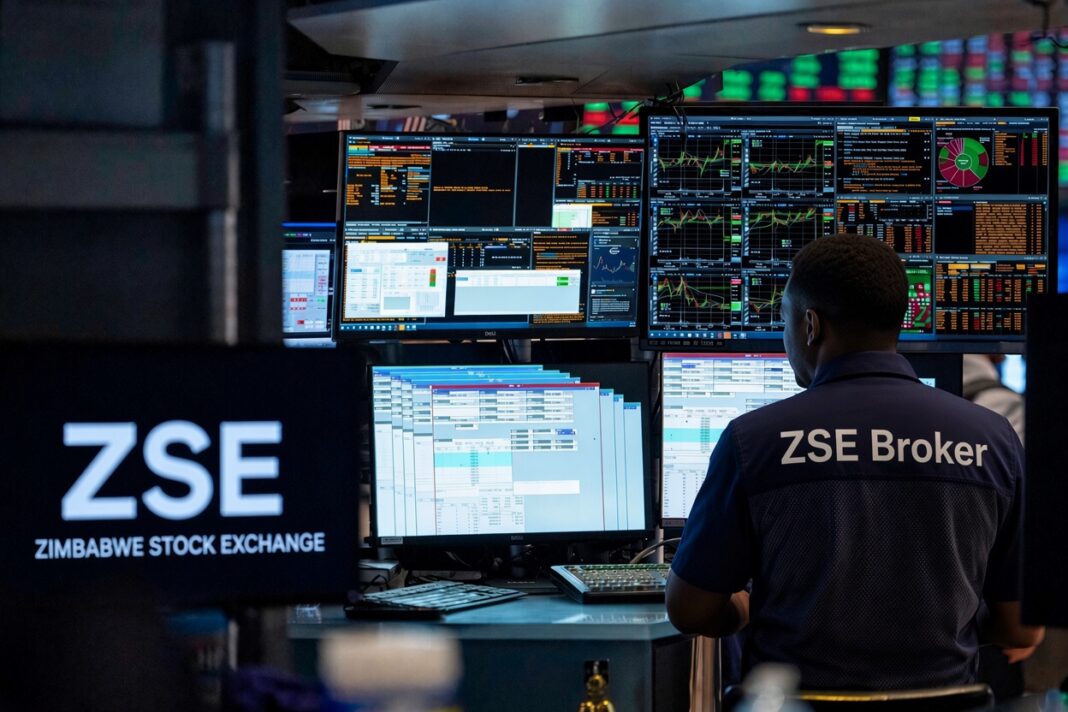
HARARE — Zimbabwean equities staged a broad-based recovery on Friday, with the Zimbabwe Stock Exchange (ZSE) All Share Index rising 1.76% as renewed buying across industrial and consumer counters pushed total market capitalisation above ZWG104 billion.
The All Share Index closed at 465.90 points, while the ZSE Top 10 advanced 1.89% to 457.29 points and the Top 15 gained 1.52% to 469.24 points. The Mid Cap Index was also firmer, rising 1.23% to 534.33 points, although the Small Cap Index remained unchanged at 100.11 points.
The gains came despite relatively modest trading activity, with 49 transactions generating ZWG69.46 million in turnover. Market capitalisation increased to ZWG104.11 billion, highlighting the continued sensitivity of Zimbabwean equities to relatively small shifts in demand given the market’s limited liquidity.
Analysts who spoke to The Zimbabwe Financial Mail said the session demonstrated that investor appetite remains present, but is highly selective and concentrated in counters where investors see either earnings potential, asset value or stronger liquidity prospects.
“The important feature of the session is not simply the rise in the headline index, but the breadth of the recovery across several industrial and consumer counters. It suggests that investors are still willing to deploy capital when valuations and corporate fundamentals provide sufficient justification,” one analyst said.
Consumer and industrial stocks lead recovery
Ariston Holdings was the strongest gainer among the major quoted counters, climbing 14.81% to 6.50 cents. Truworths gained 14.29% to 72 cents, while Rainbow Tourism Group rose 13.64% to 142.05 cents.
National Foods advanced 11.96% to 103 cents, while General Beltings increased 7.02% to 9.90 cents.
The sharp movements in some counters underline the relatively thin nature of Zimbabwe’s equity market, where limited free-float liquidity can amplify price changes when buyers or sellers enter particular stocks.
An analyst told The Zimbabwe Financial Mail that investors should therefore distinguish between a broad improvement in market sentiment and movements caused by individual transactions.
“In a relatively shallow market, percentage gains can sometimes exaggerate the underlying change in investor conviction. The more meaningful signal is whether higher prices are accompanied by sustained turnover and continued participation over several sessions,” the analyst said.
ZIMRE falls despite broader market strength
The principal drag on the market was ZIMRE Holdings, which fell 11.52% to 75.21 cents. Mashonaland Holdings declined 1.66% to 260.85 cents, Proplastics lost 1.31% to 143.10 cents, Seed Co slipped 0.43% to 420 cents and British American Tobacco Zimbabwe eased 0.18% to 14,623.53 cents.
The divergence between individual counters reinforces the increasingly stock-specific nature of the ZSE, with investors weighing corporate earnings, dividend prospects, balance-sheet strength and exposure to Zimbabwe’s changing monetary environment rather than simply buying the market as a whole.
Consumer and financial sectors strengthen
Sector performance was predominantly positive. The New Industrial Index gained 4.20%, while the Modified Consumer Staples Index rose 2.38%. Consumer Staples increased 2.09%, and the Old Industrial Index advanced 1.77%.
The Financials Index added 0.50%, while the Real Estate Index rose 0.66%. The Agriculture Index edged up 0.03%.
Consumer Discretionary recorded a 13.64% increase, although that movement was largely influenced by the strong performance of Rainbow Tourism Group.
The Materials Index was the notable industrial exception, declining 0.37%, while the Mining Index remained unchanged at 155.31 points.
REITs retain investor interest
The real estate investment trust segment also remained relatively resilient. Tigere REIT gained 2.12% to 113.27 cents, lifting its market capitalisation to about ZWG2.1 billion. Revitus remained unchanged at 200 cents, with a market capitalisation of approximately ZWG736.7 million.
Analysts said the continued interest in listed property vehicles reflects the search for assets capable of generating recurring income in an economy where investors remain sensitive to inflation, currency risk and the preservation of purchasing power.
“The real estate market is increasingly important to the investment story because investors are looking beyond nominal share-price movements towards underlying assets, rental income and the ability of businesses to preserve real value,” another analyst told The Zimbabwe Financial Mail.
ZSE remains constrained by liquidity
Despite Friday’s recovery, the relatively low number of trades illustrates the structural liquidity constraints facing the local capital market.
The ZSE has made progress in expanding investment products, including exchange-traded funds and real estate investment trusts, but participation remains concentrated. The four listed ETFs recorded no price movement during the session, while the ZSE ETF Index declined marginally by 0.07%.
For Zimbabwe’s capital market to play a larger role in economic development, analysts said the market needs deeper institutional participation, stronger domestic savings mobilisation and a more predictable monetary and investment environment.
The issue is particularly important as Zimbabwe seeks to increase domestic capital formation. A deeper equity market can provide companies with an alternative source of long-term financing, reducing excessive dependence on bank credit and short-term working-capital facilities.
Monetary stability remains central to valuations
The performance of the ZSE also remains closely linked to Zimbabwe’s currency transition and broader efforts to restore confidence in domestic financial assets.
Companies operating in the formal economy increasingly have to manage revenues, costs, working capital and investment decisions across a complex monetary environment. This makes the credibility of monetary policy particularly important for equity valuation because investors ultimately price future cash flows in relation to inflation, exchange-rate expectations and the cost of capital.
One analyst said the market’s long-term performance would depend less on isolated trading sessions and more on whether Zimbabwe succeeds in establishing a credible financial system capable of mobilising domestic savings into productive investment.
“The equity market cannot be separated from the wider economy. Sustainable market growth requires companies to generate real earnings, households and institutions to accumulate financial savings, and capital to move efficiently towards productive investment,” the analyst said.
Earnings season becomes increasingly important
The latest market performance comes as listed companies continue to release financial information to investors. ZIMRE Holdings published its unaudited half-year results on Friday, while First Mutual Holdings released its interim results earlier in the week. Other recent disclosures include annual reports from Rainbow Tourism Group and Delta Corporation.
These corporate disclosures will increasingly determine whether the recent improvement in share prices can be sustained.
For investors, the key question is whether earnings growth can keep pace with changes in operating costs, taxation, financing expenses and the evolving currency environment. For companies, the challenge is to convert relatively stable operating revenues into stronger real returns for shareholders.
Friday’s 1.76% rise therefore represents a positive session, but not yet a definitive change in the market’s underlying trend. Sustained turnover, improving institutional participation and stronger corporate earnings will be required before the recovery can be regarded as a deeper repricing of Zimbabwean equities.
For now, the ZSE remains a market where liquidity is limited but opportunities are increasingly differentiated — rewarding investors willing to look beyond headline index movements and examine the underlying businesses, assets and cash flows supporting individual stocks.