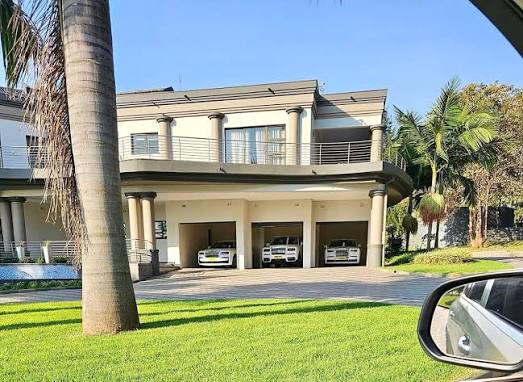
HARARE — The ownership of the multimillion-dollar Gletwyn mansion associated with the late businessman Wicknell Chivayo could face a legal dispute after sources claimed he had paid only US$1.4 million of an agreed US$2.5 million purchase price to former police commissioner Augustine Chihuri.
Chivayo, his wife Lucy Muteke, her personal assistant and two pilots died in a helicopter crash near Marondera on September 30.
According to a source familiar with the property transaction, the mansion was valued at about US$2.5 million when the deal was concluded, leaving an alleged US$1.1 million balance outstanding at the time of Chivayo’s death.
“Chivayo had not fully paid for the property at the time of his tragic death,” the source told The Zimbabwe Financial Mail. “The house was valued at US$2.5 million, but Chivayo only paid US$1.4 million.”
The source claimed the outstanding amount was intended to be settled through services rather than a conventional cash payment, creating uncertainty over how the balance would be established and enforced following Chivayo’s death.
The Zimbabwe Financial Mail could not independently verify the alleged payment arrangement or the current legal status of the property’s title.
Dispute centres on valuation and payment terms
Sources familiar with the transaction said two issues complicated the arrangement: the outstanding purchase consideration and a substantial difference between the reported sale value and a later valuation attributed to the property.
One source claimed the property was later valued at about US$7 million, compared with the reported transaction value of US$2.5 million.
“There was a serious problem of valuation of the property,” the source said. “While Chihuri sold the house for US$2.5 million, Zimbabwe valued it at US$7 million. That’s a huge discrepancy.”
The source also alleged that part of the outstanding consideration was linked to unspecified “political services”.
“How do you put a monetary value to political services when one of the parties to the deal is no longer alive?” the source said.
Those allegations could not independently be verified.
Legal ownership could become central
The dispute could ultimately turn on the property’s title, the agreement of sale and whether the conditions required for transfer of ownership were completed.
In Zimbabwe, the contractual purchase of a property and registration of legal title are distinct stages. A purchaser’s occupation of a property does not, by itself, establish registered ownership.
A property transaction can involve conveyancing, title searches, rates clearance, tax obligations and registration at the Deeds Registry, depending on the circumstances and terms of the transaction.
An analyst who spoke to The Zimbabwe Financial Mail said the key question would be documentary rather than political.
“The estate will ultimately have to establish what was agreed, what was paid, whether the conditions of sale were fulfilled and what is recorded in the property’s title and conveyancing documents,” the analyst said.
Another property-sector source said any dispute over an unpaid balance could become more complicated if consideration was allegedly linked to non-cash services.
“A cash balance is relatively straightforward to establish if there are bank records and a signed agreement. Valuing services is considerably more complicated, particularly where the alleged services are not clearly documented,” the source said.
Chihuri property has a controversial history
The Gletwyn property has previously been linked to the long-running controversy surrounding Chihuri’s wealth and assets.
Chihuri, who served as Zimbabwe’s police commissioner for many years, left the country following the 2017 political transition that removed Robert Mugabe from power.
The Zimbabwean government subsequently pursued legal proceedings concerning assets it alleged were linked to corruption and illicit enrichment. Chihuri has previously disputed allegations against him.
The mansion subsequently became associated with Chivayo, who publicly presented it as one of his luxury properties.
Estate now faces questions over outstanding obligations
Chivayo’s death introduces another layer of complexity because any outstanding contractual obligations would ordinarily have to be considered alongside the administration of his estate.
For the business community, the episode highlights a broader issue surrounding high-value private transactions in Zimbabwe: the importance of documented consideration, independent valuations, clear contractual terms and completed title transfers.
“The commercial lesson is that high-value property transactions need an auditable paper trail. Once one party dies, informal arrangements become significantly harder to establish and enforce,” a legal-sector source told The Zimbabwe Financial Mail.
The alleged US$1.1 million balance, the reported difference in property valuations and the status of the title are therefore likely to become important questions for the Chivayo estate and Chihuri.
Until the underlying sale agreement, payment records and Deeds Registry documents are independently established, however, claims about the property’s ownership and any outstanding consideration remain allegations rather than established facts.