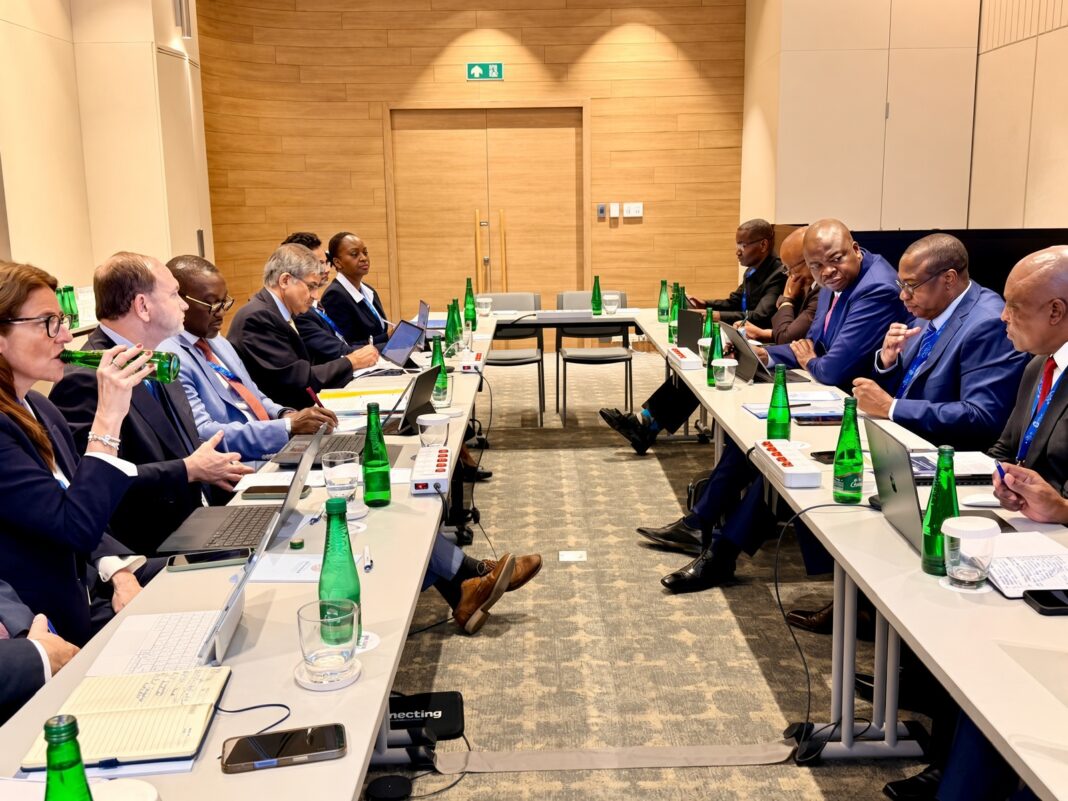
HARARE — Zimbabwe has intensified efforts to secure international financial backing for the clearance of its external debt arrears, using the International Monetary Fund and World Bank annual meetings in Bangkok to argue that improving macroeconomic stability has created an opportunity to restore the country’s access to concessional development finance.
Finance Minister Mthuli Ncube is leading the Zimbabwean delegation at the October 12–18 meetings, where discussions with senior multilateral officials have focused on debt resolution, policy reforms, possible bridge financing and the financial commitments required to normalise relations with international creditors.
According to a statement issued by the Ministry of Finance, the delegation held discussions with World Bank Regional Vice President for Eastern and Southern Africa Ndiame Diop, IMF Executive Director for Africa Group 1 Adriano Ubisse and IMF African Department Director Zeine Zeidane.
The meetings come as Zimbabwe seeks to translate its recent economic stabilisation into a credible, internationally supported debt-restructuring programme.
For Harare, the challenge is no longer simply to demonstrate progress in controlling inflation and stabilising the exchange rate. It is to persuade creditors and development partners that those improvements can be sustained long enough to justify financing an arrears-clearance arrangement.
The government is seeking international partners willing to champion the process, while exploring financing mechanisms that could help settle outstanding obligations and reopen access to development lending.
From economic stabilisation to sovereign creditworthiness
The Finance Ministry said discussions in Bangkok recognised Zimbabwe’s progress in restoring macroeconomic stability through fiscal and monetary policy measures.
Treasury pointed to single-digit inflation, greater exchange-rate stability and improved revenue collection as evidence of a strengthening policy environment.
The government also highlighted economic growth of approximately 8% in 2025, with expansion projected at around 5% in 2026.
Agricultural growth of 27% was cited as an important contributor to the recovery, reflecting the sector’s significance to domestic production, food security and rural incomes.
These figures represent the government’s assessment of economic performance and its projections, rather than independently verified outcomes from the meetings.
For investors, the distinction between macroeconomic stabilisation and restored sovereign creditworthiness remains important.
Lower inflation and greater exchange-rate predictability can improve business planning, but they do not automatically resolve the accumulated debt obligations that restrict Zimbabwe’s access to affordable external capital.
Creditors must also assess the sustainability of fiscal policy, the government’s capacity to meet future obligations and the credibility of arrangements for clearing existing arrears.
Zimbabwe’s challenge is therefore to convert an improving economic record into a financing agreement that international institutions and bilateral creditors are prepared to support.
IMF programme becomes central to debt negotiations
A central element of Zimbabwe’s case is its ongoing IMF Staff-Monitored Programme, which Treasury regards as an important mechanism for demonstrating policy discipline.
The ministry said a September staff-level agreement on the programme’s second review represented further progress towards establishing the reform record needed for debt resolution.
The final programme review is expected in December.
Staff-monitored programmes provide a framework through which IMF staff assess the implementation of agreed economic policies, but they do not themselves provide financing or guarantee subsequent access to IMF resources.
Their value lies partly in allowing countries to demonstrate a sustained commitment to fiscal management, monetary stability and structural reforms.
For Zimbabwe, successful implementation could strengthen the case for coordinated support from creditors and development partners.
However, even a favourable final review would not automatically clear arrears or establish a new lending programme.
The next stage would require agreement on financing arrangements, creditor participation and the conditions governing any subsequent restoration of access to multilateral resources.
Harare explores bridge financing and World Bank support
The Finance Ministry said Zimbabwe was exploring bridge financing arrangements as part of its arrears-clearance strategy.
Such financing can provide temporary resources to settle overdue obligations, potentially allowing a country to re-establish financial relations with institutions from which it has been unable to obtain normal lending.
The arrangement would need to be structured carefully because bridge financing generally creates an obligation that must eventually be repaid or refinanced.
The ministry also referred to discussions about possible support through the World Bank’s International Development Association, subject to the applicable requirements and approvals.
IDA provides concessional financing to eligible lower-income countries, supporting investments in areas such as infrastructure, education, healthcare and economic development.
For Zimbabwe, restored access to such resources could improve the government’s ability to finance long-term development projects without relying exclusively on domestic taxation, expensive commercial borrowing or constrained budget allocations.
Nevertheless, Treasury’s statement does not indicate that any bridge financing package has been secured or that IDA funding has been approved.
The discussions remain part of a broader effort to develop a credible and financed arrears-clearance pathway.
Why debt resolution matters for Zimbabwean businesses
Zimbabwe’s unresolved external debt obligations have implications extending beyond the government’s own finances.
A sovereign borrower with restricted access to international financial institutions can face greater difficulty mobilising long-term development funding.
The resulting financing constraints can affect infrastructure investment, particularly in electricity generation, water systems, transport networks and other projects that require substantial capital expenditure.
For businesses, inadequate infrastructure raises operating costs and reduces competitiveness.
Manufacturers depend on reliable electricity and transport links, while agricultural producers require irrigation, storage facilities and efficient access to markets.
Mining companies also depend on energy infrastructure, logistics and access to specialised equipment.
Greater access to concessional development finance could help address some of these constraints, provided that funds are allocated efficiently and projects are implemented transparently.
Debt resolution could also contribute to improved investor confidence by reducing uncertainty surrounding the government’s external financial obligations.
However, lower sovereign risk would not automatically translate into cheaper credit for every Zimbabwean business.
Domestic financial-sector liquidity, lending risks, collateral availability and the structure of the economy would continue to influence the cost and availability of private-sector financing.
The missing link between monetary stability and productive investment
Zimbabwe’s economic recovery has been accompanied by continuing debate over the relationship between monetary stability, financial intermediation and industrial growth.
Greater stability in the Zimbabwe Gold currency can support the predictability of domestic transactions and financial planning.
Yet the country’s extensive use of the United States dollar creates a complex environment for domestic monetary policy and credit creation.
Businesses require financing in currencies and maturities appropriate to their revenue streams, while banks must manage liquidity, credit risk and the availability of longer-term funding.
A successful sovereign debt-resolution programme could help improve the wider financing environment by restoring channels of development support and potentially strengthening international perceptions of Zimbabwean risk.
The benefits would be greatest if improved sovereign financing conditions were accompanied by reforms that encouraged domestic savings to flow towards productive lending and investment.
That would require stronger financial intermediation, credible institutions and an expansion of commercially viable investment opportunities.
For Zimbabwe, the ultimate measure of economic normalisation will therefore extend beyond inflation and exchange-rate indicators to include whether businesses can access affordable capital to expand production and employment.
Social protection becomes part of the reform agenda
Treasury also used the Bangkok meetings to emphasise measures intended to protect vulnerable households during the economic reform process.
The ministry said the government was completing a national social registry to improve the targeting of assistance, including support delivered through the Basic Education Assistance Programme.
It also acknowledged the need to address outstanding social spending commitments under the IMF-monitored programme.
The inclusion of social protection in the discussions is significant because fiscal consolidation and monetary stabilisation can place pressure on households when public resources are constrained.
Well-targeted assistance can help protect access to education and essential services while reducing the risk that adjustment measures disproportionately affect poorer communities.
However, the effectiveness of such programmes will depend on reliable beneficiary information, adequate funding and timely delivery.
For international development partners, social spending commitments may also provide an indication of whether Zimbabwe’s reform programme can maintain public support while improving fiscal discipline.
Climate resilience and agriculture financing
Zimbabwe also highlighted climate resilience as a priority in its engagement with the international financial institutions.
According to the Finance Ministry, the government is seeking to strengthen strategic grain reserves, expand cash transfers and increase investment in cloud seeding to improve preparedness for climate-related shocks.
Agriculture remains a major source of livelihoods and a significant contributor to economic activity, making the sector particularly sensitive to rainfall variability and extreme weather.
The government’s reported agricultural recovery provides an opportunity to rebuild production capacity, but sustained growth will depend partly on improved irrigation, storage infrastructure, agricultural financing and risk management.
Climate-related investment could therefore complement debt-resolution efforts by helping protect economic output and reducing the fiscal costs associated with future droughts and food shortages.
However, the effectiveness of individual interventions, including cloud seeding, requires careful assessment against their costs and measurable outcomes.
Global financing conditions complicate the negotiations
Zimbabwe’s appeal for international support comes at a time when developing economies face heightened competition for concessional finance.
The IMF and World Bank meetings are taking place against a backdrop of elevated global borrowing costs, energy-market pressures and growing concern about sovereign debt vulnerabilities.
For countries already experiencing financing constraints, these conditions can make it more difficult to secure affordable funding and coordinate creditor support.
The challenge is particularly acute where governments need substantial investment in infrastructure and public services but have limited access to international capital markets.
Zimbabwe’s negotiations must therefore contend with both its domestic reform record and the broader willingness of international partners to provide financing.
The annual meetings offer an opportunity for high-level engagement, but the development of an actual arrears-clearance agreement will require negotiations extending beyond the conference itself.
December review emerges as a critical milestone
The expected December review of Zimbabwe’s IMF Staff-Monitored Programme is likely to become an important reference point in the country’s debt-resolution strategy.
A positive assessment could strengthen confidence in the durability of reforms and support discussions with potential financing partners.
However, the government will still need to demonstrate that its fiscal and monetary policies are consistent with long-term debt sustainability.
Progress on domestic arrears will also matter, particularly where unpaid government obligations affect suppliers, contractors and other businesses.
Clearing or restructuring such obligations transparently could improve confidence in public-sector payment discipline and reduce financial pressures on private enterprises.
The Finance Ministry has reaffirmed its commitment to sustained reforms, transparent engagement and inclusive economic growth.
For Zimbabwe, the Bangkok meetings represent an opportunity to demonstrate that its stabilisation programme has reached a stage where international financial normalisation is increasingly achievable.
But the distinction between a credible reform record and an executable debt agreement remains substantial.
The country’s economic recovery may strengthen its negotiating position, yet meaningful progress will ultimately depend on securing financing commitments, coordinating creditors and maintaining the policy discipline necessary to support renewed borrowing.
The larger economic prize is not simply the settlement of overdue debts. It is the possibility of rebuilding Zimbabwe’s access to long-term capital, reducing financing constraints and creating conditions in which economic stability translates into industrial investment, employment and rising household incomes.