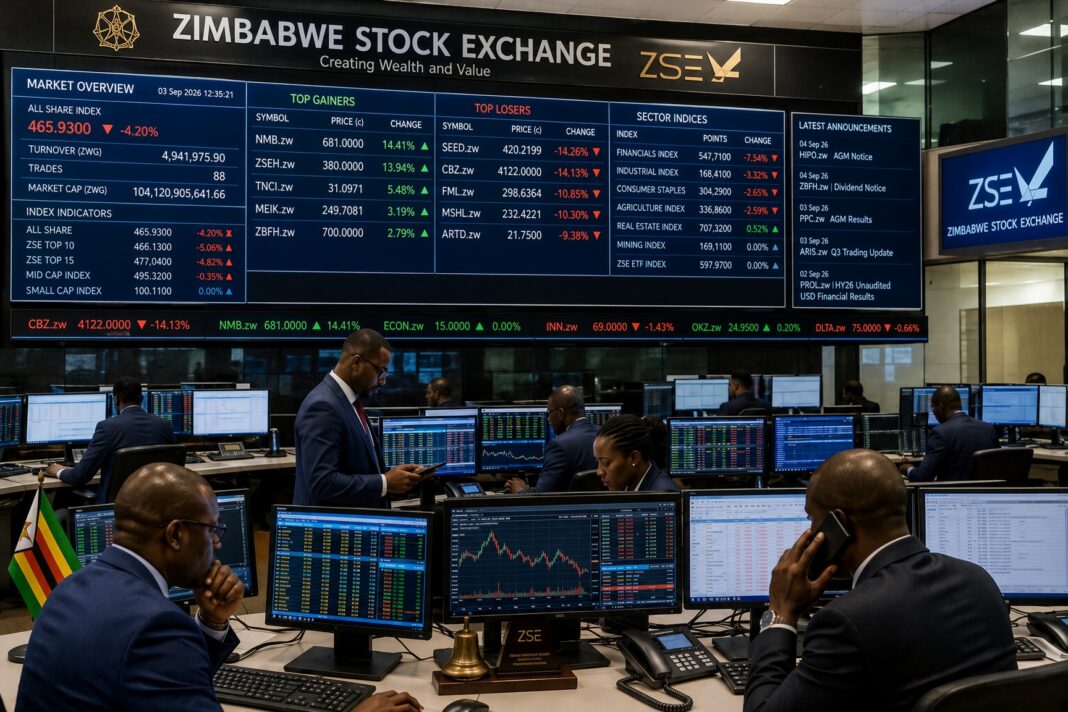
HARARE – Zimbabwean equities ended Friday on a stronger footing as gains in tobacco, agriculture and banking stocks lifted the Zimbabwe Stock Exchange (ZSE), while trading on the US dollar-denominated Victoria Falls Stock Exchange (VFEX) surged to nearly US$4.9 million, highlighting a widening divergence in liquidity between the country’s two bourses.
The ZSE All Share Index advanced 1.16 percent to 492.86 points on October 30, reversing Thursday’s decline, while market capitalisation increased by approximately ZWG1.27 billion to ZWG113.69 billion.
However, the recovery came against a backdrop of weakening trading activity. Turnover on the domestic exchange fell nearly 48 percent to ZWG13.47 million from ZWG26.12 million the previous day, with just 63 transactions recorded.
The contrasting performance suggests that rising share prices are not necessarily translating into deeper market liquidity, a structural weakness increasingly attracting scrutiny from investment professionals.
British American Tobacco Zimbabwe led the gainers, climbing 14.12 percent to ZWG228.24 per share, followed by Hippo Valley Estates, which surged 13.17 percent to ZWG12.50.
FBC Holdings advanced 5.93 percent, while Turnall Industries gained 1.45 percent. CBZ Holdings edged 0.17 percent higher, providing modest relief after consecutive sessions of losses.
The agriculture index delivered the strongest sectoral performance, rising 5.79 percent, while financial stocks gained 1.40 percent and consumer staples advanced 1.13 percent.
The ZSE Top 10 Index increased 1.49 percent to 486.80 points, indicating that larger companies were principally responsible for the market’s recovery.
Losses were concentrated in selected smaller counters, with Starafricacorporation declining 7.68 percent, Seed Co Limited retreating 2.49 percent and Ariston Holdings easing 0.59 percent.
The VFEX recorded a considerably stronger session, with its All Share Index climbing 1.47 percent to 278.34 points as daily turnover jumped to US$4.89 million from US$1.50 million on Thursday.
The increase represented a more than threefold expansion in trading value, accompanied by 274 transactions compared with 225 in the previous session.
VFEX market capitalisation rose approximately US$125.73 million to US$9.22 billion, reinforcing the exchange’s growing significance within Zimbabwe’s capital markets.
Nevertheless, the gains were uneven. WestProp Holdings fell 14.62 percent to US$0.2383, extending its previous session’s sharp decline, while Zimplow Holdings lost 9.09 percent.
First Capital Bank retreated 5.32 percent, First Mutual Properties declined 4.14 percent and Kavango Resources slipped 1.74 percent.
The stronger VFEX trading figures come amid renewed debate over the long-term viability of Zimbabwe’s domestic capital market.
International investor Ritesh Anand, writing for NewZwire on Friday, warned that the ZSE’s declining liquidity, corporate delistings and diminishing foreign participation were undermining its traditional role in mobilising investment capital.
Anand argued that Zimbabwe’s predominantly US dollar-based economy remains poorly aligned with a domestic exchange where equities are priced and settled in ZiG.
He proposed allowing investors to settle ZSE transactions in either currency, alongside reductions in trading costs, stronger shareholder protections and more predictable repatriation of foreign investment proceeds.
His analysis also highlighted the migration of major companies to the VFEX, which has offered an alternative for businesses seeking US dollar-denominated share trading.
Friday’s market performance illustrated the distinction between price appreciation and genuine capital-market development.
While both exchanges registered gains, turnover on the ZSE contracted sharply even as activity on the VFEX accelerated.
The divergence does not, by itself, establish a permanent shift in investor preferences, since daily turnover can be heavily influenced by individual block transactions and institutional portfolio adjustments.
Nevertheless, it reinforces the broader question raised by Anand: whether Zimbabwe can rebuild a sufficiently liquid domestic equity market capable of attracting long-term savings, financing corporate expansion and supporting new public listings.
For investors, the immediate focus will be whether the recovery in share prices is sustained by stronger trading volumes and corporate earnings rather than isolated gains in a handful of heavyweight counters.
For policymakers, the challenge is more fundamental: ensuring that Zimbabwe’s capital markets become effective channels for productive investment rather than increasingly fragmented platforms for trading existing shares.