
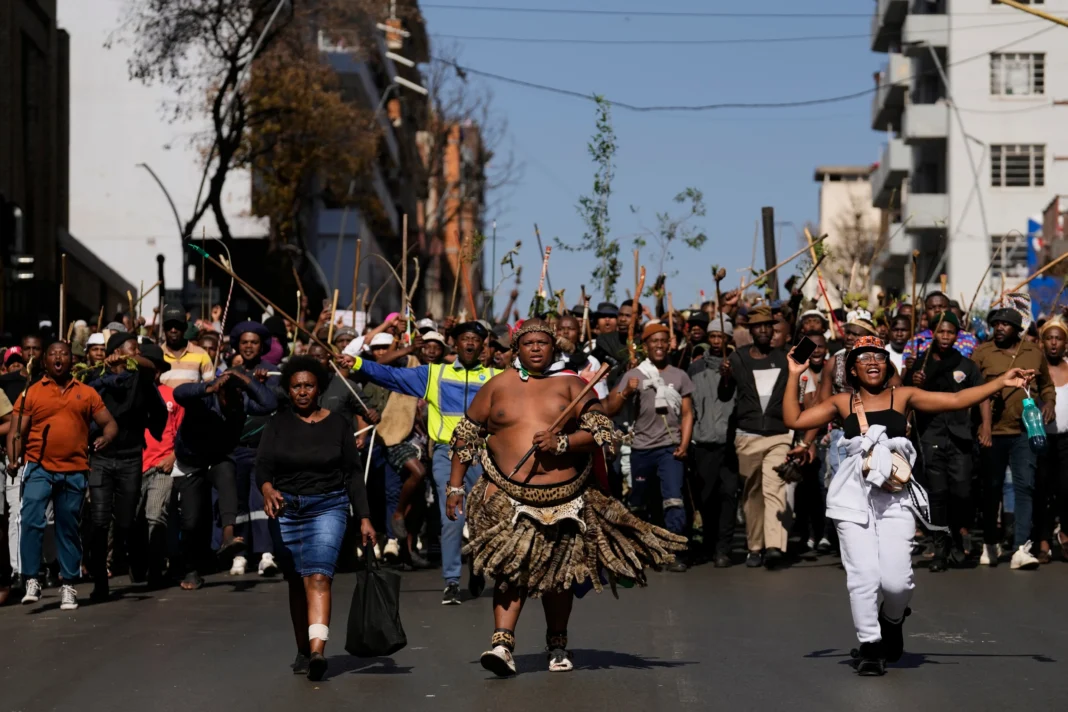
JOHANNESBURG — Thousands of demonstrators gathered in parts of South Africa to rally against illegal immigration on Tuesday, which some protest groups set as a deadline for the departure of all illegal migrants from the country.
South African groups planning to demonstrate blame illegal immigrants for causing unemployment among South Africans by accepting low wages, as well as high levels of crime and other problems.
The Tuesday deadline set by the groups for migrants to leave was not recognized by South Africa’s government, which has maintained that only authorities can enforce immigration laws.
The most prominent groups opposing illegal immigration include March and March, Operation Dudula and Progressive Forces. President Cyril Ramaphosa met Monday night with leaders of some of the groups and asked them to conduct peaceful demonstrations.
The South African police deployed hundreds of officers in cities including Johannesburg in Gauteng province and Durban in KwaZulu-Natal province to prepare for potential violence.
Previous marches against illegal immigration have resulted in attacks on migrants and vandalism of foreign-owned businesses. In Johannesburg, some shops owned by foreign nationals were closed before the arrival of protesters on Tuesday.
Demonstrators express frustration
Protesters marching through Johannesburg’s city center Tuesday included young men carrying traditional fighting sticks and women of all ages. Some wore the South African flag and sang liberation songs.
They carried posters with slogans including “SA withdraw from the UN refugee convention,” “The future of our kids” and “80% of children born in Limpopo province are born to foreign nationals.”
“Today is the last day,” protester Nkele Thebe said at the start of the Johannesburg demonstration. “After today, we’ll be dealing with our president and our nation. We don’t want an outsider to come interfere.”
Another protester, Bongani Cindi, said groups opposing illegal immigration were being unfairly labeled as xenophobic for raising legitimate issues.
“Our country has got a lot of problems. We have influx of illegal immigrants who are committing crimes that we can’t even take anymore. So we need them to leave us in peace, so we can sort our house. We are not fighting anyone,” he said.
Demonstrators also gathered Tuesday in parts of Durban with reports of more protesters in parts of the North West and Free State provinces.
Protests fuel an exodus of migrants
Officers and private security firms also have been deployed in the Eastern Cape province where previous demonstrations against illegal immigration have turned violent, with some public infrastructure destroyed and shops owned by foreign nationals forced to close.
The planned protests have sparked fear of violence among thousands of migrants, primarily from neighboring Zimbabwe and Malawi, who have gathered at their embassies and consulates to request transport back to their countries.
There has been increased traffic over the past few days at the Beitbridge checkpoint along the Zimbabwe border as buses carrying migrants left South Africa. Thousands of Malawian nationals also have returned to their country from a temporary repatriation center in Durban.
Three groups of Nigerian migrants returned to their country this month in response to the rising anti-immigrant tensions in South Africa, including a group of 271 people who arrived in Lagos on Tuesday.
Source: AP