


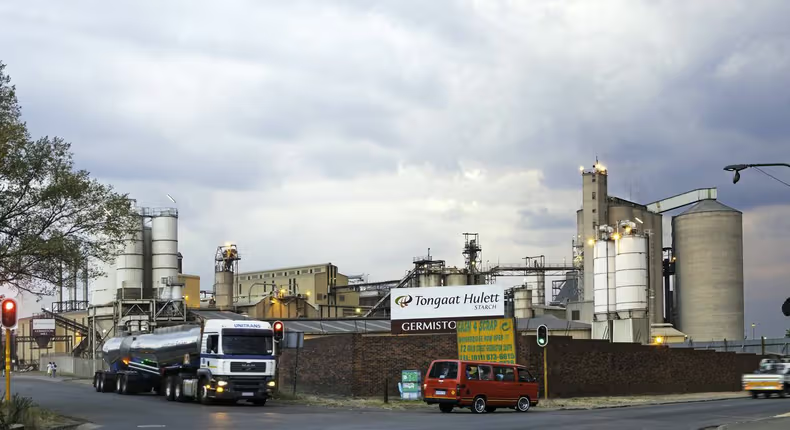
JOHANNESBURG – Government Moves to Prevent Liquidation of Tongaat Hulett as Jobs and Sugar Value Chain Hang in the Balance
South Africa’s government has stepped into the deepening crisis at Tongaat Hulett, one of the country’s oldest and largest sugar producers, warning that the company’s potential liquidation could have far-reaching economic and social consequences.
The 134-year-old sugar group, which has an annual milling capacity of approximately 2 million metric tonnes and operations spanning South Africa, Zimbabwe, Mozambique, and Eswatini, is facing provisional liquidation following the collapse of a three-year business rescue process.
While the Department of Trade, Industry and Competition (DTIC) does not have the legal authority to halt liquidation proceedings, it has confirmed it will participate in court hearings alongside other stakeholders to oppose the move.
Trade and Industry Minister Parks Tau described Tongaat Hulett as a “systemically important player” in South Africa’s sugar industry.
“The department, together with other organs of state, will oppose the liquidation of Tongaat Hulett and will continue to support all lawful efforts aimed at finding a viable and durable resolution,” Tau said.
He emphasised that the company’s survival was closely tied to the stability of the broader sugar value chain, including farmers, suppliers, mill workers, and rural communities.
Accounting Irregularities and Rescue Failure
Tongaat Hulett’s financial turmoil can be traced back to 2022, when accounting irregularities came to light, triggering a governance and liquidity crisis that severely weakened the group’s balance sheet.
In response, Vision Group, the company’s lead secured creditor, initiated a business rescue process aimed at stabilising operations, restructuring debt, and preserving the company’s assets.
However, after nearly three years, the rescue effort has failed to produce a sustainable recovery plan, prompting Vision Group to seek provisional liquidation.
The creditor argues that liquidation is necessary to protect remaining assets, maintain operational stability, and safeguard economic interests linked to the business.
Hundreds of Thousands of Livelihoods at Risk
The potential fallout from Tongaat Hulett’s liquidation is substantial.
According to estimates cited by Vision Group and industry stakeholders, approximately 250,000 grower and supplier jobs are linked to the cane-growing sector in KwaZulu-Natal and Mpumalanga — regions heavily dependent on sugar production.
In addition, around 2,600 direct jobs within Tongaat Hulett itself are at risk.
The uncertainty has intensified anxiety in rural communities, where sugar farming remains a critical source of income and economic activity.
Industry observers warn that disruptions to milling operations could have cascading effects across the agricultural value chain, affecting cane deliveries, logistics, and downstream industries reliant on sugar output.
“The sugar industry supports an extensive ecosystem of small-scale farmers, contractors, transport operators, and service providers,” said an industry analyst.
“A collapse of a major processor such as Tongaat Hulett would not be an isolated corporate failure — it would have systemic consequences.”
Court Battle Looms
Attention is now focused on the provisional liquidation hearing scheduled for February 27, where government representatives and other interested parties are expected to present arguments against the move.
The DTIC’s intervention reflects broader concerns about industrial stability and employment protection at a time when South Africa is confronting sluggish economic growth and persistent joblessness.
Strategic Industry Under Pressure
The government’s response also comes amid a challenging global trade environment.
South Africa’s agricultural and manufacturing sectors are navigating shifting market conditions, geopolitical tensions, and trade disputes involving major partners, including the United States.
Analysts note that safeguarding domestic industries such as sugar forms part of a wider policy effort to reinforce economic resilience, preserve export capacity, and protect rural livelihoods.
“The survival of key agro-industrial players is increasingly viewed through the lens of national economic security,” said a Johannesburg-based economist.
Uncertain Future
Despite government efforts, Tongaat Hulett’s immediate future remains uncertain.
However, the state’s decision to oppose liquidation underscores the company’s significance within South Africa’s agricultural economy and the broader sugar value chain.
For farmers, workers, and communities tied to the industry, the outcome of the court proceedings could prove decisive.
As the legal and financial battle unfolds, Tongaat Hulett’s crisis has become emblematic of the delicate balance between corporate restructuring, creditor rights, and the socio-economic stakes embedded in South Africa’s industrial landscape.


