


HARARE — Vice President Dr Constantino Chiwenga held an engagement with British Prime Minister Sir Keir Starmer on the sidelines of the G20 Leaders’ Summit in Johannesburg, South Africa, in a development seen as both diplomatically symbolic and politically consequential for Zimbabwe’s future trajectory.
The encounter carries significance well beyond protocol. Zimbabwe and the United Kingdom share a complex and painful history shaped by colonisation, the liberation struggle, and the rupture that followed the Fast-Track Land Reform Programme. For two decades, relations were defined by mistrust, sanctions, and diplomatic frostiness—a period in which Zimbabwe asserted its sovereignty while enduring political and economic pressure from London.
Yet recent years have shown signs of a gradual thaw, marked by renewed dialogue, selective easing of sanctions, and quiet overtures from British officials. This shifting posture reflects both changing geopolitical realities and a growing recognition in London that isolation has yielded limited strategic influence, while Zimbabwe has retained regional significance, particularly in energy, agriculture and critical minerals.
The meeting also aligns with President Emmerson Mnangagwa’s foreign policy doctrine that “Zimbabwe is a friend to all and an enemy to none,” a pragmatic effort to restore global ties while safeguarding national sovereignty and post-liberation gains. Against that backdrop, the Chiwenga–Starmer exchange is viewed as more than ceremonial diplomacy—it is a substantive step in rebuilding a relationship once fractured by historical grievance and ideological confrontation.
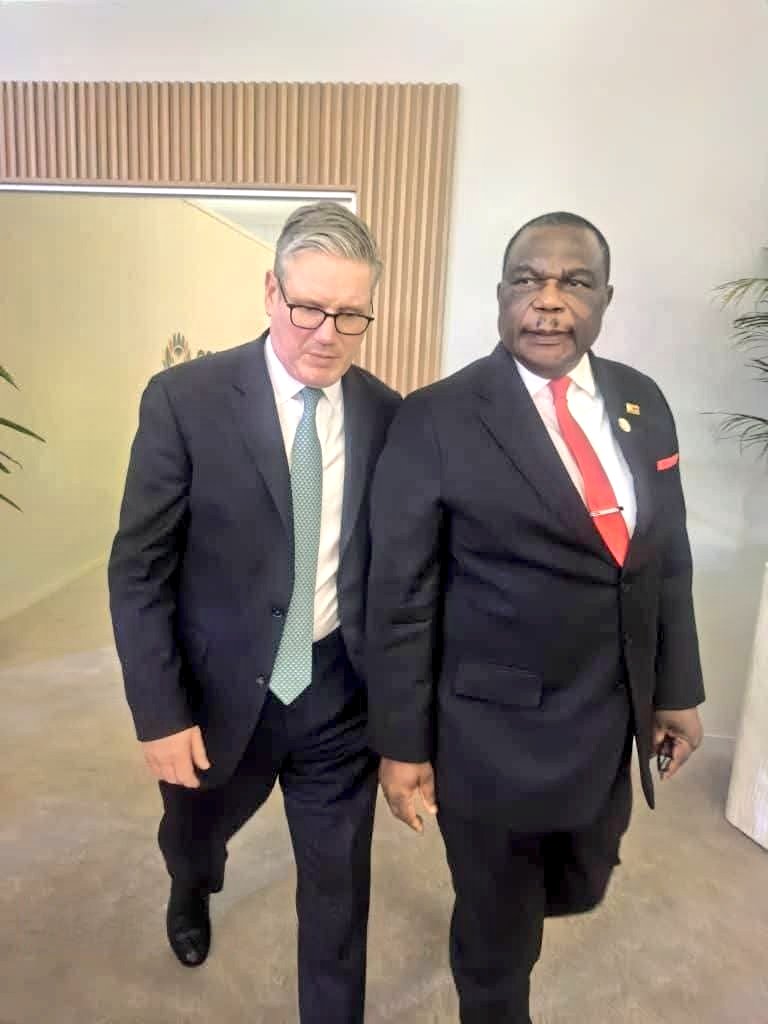
Diplomatic insiders say discussions focused on re-engagement, investment conditions, and regional stability, though official details remain undisclosed. For the United Kingdom, the engagement comes as the Starmer government recalibrates post-Brexit foreign policy, seeking renewed leverage in Africa amid intensified competition from China, Russia and India. For Zimbabwe, improved relations could ease constraints on capital flows, international lending, and trade frameworks.
Beyond the diplomatic surface, the meeting feeds into ZANU–PF’s evolving internal political landscape. Chiwenga’s rising international visibility, including high-profile engagements at global forums, has revived long-running speculation about his positioning within the ruling party’s succession matrix. His liberation credentials, command over security structures and expanding diplomatic portfolio continue to shape perceptions of him as a plausible future head of state once the post-Mugabe political order transitions.
While ZANU–PF publicly projects unity and continuity, internal dynamics remain fluid, with technocratic reformists, provincial power blocs, and business-aligned elites also shaping the leadership horizon. Chiwenga’s engagement with Starmer may therefore carry both diplomatic value and implicit signalling to external actors assessing Zimbabwe’s post-Mnangagwa future.
For now, what stands out is the symbolism: a British prime minister and a Zimbabwean vice president, seated not in confrontation but in cautious dialogue, acknowledging that history cannot be undone but the future can be negotiated.
As the G20 Summit continues, the Johannesburg exchange may emerge as a turning point—part diplomatic reset, part geopolitical recalibration, and part prelude to Zimbabwe’s next chapter both internationally and at home.

