

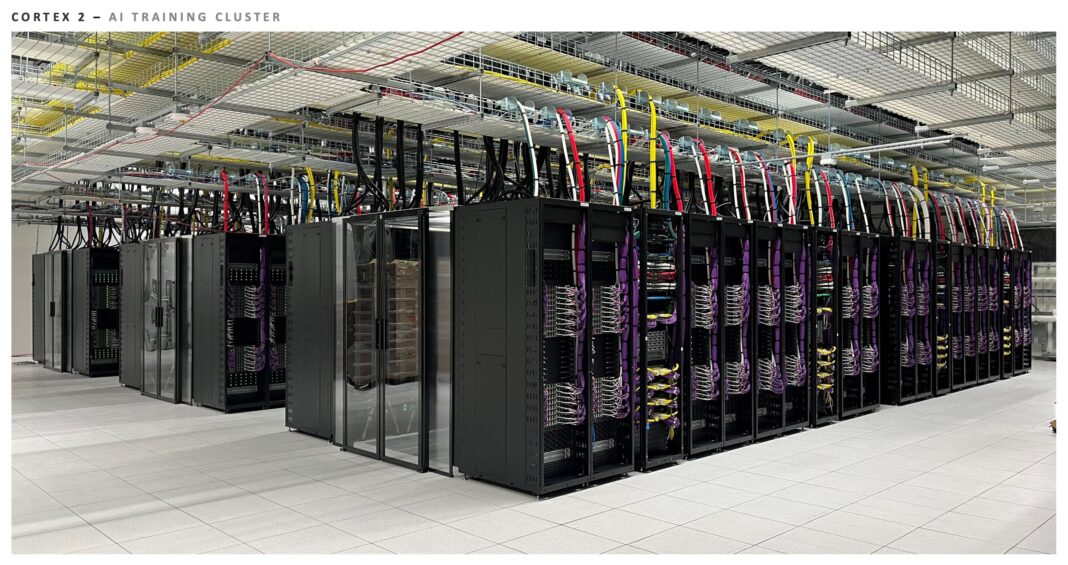
For much of the past three years, investors, policymakers and technology executives have been captivated by a single narrative: artificial intelligence would trigger the largest infrastructure build-out since the dawn of the internet. Across the United States, Europe and other advanced economies, announcements of multi-billion-dollar data centres, cloud campuses and high-performance computing facilities became almost routine. Every week seemed to bring news of another hyperscale project promising to power the AI revolution.
By Brighton Musonza
Yet beneath the headlines, a more complicated story is beginning to emerge.
A growing number of data centre projects across North America and Europe are facing delays, redesigns, financing challenges or outright cancellation. While industry executives continue to attribute these setbacks to supply-chain constraints, power shortages, permitting bottlenecks and rising construction costs, there is a broader geopolitical dimension that remains largely underexplored.
The global AI race is not simply a competition of algorithms and semiconductor design. It is increasingly becoming a contest over capital allocation, energy security and geopolitical resilience.
The AI Infrastructure Gold Rush
The emergence of generative AI following the public release of large language models transformed the economics of computing almost overnight. Companies that had previously invested cautiously in cloud infrastructure suddenly found themselves competing to secure access to graphics processing units (GPUs), specialised chips, electricity generation capacity and data centre space.
Technology giants committed hundreds of billions of dollars to infrastructure expansion. New campuses were announced throughout the United States, from Texas and Arizona to Virginia and Ohio. Similar projects emerged across Western Europe, Canada, Australia and parts of Asia.

The prevailing assumption was straightforward: demand for AI computing power would grow exponentially for decades, justifying unprecedented levels of capital expenditure.
However, building a modern AI data centre is fundamentally different from constructing a traditional commercial property.
A single hyperscale AI facility can require billions of dollars in capital, enormous quantities of electricity, dedicated transmission infrastructure, sophisticated cooling systems and long-term financing commitments. Such projects often depend on intricate funding arrangements involving private equity firms, pension funds, sovereign wealth funds and specialised infrastructure investors.
The Sovereign Wealth Connection
One of the least discussed aspects of the AI infrastructure boom is the growing role of sovereign capital from the Middle East.
Over the last decade, sovereign wealth funds from the Gulf region have become among the world’s most influential investors. Funds from countries such as Saudi Arabia, the United Arab Emirates and Qatar have accumulated trillions of dollars in assets and have steadily increased their exposure to technology, digital infrastructure and artificial intelligence.
Many Western technology ventures that appear domestically financed often rely indirectly on pools of international capital that include sovereign investors from the Gulf.
This relationship became even more important as rising interest rates made traditional project financing more expensive. Sovereign funds, with their long investment horizons and substantial liquidity, increasingly emerged as critical providers of patient capital for large-scale infrastructure projects.
Consequently, any disruption affecting the financial priorities of these investors has implications far beyond the Middle East itself.
Geopolitical Shocks and Capital Reallocation
The escalation of tensions involving Iran, Israel and the United States has introduced a new layer of uncertainty into global capital markets.
Historically, major geopolitical conflicts in the Middle East have not only influenced energy prices but have also altered investment behaviour across sovereign wealth institutions. During periods of heightened uncertainty, investors often reassess risk exposure, preserve liquidity and prioritise strategic domestic interests over international expansion.
The result is not necessarily an immediate withdrawal from existing commitments. Rather, it can manifest through slower capital deployment, delayed investment decisions and increased scrutiny of new projects.
For infrastructure developments dependent on multiple financing rounds, even modest shifts in investor sentiment can produce significant delays.
A project that appeared financially viable six months earlier may suddenly face funding gaps, higher borrowing costs or revised return expectations.
The Legacy of COVID-19
The current challenges facing data centre development cannot be understood without recognising the lingering effects of the COVID-19 pandemic.
The pandemic exposed vulnerabilities throughout global supply chains. Critical components required for data centre construction—including transformers, electrical equipment, cooling systems and specialised semiconductors—remain subject to long lead times.
Many projects announced during the height of post-pandemic optimism were based on assumptions regarding equipment availability, labour costs and energy prices that no longer hold true.
Developers now face a significantly different operating environment characterised by inflationary pressures, elevated financing costs and growing competition for electricity generation capacity.
The AI boom arrived before the global economy had fully resolved the infrastructure bottlenecks created by COVID-19.
The Energy Constraint
Perhaps the most important challenge confronting AI infrastructure expansion is energy.
Artificial intelligence is fundamentally an energy-intensive technology.
The enormous computational requirements associated with training and operating advanced AI models have created unprecedented electricity demand. In many regions, power grids were never designed to accommodate the scale of consumption now envisioned by technology companies.
Consequently, some of the most significant delays affecting data centre developments stem not from financing difficulties but from power availability.

Utilities throughout the United States and Europe are struggling to connect new facilities to already stressed transmission networks. In some cases, projects have been postponed for years while developers wait for grid upgrades.
This reality introduces a paradox at the heart of the AI revolution. While software innovation is moving at extraordinary speed, the physical infrastructure required to support it is constrained by engineering, energy and regulatory realities.
China’s Strategic Advantage
Against this backdrop, China may be positioned to derive strategic advantages.
While Western economies rely heavily on private capital markets and fragmented regulatory systems, China retains the ability to coordinate industrial policy, energy planning and infrastructure development through centralised mechanisms.
Beijing has spent years investing in data infrastructure, digital industrial parks, semiconductor capabilities and national computing networks.
Although China continues to face significant challenges related to advanced semiconductor access and export controls, its ability to align state policy with industrial objectives may provide advantages in infrastructure deployment.
The competition between China and the West is therefore increasingly extending beyond chip manufacturing into the broader ecosystem of AI infrastructure.
The decisive factor may not simply be who develops the most advanced algorithms, but who can construct, finance and power the largest computing platforms.
Beyond the Hype Cycle
Much of the public discourse surrounding artificial intelligence remains focused on software breakthroughs, model capabilities and technological milestones.
Yet history suggests that transformative technologies ultimately depend on physical infrastructure.
Railways required steel and capital. The automobile age required roads and refineries. The internet required fibre-optic networks and telecommunications infrastructure.
Artificial intelligence is no different.
The future of AI will be determined not only by computer scientists and software engineers but also by financiers, energy planners, construction firms, utility companies and geopolitical strategists.
The emerging delays affecting data centre projects should therefore be viewed not as isolated operational challenges but as indicators of deeper structural tensions within the global economy.
A New Phase of the AI Race
The next phase of the AI revolution is likely to be defined less by technological possibility and more by economic sustainability.
Capital is becoming more selective. Energy is becoming more strategic. Geopolitics is becoming more influential. Infrastructure is becoming more difficult to build.
For investors, policymakers and technology executives, the critical question is no longer whether artificial intelligence will transform the global economy.
The question is whether the physical, financial and geopolitical foundations required to support that transformation can be built quickly enough.
The world may be discovering that the greatest constraint on artificial intelligence is not computational intelligence itself, but the increasingly complex infrastructure ecosystem upon which it depends.
If that proves to be the case, then the story of the AI era will not merely be about algorithms. It will be about power grids, sovereign capital, geopolitical stability and the struggle to finance and construct the digital foundations of the twenty-first century.
Conclusion
The prevailing narrative surrounding artificial intelligence suggests an unstoppable wave of technological progress driven by innovation, venture capital and corporate ambition. Yet the reality is that AI is ultimately constrained by the same forces that have shaped every major industrial transformation in history: capital, energy, geopolitics and infrastructure.
The emerging slowdown in data centre development across parts of the United States and other Western economies may be an early indication that the AI revolution is entering a more complex phase. While technology firms continue to announce ambitious investment plans, the physical infrastructure required to support those ambitions is becoming increasingly expensive, energy-intensive and geopolitically exposed. Rising financing costs, grid limitations, supply-chain vulnerabilities and global geopolitical tensions are creating headwinds that cannot be solved by software innovation alone.
At the same time, the strategic competition between the West and China is evolving beyond semiconductors and artificial intelligence models into a broader contest over infrastructure deployment, energy security and access to long-term capital. The countries and regions capable of mobilising capital efficiently, securing reliable energy supplies and building digital infrastructure at scale will likely emerge as the long-term beneficiaries of the AI age.
The lesson for investors and policymakers is clear. Artificial intelligence should not be viewed solely as a technology story. It is increasingly an infrastructure story, an energy story and a geopolitical story. Those who focus exclusively on algorithms risk overlooking the deeper structural forces that will determine which nations, companies and economic blocs ultimately dominate the next era of global technological leadership.
In the end, the AI race may not be won by those who create the smartest machines, but by those who can most effectively finance, power and sustain the vast physical infrastructure upon which those machines depend.