
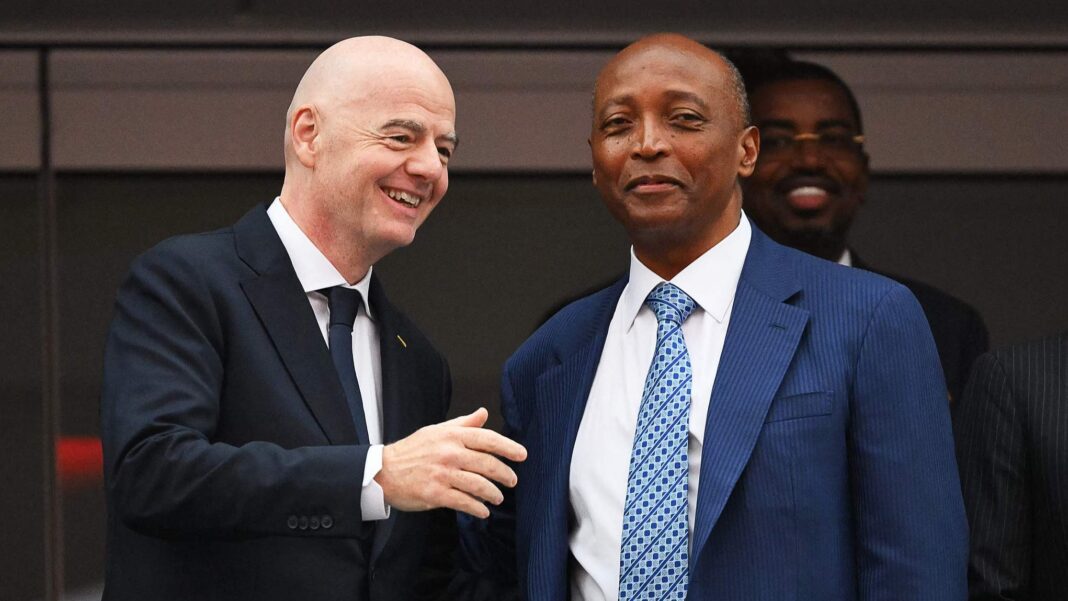
HARARE — Confederation of African Football (CAF) president Patrice Motsepe has challenged opponents of FIFA president Gianni Infantino to stop calling for his removal and instead face him at the ballot box, arguing that the leadership of world football should ultimately be decided by FIFA’s member associations.
“If you want to remove him, go through the elections. Let the 211 FIFA member associations decide. It’s as simple as that,” Motsepe said, as an increasingly bitter leadership dispute threatens to widen divisions within global football.
Motsepe’s intervention comes as Infantino faces mounting pressure from several of FIFA’s most powerful continental confederations over his controversial proposal to establish the FIFA Forward Enterprise, including plans to bring private investment into the commercial rights of FIFA competitions.
UEFA, the Asian Football Confederation (AFC) and Concacaf have publicly challenged Infantino’s leadership, accusing him of undermining consultation and governance processes. The three confederations have called for a change at the top of FIFA after the collapse of the investment proposal.
Infantino subsequently abandoned the proposal and apologised for the way it had been handled, but the retreat has failed to end the political confrontation surrounding his presidency.
Motsepe, however, has argued that dissatisfaction with Infantino should be settled through FIFA’s established electoral process rather than through pressure campaigns designed to force him from office.
The position is significant because CAF represents 54 of FIFA’s 211 member associations, giving Africa one of the largest voting blocs in the FIFA Congress. CAF associations unanimously endorsed Infantino for re-election at a meeting in April, committing the confederation to his campaign for another term from 2027 to 2031.
Infantino has already confirmed that he will seek another term when FIFA holds its presidential election in March 2027. Each of FIFA’s 211 member associations has a vote, meaning a candidate needs to build a broad international coalition rather than rely solely on support from one continental confederation.
The election could therefore become a test of whether the growing institutional opposition to Infantino can be converted into an effective electoral challenge.
Critics have been discussing possible alternatives, with Concacaf president Victor Montagliani among the names associated with a potential challenge. But the opposition has yet to consolidate around a single candidate capable of uniting the federations seeking a change in leadership.
The arithmetic is particularly important. With 211 associations entitled to vote, a simple majority requires 106 votes if the contest is between two candidates. The presence of additional candidates could make the first round more complicated, increasing the importance of coalition-building across the six continental confederations.
Motsepe’s remarks effectively turn the dispute into a straightforward political proposition: if Infantino’s opponents believe he has lost the confidence of world football, they should produce a candidate and allow the 211 associations to make the final decision.
The challenge also exposes a deeper divide over the governance of FIFA. Infantino’s supporters point to increased development funding, the expansion of the World Cup and greater opportunities for smaller football nations as evidence of his leadership record. FIFA says its investment in African football since 2016 is expected to exceed $1 billion, strengthening his relationship with many African federations.
His opponents, meanwhile, argue that FIFA’s growing commercial ambitions require stronger institutional checks, greater transparency and more consultation with the confederations and member associations.
That dispute has transformed the 2027 presidential election from what had appeared to be a relatively predictable re-election campaign into a potentially significant contest over the future direction and governance of global football.
For now, Motsepe’s message is clear: the route to removing Infantino is not through political pressure alone, but through the FIFA Congress and the votes of its 211 member associations.
And with the election scheduled for March 2027, Infantino’s challengers now face the task Motsepe has placed squarely before them — produce a candidate, build a majority and win the vote.