
The ceasefire between the United States and Iran is being interpreted through sharply contested narratives. Tehran has described it as an “unconditional surrender” by Washington – a claim that, while rhetorically charged, draws attention to a deeper structural reality: the inability of a dominant power to translate coercive intent into political outcome.
By Tim Mutsekwa
This was not simply a war that ended without victory. It was a demonstration of how hegemonic power, when detached from strategic realism, falters – first in diplomacy, then in war, and finally in its attempt to control the narrative of its own actions.
Coercive Diplomacy and Its Structural Limits
The origins of this conflict lie not on the battlefield, but at the negotiating table. Before escalation, there were diplomatic engagements – formal and informal -aimed at managing tensions. These talks did not fail due to miscommunication or tactical disagreement. They collapsed because they were built on fundamentally incompatible frameworks.
Its demands reportedly extended beyond the nuclear issue to include restrictions on Iran’s regional influence and strategic posture. These were not incremental concessions; they were structural demands that struck at the core of Iranian sovereignty.
Iran’s response was shaped by experience, particularly the collapse of the Joint Comprehensive Plan of Action. From Tehran’s perspective, the agreement had already exposed the asymmetry inherent in dealing with Washington: commitments could be extracted, but not guaranteed. In such a context, entering another agreement without enforceable assurances would have meant accepting vulnerability without reciprocity.
This was not diplomacy in the classical sense. It was an attempted imposition – and when impositions are resisted, they collapse.
Maximalism and Strategic Contraction
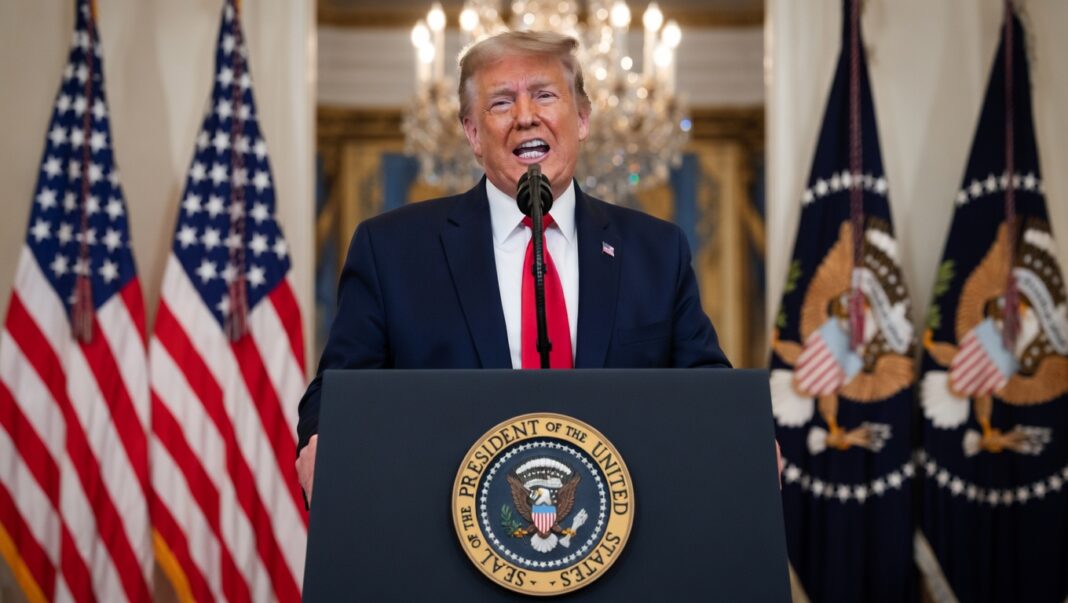
The political framing of the conflict reinforced this structural rigidity. Early in the confrontation, Donald Trump articulated the demand for Iran’s “unconditional surrender.” This was not merely rhetorical excess. It set the strategic horizon of the conflict—total compliance, potentially extending to regime transformation.
What followed reflects a well-documented pattern in hegemonic behaviour: maximalist entry followed by constrained exit. The United States entered the conflict projecting overwhelming power and expansive intent. It exited through a ceasefire that left Iran’s political system intact, its leadership in place, and its strategic posture largely unchanged.
This is not a conventional military defeat. It is a failure of strategic conversion—the inability to translate military and economic superiority into political submission.
Hegemonic Overreach and Miscalculation
Political theory provides a useful framework for understanding this outcome: hegemonic overreach. This occurs when a dominant power extends its ambitions beyond what its material, political, and contextual capacities can sustain.
In this case, three miscalculations are evident. First, the resilience of the adversary was underestimated. Iran is not a fragile state
susceptible to rapid collapse. It is a system with deep institutional continuity, a strong national identity, and a doctrine built on endurance and asymmetry. Second, the limits of coercive leverage were misjudged. Pressure—economic or military—does not automatically produce compliance, particularly when the target state has adapted to operate under sustained constraints.
Third, the costs of prolonged engagement were insufficiently anticipated. Escalation carries not only military risks, but political and reputational ones, especially when outcomes remain uncertain.
Analysts such as Pravin Sawhney have long argued that modern warfare is multidomain, where success depends on aligning military action with political objectives and informational coherence. In this case, that alignment was absent.
The Failure of Strategic Rationality
More troubling than the outcome itself is what it reveals about the quality of strategic thinking. Effective policy requires the alignment of ends, means, and context. When this alignment breaks down, power becomes blunt and ineffective.
The collapse of negotiations should have triggered recalibration. Instead, escalation followed. When escalation failed to produce results, the shift to ceasefire was abrupt rather than strategic.
This sequence – failed diplomacy, followed by coercion, followed by withdrawal – suggests not a coherent plan, but policy drift under the illusion of control. Such drift is often associated with decision-making environments where dissent is limited and assumptions go unchallenged. When policy is shaped within narrow circles of agreement, the capacity for correction diminishes. Maximalist positions harden, even when they become untenable. The result is not decisive action, but delayed adjustment.
Legitimacy and the Constraints of Power Power in international relations is not purely material; it is also legitimacy-based. The
ability to mobilise allies, sustain coalitions, and justify intervention depends on perceived legitimacy. In this instance, the United States operated with a significant legitimacy deficit. Its involvement was not widely seen as necessary or defensive, but as discretionary. This perception constrained its ability to build broad-based support and limited the effectiveness of its actions.
Legitimacy does not determine outcomes on its own, but it shapes the environment in which power is exercised. When legitimacy is weak, resistance becomes stronger and options narrower.
Narrative as a Domain of Power
Iran’s characterisation of the ceasefire as an “unconditional surrender” must be understood as part of a broader narrative strategy. By invoking the language originally used by Washington, Tehran has reframed the conflict to highlight the gap between intention and outcome.
In contemporary conflicts, narrative is not secondary – it is a domain of power. It shapes perception, influences diplomatic positioning, and contributes to long-term strategic advantage. The plausibility of Iran’s claim lies not in its literal accuracy, but in its
alignment with observable facts. The United States set expansive objectives and concluded the conflict without achieving them. That gap creates space for adversarial interpretation.
The Refusal to Internalise Limits
A defining feature of great powers is their reluctance to acknowledge limits. Publicly recognising constraint carries political cost. As a result, outcomes are often presented as deliberate choices rather than constrained ones. However, the sequence of events in this case- failed negotiations, ineffective coercion, and eventual ceasefire- points to a more complex reality. The inability to secure concessions at the negotiating table, followed by the inability to compel them through force, indicates that initial objectives exceeded available leverage.
Limits are not signs of weakness. They are conditions of strategy. Ignoring them does not eliminate them; it magnifies their consequences.
A Recurring Pattern
This episode is not an isolated failure. It reflects a recurring pattern in U.S. foreign policy: expansive entry, misreading of context, over-reliance on coercion, and inconclusive exit.
Conclusion: Power Without Conversion
The ceasefire between the United States and Iran will not be remembered as a decisive military event. It will be remembered as a moment of exposure. It exposed the limits of coercive diplomacy. It exposed the risks of hegemonic overreach. It exposed the gap between ambition and outcome.
Iran’s claim of “unconditional surrender” is an exaggeration. But it is an exaggeration grounded in a discernible truth: the United States entered this conflict seeking to impose its will and left without doing so. In international politics, that is not a neutral outcome. It represents a loss—not of power in the material sense, but of strategic authority. And when authority erodes, power itself begins to lose its coherence, its direction, and ultimately, its meaning.