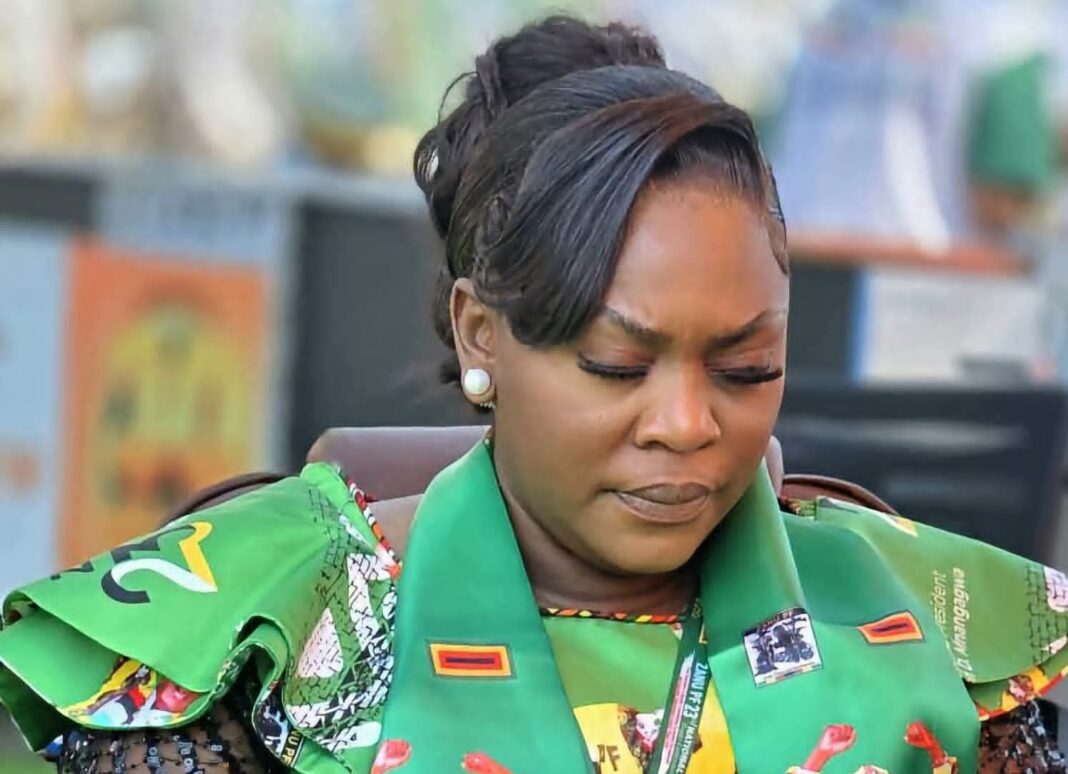
HARARE — Zimbabwe’s Information Communication Technology Minister Tatenda Mavetera has become embroiled in a political controversy following allegations that she likened ZANU-PF delegates to dogs after they enthusiastically welcomed Vice President Constantino Chiwenga at the ruling party’s 23rd National People’s Conference in Chinhoyi.
The reported remarks, highlighted in the October 17 edition of Takabatana Investigative Magazine, have raised questions about political tolerance within ZANU-PF and the increasingly strained relationship between supporters of President Emmerson Mnangagwa and those sympathetic to his deputy.
According to the publication, Mavetera rebuked delegates who stood and applauded Chiwenga as he approached the conference podium, using the Shona expression “Imbwa inoroverwa painenge yabira”.
The expression, broadly understood to mean that a dog is beaten where it has stolen, was reportedly directed at delegates whose enthusiastic reception of the Vice President appeared to displease the minister.
The Zimbabwe Mail’s examination of the published account indicates that the controversy goes beyond the language allegedly used. It raises a wider question about whether ordinary party members are free to express their political preferences without intimidation or humiliation.
The allegation has not been independently verified by The Zimbabwe Mail, and the supplied publication does not include Mavetera’s response.
Delegates’ applause becomes a political flashpoint
The controversy reportedly unfolded against the backdrop of Chiwenga’s address to the conference, during which he challenged ZANU-PF to undertake what he described as a brutal and honest assessment of its leadership and political direction.
The Vice President questioned whether the governing party was repeating the mistakes that led to the removal of former President Robert Mugabe in November 2017.
His remarks placed accountability, institutional integrity and the participation of ordinary party members at the centre of the conference’s political debate.
Chiwenga’s message was particularly significant given the continuing controversy surrounding proposals to extend Mnangagwa’s leadership beyond the constitutional presidential term ending in 2028.
The Vice President has emphasised that political authority should derive from party structures and members rather than the personal ambitions of individual leaders.
His argument challenged the increasingly personalised nature of Zimbabwe’s succession debate.
According to Takabatana, delegates responded enthusiastically to Chiwenga’s presence, standing to welcome him as he approached the podium.
It was this reception that reportedly prompted Mavetera’s intervention.
The publication alleged that the minister subsequently told delegates that their enthusiasm should be reserved for Mnangagwa, suggesting that applause for the Vice President was politically inappropriate.
If accurately reported, the incident would highlight the difficulty facing ZANU-PF as it attempts to maintain an appearance of internal unity while managing competing political loyalties.
Chiwenga’s popularity and the question of political loyalty
Chiwenga occupies one of the most senior positions in ZANU-PF and the Zimbabwean government.
As Vice President and Second Secretary of the ruling party, he is not an outsider seeking recognition from its membership.
He is a central figure in the political administration established following Mugabe’s departure.
His public reception at a national party conference would ordinarily be regarded as a legitimate expression of support for a senior leader.
The reported controversy therefore raises a fundamental question: why should delegates face criticism for applauding a constitutional office-holder and senior party official?
Within a political organisation that publicly champions collective leadership and grassroots participation, expressions of support for different leaders should not automatically be interpreted as acts of disloyalty.
Yet the incident described by Takabatana suggests that the symbolism of applause has become politically sensitive.
The enthusiastic reception of one leader can be interpreted by supporters of another as an indication of shifting political allegiances.
Such interpretations risk turning routine party gatherings into contests over personal loyalty rather than opportunities to debate policy and national development.
The significance of Mavetera’s alleged remarks
The language attributed to Mavetera has attracted particular attention because of its apparent contempt for ordinary delegates.
ZANU-PF’s conference participants include provincial representatives, long-serving party organisers, community leaders and grassroots activists who contribute to the organisation’s political mobilisation.
Many travel considerable distances to attend national gatherings, often after years of involvement in local party structures.
Their participation forms part of the institutional foundation upon which the ruling party has maintained its political influence since independence.
The use of a derogatory comparison against such members, if confirmed, would raise questions about the standards of conduct expected from senior public officials.
It would also expose a contradiction between the party’s stated commitment to grassroots leadership and the treatment allegedly directed towards delegates exercising their right to applaud a senior official.
Mavetera, as a Cabinet minister, holds responsibilities extending beyond internal party politics.
Her public conduct is therefore subject to expectations of professionalism, restraint and respect for citizens, including those whose political preferences may differ from her own.
The central issue is not whether delegates support Mnangagwa or Chiwenga, but whether political differences justify language that could reasonably be perceived as degrading.
Chiwenga’s call for self-examination acquires new significance
The controversy comes at a particularly sensitive moment because Chiwenga’s conference message was itself centred on accountability.
He urged ZANU-PF to reflect on its political conduct and examine whether the Second Republic had remained faithful to the principles that accompanied its establishment.
The Vice President’s intervention suggested that political renewal requires more than economic development targets and conference resolutions.
It also demands institutional discipline, respect for members and a willingness to confront uncomfortable questions.
The allegations surrounding Mavetera’s remarks, if substantiated, would illustrate precisely the kind of internal political culture that such self-examination might need to address.
A party that encourages members to participate in its structures must also provide space for disagreement and differing assessments of its leadership.
Otherwise, grassroots participation risks becoming a ceremonial exercise in which members are expected to endorse decisions rather than contribute meaningfully to them.
The Mnangagwa succession debate intensifies
The Chinhoyi conference took place amid renewed debate over ZANU-PF’s leadership arrangements and proposals associated with Mnangagwa’s continued political authority.
Supporters of the President have promoted continuity as necessary to consolidate economic reforms and achieve the government’s Vision 2030 development objectives.
Critics, however, have questioned whether changes to leadership arrangements could weaken constitutional safeguards and institutional accountability.
Chiwenga’s remarks have added weight to that debate by placing the principles of collective leadership and constitutional procedure at the forefront of the discussion.
His position does not necessarily amount to a formal challenge to Mnangagwa, but it has highlighted differences in emphasis within the ruling party.
The reported reaction to delegates applauding him suggests that those differences may be increasingly difficult to contain.
For ZANU-PF, the danger lies in allowing personal loyalties to overshadow the institutional rules that are supposed to govern leadership transitions.
Respect for grassroots members becomes the central issue
Beyond the immediate controversy, the allegations have implications for the relationship between political leaders and the members who sustain their organisations.
ZANU-PF frequently invokes its liberation history, grassroots mobilisation and popular participation as sources of political legitimacy.
Those traditions place ordinary members at the centre of the party’s identity.
However, meaningful participation requires more than attendance at conferences and public demonstrations of unity.
It requires members to retain the freedom to express support, question decisions and participate in debates without fear of humiliation.
The controversy surrounding Mavetera’s reported remarks therefore raises a broader institutional question about the boundaries of political loyalty.
A delegate’s decision to applaud Chiwenga does not, in itself, establish opposition to Mnangagwa.
Equally, support for the President should not require hostility towards his deputy.
Both leaders occupy senior positions within the same political organisation and government.
A political culture that treats admiration for one as betrayal of the other risks deepening divisions rather than resolving them.
Calls for clarification
The allegations published by Takabatana Investigative Magazine warrant clarification from Mavetera and the relevant ZANU-PF authorities.
The precise wording, context and intended audience of the reported remarks are important to establishing what occurred.
Without an authenticated recording or an on-the-record explanation, the allegation should not be treated as an independently established account of the minister’s conduct.
Nevertheless, the political questions raised by the report remain significant.
As ZANU-PF navigates an increasingly sensitive debate over its future leadership, its ability to accommodate different voices will be an important test of institutional maturity.
Chiwenga’s demand for honest self-examination has placed that issue squarely before the ruling party.
The controversy surrounding Mavetera now presents a practical question about whether such introspection will extend to the treatment of ordinary members.
For a party that derives much of its political identity from the liberation struggle and grassroots organisation, the dignity of its membership should remain central to its internal culture.
The ultimate test of ZANU-PF’s commitment to collective leadership may not be found in the resolutions adopted at Chinhoyi, but in whether its members can express political preferences without being subjected to ridicule by those holding public office.