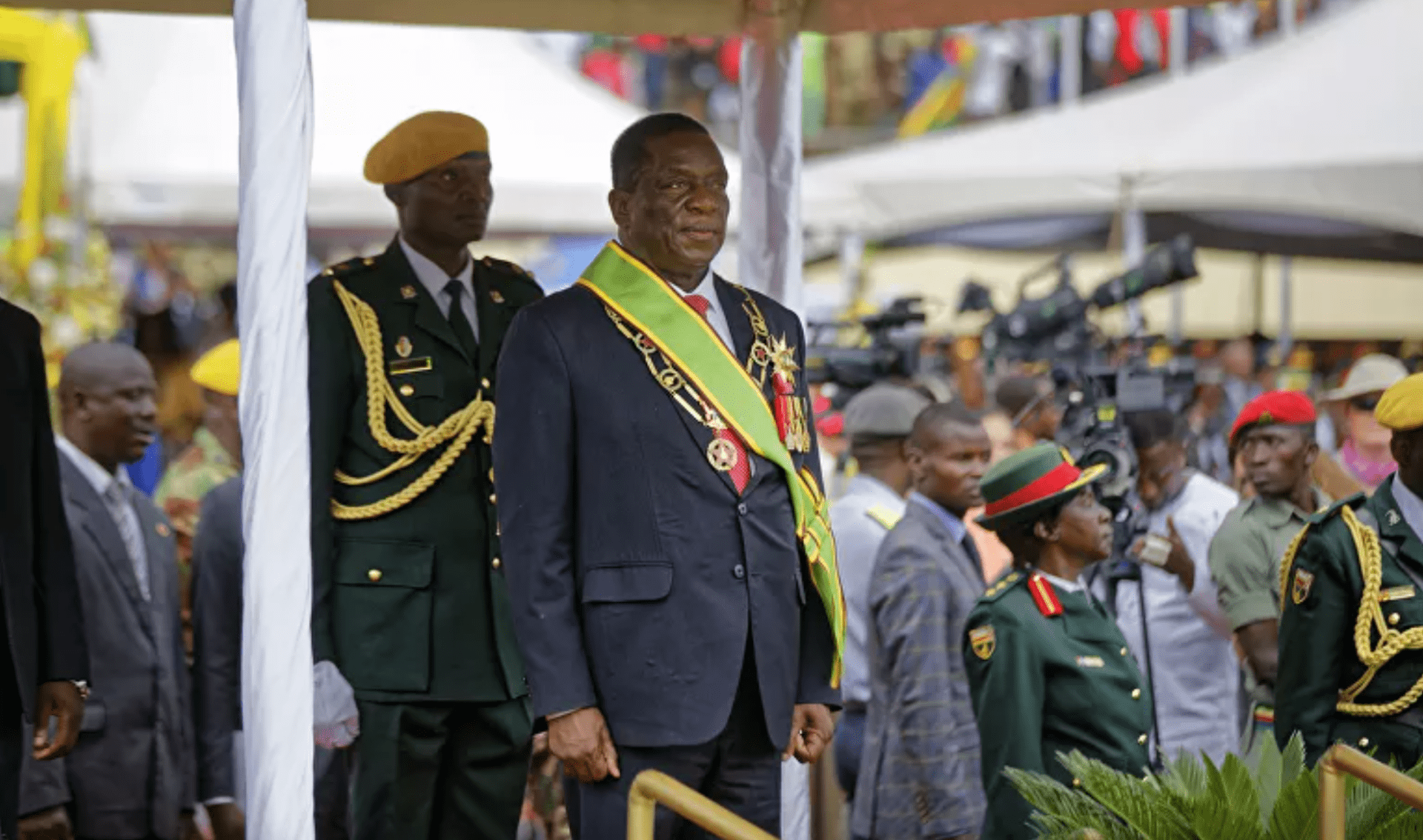
HARARE – President Emmerson Mnangagwa has signed into law constitutional amendments extending presidential terms from five to seven years, allowing him to remain in office until 2030, and abolishing the direct popular election of the president in favour of a vote by parliament.
Both houses of parliament, dominated by the ruling Zanu PF party and its proxies, approved the bill late last month. Mnangagwa’s assent to the Constitution of Zimbabwe (Amendment) Act (No. 3), 2026 – published as Act No. 6 of 2026 – was announced in a special government gazette on Tuesday.
The National Assembly voted 226 to 41 on 30 June to accept the changes proposed by the Senate, which had passed the bill 75 votes to 4 on June 24.
The raft of changes, labelled a “constitutional coup” by critics, extends the presidential and parliamentary terms from five to seven years, meaning the last of Mnangagwa’s constitutionally limited two terms, due to end in 2028, is now extended to 2030.
The new section 92 does away with direct presidential elections, introduced in 1987, replacing them with election by MPs sitting jointly in the Senate and National Assembly, held after every general election or whenever a vacancy arises.
A candidate needs more than half of the valid votes cast by MPs to win, with a run-off between the top two candidates if no one secures a majority in the first round. The Zimbabwe Electoral Commission will administer the process.
A person elected president must give up their seat in parliament, and any vacancy in the presidency must be filled within 30 days – during which no law introducing “substantive policy changes” may be passed.
However, opposition lawyer Doug Coltart has warned that the same provisions open the way for a president to begin a fresh seven-year term whenever elected by parliament, potentially allowing MPs “to continually renew their own mandate without ever returning to the electorate.”
“It’s an interpretation that we are now going to have to fight,” Coltart said.
Tendai Biti, leader of the Constitution Defenders Forum, said: “These amendments shift power and control to the few rag tag bandits that have made billions from looting the state.
“They create a clear pathway to power for syndicates and fat cats, unapologetic gold smugglers using expensive private jets to ferry gold bars from different disparate African state houses to the murky corridors of Dubai’s underworld.
“They allow the complete privatisation of power, pushing away power and legitimacy from millions of Zimbabweans to those that will be able to control the process and outcomes of any party primary election process. Democracy has been commodified.”
Section 120 is amended to expand the Senate from 80 to 90 members, adding a new category of 10 senators appointed directly by the president “for their professional skills and other competencies” after consultation with the National Assembly – a provision critics say further tilts the upper chamber toward the executive.
A new section 43A strips the Zimbabwe Electoral Commission of its long-standing role over the voters’ roll, transferring responsibility for registering voters and compiling and maintaining voters’ rolls and registers to the Registrar General. Correspondingly, section 239 is amended to repeal several of ZEC’s functions outright.
A separate new section 159A creates a Delimitation Commission to take over the redrawing of electoral boundaries from ZEC, chaired by a sitting or former Supreme Court judge (or someone qualified for that role) appointed after consultation with the Judicial Service Commission, alongside five other members with expertise in demography, public administration, cartography and a representative of the National Chiefs Council. The timeline for completing delimitation exercises is also extended from six to eighteen months.
The Act creates a new post of Judge President of the Supreme Court, who will head that court under the Chief Justice, who remains head of the judiciary overall and in charge of the Constitutional Court. The Constitutional Court’s minimum bench is set at five judges besides the Chief Justice and Deputy Chief Justice, and it gains a new discretionary jurisdiction to hear “any other matter” if it grants leave to appeal on a point of law of general public importance.
Public interviews for judicial officers have been scrapped. The president will now appoint the Chief Justice, Deputy Chief Justice, the two Judge Presidents and all other judges after consulting the JSC.
Part 6 of Chapter 12 of the Constitution, which established the National Peace and Reconciliation Commission, is repealed entirely, with related conflict-resolution and healing functions folded into the Zimbabwe Human Rights Commission’s mandate. The Zimbabwe Gender Commission, by contrast, survives, its proposed repeal in the original bill was dropped after a National Assembly amendment retained it, which the Senate subsequently endorsed.
Section 277 introduces gender and youth quotas for local councils elected through proportional representation, at least 30 percent women and 10 percent youth aged 18 to 35, while section 285 extends the term of the National Council and provincial assemblies of chiefs from five to seven years, mirroring the changes to presidential and parliamentary terms.
The changes have been sharply criticised by opposition figures, lawyers and church leaders. The Zimbabwe Heads of Christian Denominations, an umbrella grouping of the Evangelical Fellowship of Zimbabwe, the Zimbabwe Catholic Bishops’ Conference, the Zimbabwe Council of Churches and UDACIZA, warned in a February pastoral statement that the amendments should not be enacted without a referendum, cautioning that bypassing Mnangagwa’s own past pledges to respect term limits “would deeply wound the nation’s trust.”
The Zimbabwe Council of Churches separately called the bill “morally indefensible” in April, while six war veterans and other applicants have mounted Constitutional Court challenges arguing the changes to entrenched term-limit provisions can only be made through a referendum under section 328.
Justice minister Ziyambi Ziyambi has countered that lengthier terms for the president and parliament will remove “toxicity” from local politics.
“That five-year election cycle has proved too short for the work of building and developing the nation,” he told MPs.
“The divisive method of electing the president and the restless electoral cycle within which we have done that, do not stand apart. They reinforce one another to the detriment of the national interest in general and the development of the country in particular. That is the mischief which parliament has a constitutional duty to remedy.”
Zimbabwe’s opposition, weakened by years of repression and tainted elections, charges that the amendments will further entrench Zanu PF’s grip on power.
Mnangagwa, 83, came to power in 2017 in a military-backed coup that ousted Robert Mugabe at the age of 93 after 37 years in power.
Source: ZimLive