

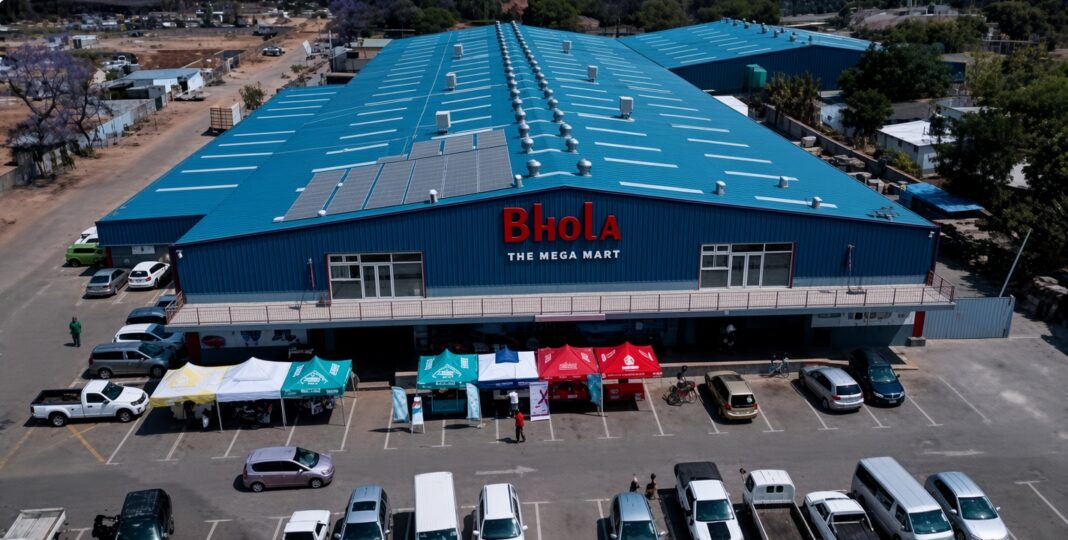
HARARE — Zimbabwe’s formal retail sector is entering a new phase of expansion, with established chains and emerging operators investing in additional stores even as informal traders continue to exert intense pressure on prices, convenience and consumer spending.
The latest investment cycle, according to Equity Axisis, is being led by TM Pick n Pay, SPAR and Bhola, whose expansion strategies differ but share a common objective: capturing consumer demand in a market where the traditional supermarket model is being reshaped by informality, currency dynamics and increasingly price-sensitive households.
The renewed investment is taking place against a difficult backdrop. OK Zimbabwe, once the country’s dominant supermarket operator, has been forced into corporate rescue after severe liquidity and supplier-payment pressures exposed the vulnerabilities of operating a large formal retail network in Zimbabwe’s volatile trading environment.
TM Pick n Pay turns volumes into profitability
TM Pick n Pay has provided one of the clearest signs that formal retail can still generate growth when operators combine tighter cost management with improved customer traffic.
During the year ended February 2026, the retailer opened a new supermarket in Shurugwi and invested approximately US$3.2 million in capital expenditure, funded entirely from internally generated cash.
Unit sales increased 6 percent, while gross margin expanded to 29 percent from 23 percent. Its supermarket division moved from an operating loss of ZWG516.3 million to an operating profit of ZWG63.7 million.
The improvement came despite weaker average basket values, with customers visiting stores more frequently and purchasing more units.
An important shift was also evident in the currency composition of sales. US dollar-denominated sales increased from an average of 23 percent to 45 percent of supermarket revenue, providing greater foreign-currency capacity for procurement and inventory replenishment.
The performance suggests that, for formal retailers, increasing transaction frequency may be more important than simply attempting to increase the value of each shopping basket.
SPAR expands through independent operators
SPAR Zimbabwe is pursuing a different route to expansion by relying on independently operated stores under its established brand and retail-support system.
A new supermarket opened in Mazowe in March, comprising about 970 square metres of grocery retail space, alongside a 130-square-metre liquor section.
The store stocks more than 4,300 products and targets a diverse catchment incorporating agricultural and mining workers, highway traffic and surrounding communities.
The independent-retailer model allows SPAR to expand its footprint without every new outlet requiring the same level of corporate capital deployment from the central organisation.
It also gives individual operators greater responsibility for local execution while benefiting from the broader group’s procurement, branding and retail infrastructure.
That structure could prove increasingly relevant in Zimbabwe, where store economics vary considerably between urban centres, mining communities, agricultural districts and transport corridors.
Bhola challenges established retail formats
Bhola is adding another dimension to the competitive landscape.
The company initially built its presence in hardware before expanding into groceries and larger Mega Mart formats.
Its approach has centred on broad product ranges, aggressive sourcing from domestic and international suppliers, multi-currency trading and price competition.
The move into supermarkets illustrates how Zimbabwe’s retail boundaries are becoming less rigid. Hardware operators, wholesalers and smaller traders can increasingly migrate into grocery retail when they identify opportunities to exploit their existing procurement networks and customer bases.
Unlike legacy supermarket groups carrying extensive historical store infrastructure, newer entrants can potentially design their outlets around current consumer behaviour, product demand and location economics.
Informal traders remain the price benchmark
The biggest challenge for all formal retailers, however, continues to come from the informal economy.
A 2026 IH Securities consumer study found that a 16-item basket of basic goods was approximately 12 percent cheaper in tuckshops than in formal retail outlets.
The price difference reflects structural disparities in operating costs. Formal retailers must contend with taxation, labour, property, utilities, licensing and compliance expenses, while smaller informal businesses frequently operate with substantially lower fixed costs.
Informal traders also benefit from proximity. A neighbourhood tuckshop can serve customers within walking distance, reducing transport costs and allowing households to purchase small quantities more frequently.
That combination of lower prices and convenience makes informal retailers formidable competitors even when supermarkets offer significantly broader product ranges.
Currency dynamics have reshaped competition
The competitive imbalance became particularly visible during Zimbabwe’s currency and pricing disruptions.
Formal retailers have previously warned that exchange-rate rules could leave them structurally more expensive than informal competitors when suppliers adjusted prices in response to parallel-market currency conditions.
The result was a growing divergence between the prices available through formal supermarket chains and those offered by informal traders.
For large retailers, the problem extends beyond pricing. When customers migrate to informal channels, falling sales volumes can reduce stock turnover, weaken supplier relationships and increase the amount of working capital tied up in inventory.
That was part of the broader pressure eventually confronting OK Zimbabwe.
OK Zimbabwe highlights the risks
OK Zimbabwe’s difficulties demonstrate what happens when a large retail footprint meets severe working-capital constraints.
By May 2025, the retailer owed suppliers approximately US$30.34 million, had closed five stores and faced difficulties maintaining adequate stock across parts of its network.
Shareholders subsequently approved a US$30 million recapitalisation programme as the company attempted to restore liquidity, rebuild supplier confidence and stabilise operations.
The contrast with TM Pick n Pay is instructive.
While TM Pick n Pay has been able to finance expansion through internally generated cash, OK Zimbabwe has had to focus on balance-sheet repair and restoring the foundations of its existing network.
The emerging market therefore rewards not simply store numbers but cash generation, stock availability, procurement efficiency and the ability to maintain customer traffic.
The supermarket is becoming a distribution platform
Technology is also beginning to change the economics of formal retail.
TM Pick n Pay already operates an online shopping platform and mobile application offering home delivery and collection from stores.
The significance extends beyond e-commerce sales. Existing supermarkets can increasingly function as fulfilment points, allowing the same inventory, warehousing infrastructure and locations to service both physical shoppers and digitally generated orders.
South Africa demonstrates the potential scale of this model. Shoprite’s Sixty60 generated R25.5 billion in sales in the year to June 2026, following 34.5 percent growth, with the platform reaching sales equivalent to approximately 11 percent of Shoprite’s South African supermarket business.
Zimbabwe’s economics are different, particularly because of deeper informality, higher price sensitivity and constraints around power, data and logistics.
Nevertheless, established retailers already possess assets that would be expensive for pure digital businesses to replicate: stores, inventory, supplier relationships, cold-chain infrastructure and customer networks.
A new retail hierarchy is emerging
Zimbabwe’s supermarket sector is consequently being reshaped rather than simply expanded.
TM Pick n Pay is demonstrating that higher volumes, stronger margins and disciplined capital expenditure can support store growth. SPAR is using independent operators to distribute expansion risk and bring locally financed outlets into new catchments. Bhola is challenging conventional supermarket structures through a broader multi-format strategy.
Meanwhile, OK Zimbabwe must first rebuild liquidity and restore stock availability.
Informal retailers remain the market’s most powerful price benchmark, forcing formal operators to find other sources of competitive advantage through procurement scale, product assortment, customer experience, location, technology and brand trust.
The result is likely to be a more fragmented but potentially more productive retail market in which store count alone will no longer determine market power.
The decisive metric will increasingly be how efficiently each outlet converts capital and inventory into sales, how frequently customers return and how successfully retailers balance formal-sector costs against the informal market’s low-price advantage.
Zimbabwe’s retail investment cycle is therefore returning, but it is returning under very different rules. The next generation of winners will not necessarily be the businesses with the largest physical footprint. They will be those capable of combining scale with cash discipline, procurement power with competitive pricing, and physical stores with increasingly digital distribution.