NEW YORK — Global equity markets opened the week on a firmer footing as a retreat in oil prices and US Treasury yields offered investors some relief after last week’s sharp rise in energy and borrowing costs.
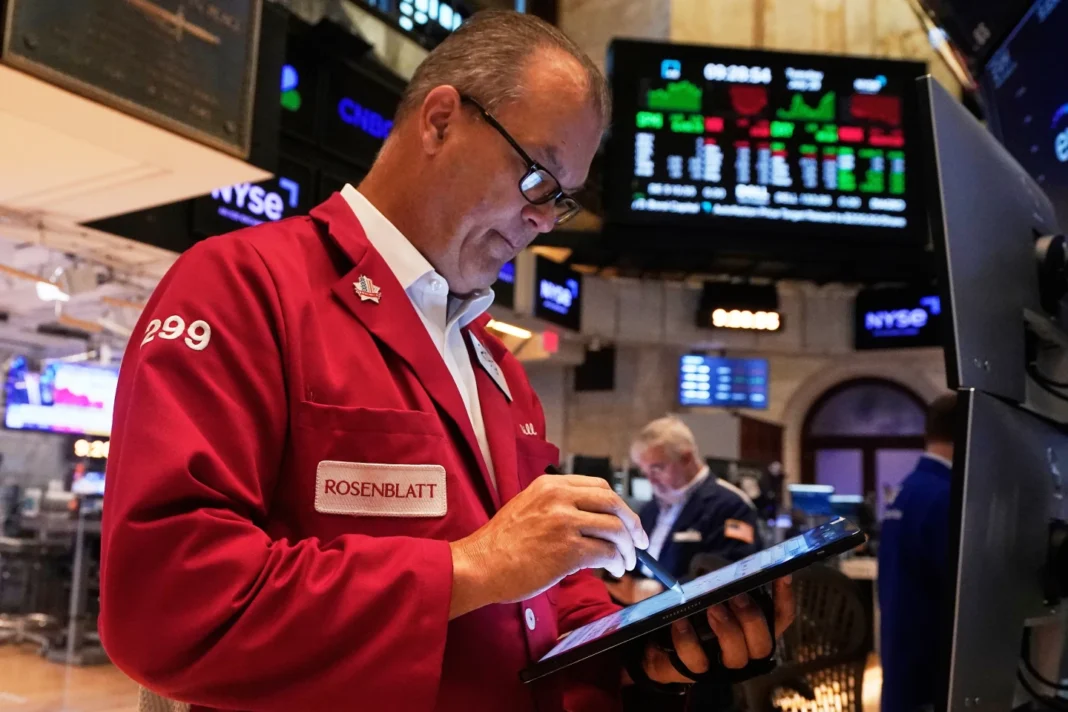
On Wall Street, the S&P 500 gained about 0.6% in early trading on Monday, moving back to within roughly 1.3% of the record high reached last month. The Dow Jones Industrial Average rose 224 points, or 0.4%, while the technology-heavy Nasdaq Composite advanced 0.8%.
The recovery was supported by a decline in crude prices, although energy markets remain highly volatile because of continuing disruptions and uncertainty surrounding Middle Eastern oil supplies.
Brent crude fell about 3.1% to $100.62 a barrel, retreating from almost $110 reached last week. The benchmark, however, remains substantially above the roughly $72 level recorded earlier in the summer.
The movement in oil prices has become one of the most important variables for global investors because sustained energy inflation could complicate the outlook for interest rates, corporate earnings and consumer spending.
The Strait of Hormuz remains central to the market’s concerns. Some crude is continuing to move through the strategic waterway, but flows remain well below normal levels amid the conflict involving Iran.
Market analysts have warned that another sustained rise in crude, petrol and refined-product prices could put renewed pressure on equities by increasing inflation expectations and limiting the room available to central banks to reduce interest rates.
Morgan Stanley strategist Michael Wilson has identified a renewed surge in energy prices as one of the principal risks to his outlook for US equities through the end of the year.
Bond markets offer investors some relief
The easing in oil prices was accompanied by a modest retreat in US Treasury yields.
The yield on the benchmark 10-year Treasury note fell to about 4.96%, from 5.01% at the end of last week. The yield had moved above 5% last week for the first time in three years, highlighting the renewed pressure facing global borrowing costs.
Higher government bond yields can weigh on equity valuations because they raise the cost of capital for companies while making relatively safe government securities more attractive to investors.
They can also increase financing costs for households and businesses, potentially slowing economic activity.
The combination of elevated oil prices and higher bond yields has therefore become a critical market concern: energy inflation threatens to push up consumer prices, while higher borrowing costs can simultaneously weaken demand.
Investors look beyond Middle East risks
Despite the geopolitical uncertainty, investors appeared more willing to take risk on Monday.
ING commodities strategists Ewa Manthey and Warren Patterson said profit-taking following the recent oil rally, alongside hopes for constructive diplomatic engagement at the United Nations General Assembly and between the United States and China, had helped improve market sentiment.
US-China relations are particularly important for global markets because trade policy, tariffs, technology restrictions and artificial intelligence remain significant sources of uncertainty for multinational companies.
US Treasury Secretary Scott Bessent described weekend discussions with Chinese Vice Premier He Lifeng as a successful engagement, with trade and artificial intelligence among the issues discussed.
The two countries have also been considering reciprocal tariff reductions involving about $30 billion of goods on each side.
China’s Foreign Ministry separately confirmed that President Xi Jinping is scheduled to visit the United States from September 23 to 25. Trade, tariffs, artificial intelligence and technology policy are expected to feature prominently in discussions, alongside broader geopolitical issues.
For financial markets, any evidence of a stabilisation in US-China economic relations could provide support for global equities, particularly companies exposed to international trade and technology supply chains.
AI stocks regain their footing
Technology shares also contributed to Monday’s recovery following the sharp sell-off that affected artificial-intelligence stocks earlier in the month.
Advanced Micro Devices gained 4.8%, while Nvidia rose 0.4% as investors reassessed the outlook for AI-related investment and valuations.
The AI sector remains one of the strongest drivers of the US equity market, but concerns over excessive valuations, enormous capital expenditure requirements and the sustainability of the current investment cycle have made investors increasingly selective.
Warnings from some technology executives that the pace of AI development may need to slow for safety reasons have added another dimension to the debate over the industry’s long-term trajectory.
Cryptocurrency-linked stocks rally
Shares linked to the cryptocurrency industry also advanced as bitcoin recovered above $85,000, returning to levels last seen in January.
Coinbase Global rose 5.4%, while Robinhood Markets gained 2.8%, reflecting renewed appetite for higher-risk assets.
The broader recovery was not confined to the United States.
European and Asian markets also moved higher, with France’s benchmark index gaining about 1%, Hong Kong advancing 1.2% and South Korea’s market rising 1.6%.
The synchronised move suggests that investors were responding less to domestic economic developments and more to a global easing in financial-market pressure.
Oil remains the market’s biggest variable
The immediate improvement in sentiment should not be interpreted as a resolution of the risks confronting the global economy.
US petrol prices have already risen sharply. The average price of regular gasoline in the United States reached nearly $4.48 a gallon, according to AAA, compared with less than $4.32 a week earlier and about $3.18 a year ago.
For consumers and businesses, the trajectory of energy prices could ultimately matter more than a single day’s movement in equity markets.
If oil prices remain around or above $100 a barrel for an extended period, the resulting increase in transport, manufacturing and household costs could feed into broader inflation. That would make the task of central banks considerably more difficult.
Monday’s market rally therefore represents a reprieve rather than a definitive change in direction.
For investors, the next moves in crude oil, US Treasury yields and US-China relations are likely to determine whether the recovery in global equities develops into a sustained rally — or proves to be another temporary bounce in an increasingly volatile market.