
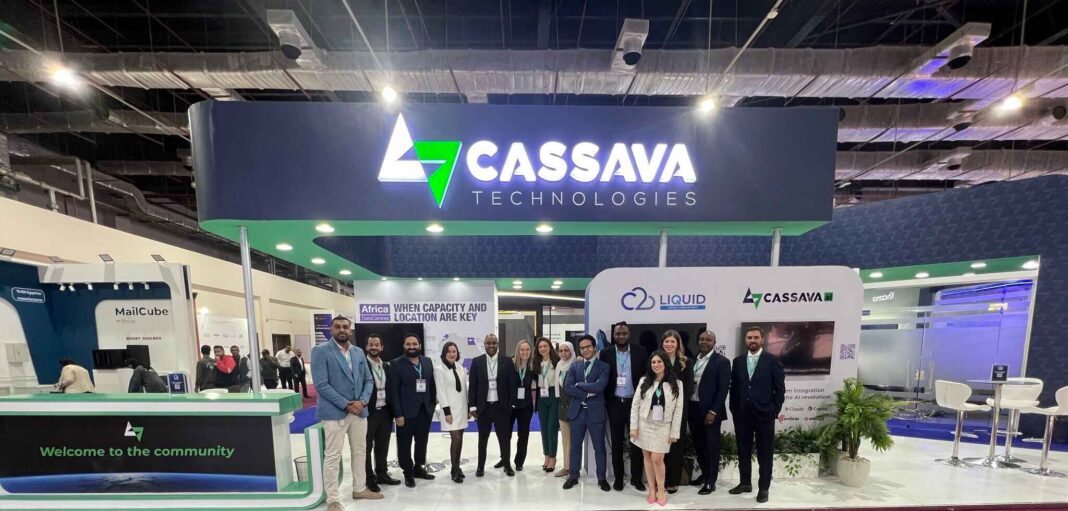
JOAHANNESBURG — Africa’s artificial-intelligence ambitions are increasingly being matched by the physical infrastructure required to turn them into commercial applications, after Cassava Technologies’ AI Factory was ranked 36th in the latest TOP500 list of the world’s most powerful supercomputers.
The ranking represents more than a technology milestone for Cassava. It points to the emergence of industrial-scale computing capacity on African soil at a time when access to advanced computing is becoming a strategic determinant of competitiveness in artificial intelligence, cloud services, financial technology, scientific research and digital industrialisation.
According to data published by TOP500, the Cassava AI Factory is installed at Africa Data Centres’ CPT1 facility in Cape Town and is built around HPE Cray XD670 infrastructure with NVIDIA H200 SXM5 accelerators. The system has 285,696 processor cores and delivers a measured Linpack performance of 77.79 petaflops, against a theoretical peak of 102.16 petaflops.
The system was installed in 2026 and runs on Linux, with NVIDIA’s HPL software stack and an InfiniBand NDR interconnect providing the high-speed communications architecture required for large-scale AI workloads.
For Africa, the strategic importance lies in the location of the computing capacity itself.
AI development has traditionally depended heavily on computing infrastructure concentrated in North America, Europe and parts of Asia. That geographic concentration creates challenges for African organisations dealing with data sovereignty, latency, connectivity costs and access to scarce high-performance computing resources.
The arrival of a major AI computing platform on the continent begins to change that equation.
The Zimbabwe Financial Mail views the development as particularly significant for countries such as Zimbabwe, where the next phase of digital transformation will increasingly depend not simply on access to the internet, but on access to sophisticated computing infrastructure capable of processing large datasets and running advanced AI models.
For Zimbabwean businesses, the implications extend well beyond the technology sector.
Banks could use high-performance computing for fraud detection, credit-risk modelling, customer analytics and increasingly sophisticated financial forecasting. Insurers could deploy AI to improve underwriting and claims analysis, while mining companies could apply machine learning to geological modelling, exploration, equipment maintenance and production optimisation.
Agriculture represents another potentially important application. AI models operating against weather, satellite, soil and crop datasets could improve forecasting and farm-level decision-making, while manufacturers could use computer vision, predictive maintenance and automated quality control to increase productivity.
The emergence of African-based computing capacity therefore potentially lowers one of the structural barriers between AI experimentation and industrial deployment.
From AI experimentation to industrial infrastructure
Africa’s AI debate has often focused on the shortage of skills, data centres, connectivity and computing resources required to develop locally relevant applications.
The Cassava AI Factory suggests that part of this infrastructure gap is beginning to close.
The distinction is important. An AI application may be developed using relatively modest computing resources, but training and deploying sophisticated models at scale can require enormous computational capacity. Businesses moving from prototypes to production therefore need infrastructure that can support sustained workloads rather than isolated experiments.
That is where high-performance computing becomes economically significant.
The Cassava system’s 77.79 petaflops of measured performance places it firmly within the global high-performance computing ecosystem. Its NVIDIA H200 accelerators are designed for demanding AI and accelerated-computing workloads, while the InfiniBand architecture allows large numbers of processors and accelerators to operate as a coordinated computing environment.
The consequence is that African organisations can increasingly contemplate AI as production infrastructure rather than merely as an experimental technology.
Why Zimbabwe should be paying attention
For Zimbabwe, the development comes at a particularly important moment.
The country’s financial services, telecommunications, mining, agriculture and manufacturing industries are generating increasing volumes of digital information, while businesses are under pressure to improve productivity without proportionately increasing costs.
The availability of regional AI infrastructure creates the possibility of building applications around African datasets while keeping computing workloads geographically closer to their users and commercial operations.
That could become important for Zimbabwean banks and other highly regulated institutions, where questions surrounding data governance, security and the location of sensitive information are becoming increasingly relevant.
It also creates an opportunity for Zimbabwe’s technology companies.
Rather than attempting to build expensive hyperscale computing infrastructure domestically, software companies could potentially develop AI applications in Zimbabwe while accessing large-scale computing capacity elsewhere in the region. This creates a model in which intellectual property, software engineering and industry expertise can remain local while computational infrastructure is accessed as a service.
The economic value could therefore move beyond the physical data centre.
Zimbabwean developers, financial institutions, mining companies and universities could become consumers of African computing capacity while building products designed for Zimbabwean and wider African markets.
The next infrastructure race
The significance of the Cassava AI Factory is ultimately not its position at No. 36 alone. The more important question is what comes next.
AI infrastructure is becoming an increasingly strategic asset. Countries and companies that possess large-scale computing capacity can participate further up the technology value chain, from simply consuming AI applications to training models, developing proprietary systems and providing computing services to other organisations.
Cassava’s achievement consequently places Africa inside a global infrastructure race that is likely to intensify.
The opportunity for African economies is substantial, but computing capacity by itself will not produce an AI economy. It must be connected to reliable electricity, high-capacity telecommunications networks, cloud platforms, skilled engineers, data scientists, researchers, commercially useful datasets and businesses capable of converting technology into productivity gains.
For Zimbabwe, the lesson is particularly clear: AI policy cannot be reduced to encouraging businesses to use chatbots or generative-AI applications. The more consequential question is whether the country can build an ecosystem in which local companies possess the skills, data, connectivity and capital necessary to exploit increasingly accessible regional computing infrastructure.
Cassava’s AI Factory demonstrates that the continent is beginning to build the physical foundation.
The next challenge is to ensure that African businesses — including those in Zimbabwe — are sufficiently prepared to use it.
The emergence of 77.79 petaflops of computing capacity in Cape Town is therefore not simply a South African technology story. It is an indication that Africa’s AI economy is acquiring the infrastructure necessary to become commercially consequential.
And for Zimbabwe, the opportunity is to ensure that it does not remain merely a consumer of that infrastructure, but becomes one of the businesses, developers and industries creating economic value from