

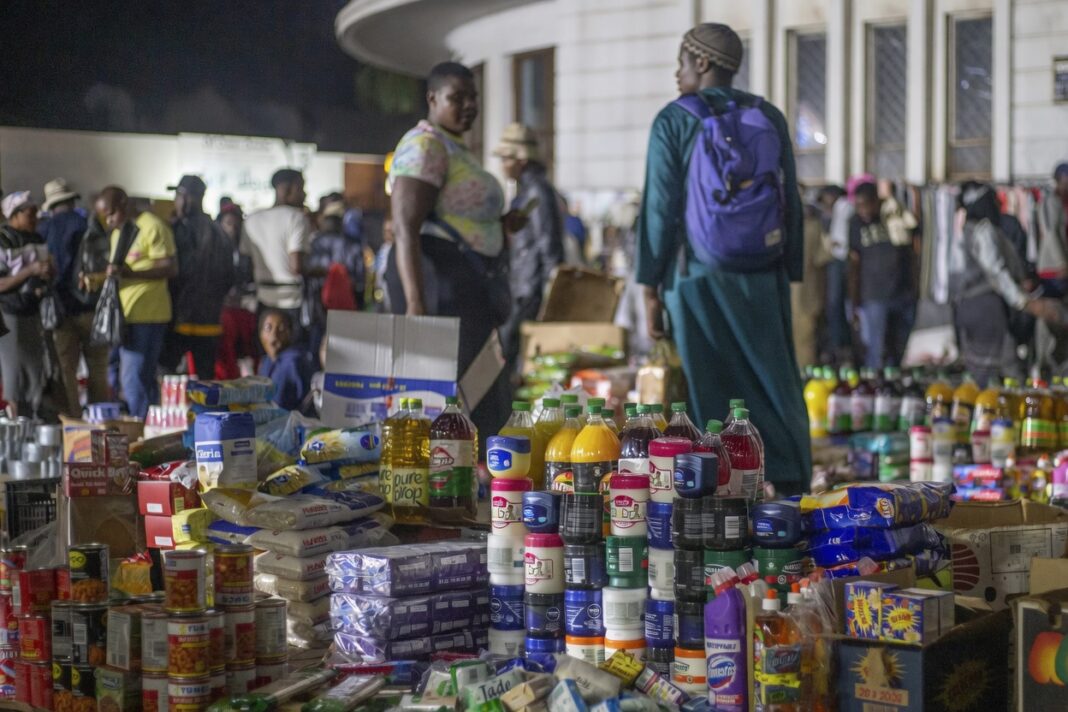
Zimbabwe’s deepening informalisation is no longer a peripheral labour-market adjustment; it is a structural macroeconomic condition shaped by currency instability, fiscal design, institutional credibility, and the reconfiguration of global capital flows. A recent assessment by the World Bank situates the country’s trajectory within a broader pattern observed across emerging and frontier economies: once informality becomes entrenched, it evolves into a parallel system of production, exchange, and accumulation that resists rapid reversal.
By Brighton Musonza
The Zimbabwean case is particularly instructive because it reflects the convergence of domestic policy distortions and global economic shifts. Between 2020 and 2023, the economy is estimated to have absorbed losses of approximately US$4.5 billion arising from exchange-rate misalignments and monetary policy inconsistencies. These losses translated into a significant erosion of fiscal capacity, with an estimated US$1.15 billion in foregone tax revenues as firms and households migrated into informal channels. Under a counterfactual of policy coherence and exchange-rate alignment, tax revenues could have approached US$6.6 billion in 2023, or close to one-fifth of GDP—levels more consistent with fiscally functional emerging markets.
Yet the implications extend beyond revenue shortfalls. Informalisation reconfigures the very architecture of the economy, altering incentives, compressing productivity, and weakening the state’s capacity to intermediate between capital and labour. In this respect, Zimbabwe’s experience echoes patterns seen in parts of Latin America during the debt crises of the 1980s and, more recently, in economies such as Argentina, where persistent macroeconomic instability has entrenched a dual economic structure in which formal and informal systems coexist uneasily.
The Structural Entrenchment of Informality
Informality is not merely a residual category; it is a rational equilibrium outcome under conditions of policy uncertainty and institutional fragility. Once firms and households adjust their behaviour to operate outside formal regulatory and tax frameworks, re-entry into the formal sector becomes both economically and psychologically costly.
The World Bank emphasises that re-formalisation is inherently a slow process, often spanning years or even decades. This is consistent with evidence from economies such as Brazil and India, where large informal sectors have persisted despite sustained growth. In these contexts, informality is sustained by a combination of regulatory complexity, limited enforcement capacity, and the absence of tangible benefits associated with formalisation.
In Zimbabwe, the persistence of informality is further reinforced by the erosion of trust in state institutions. Where taxation is perceived as punitive and public service delivery as inadequate, compliance becomes a weak equilibrium. Informality, in this sense, is both an economic strategy and a political statement—a withdrawal from a system that is seen as extractive rather than enabling.
Currency Instability and the Parallel Market Distortion
At the core of Zimbabwe’s informalisation lies the breakdown of the monetary system’s credibility. The divergence between the official exchange rate and the parallel market rate has created a structural arbitrage opportunity that distorts pricing, incentivises rent-seeking, and undermines formal economic activity.
This dual exchange-rate system effectively imposes an implicit tax on firms operating within the formal sector. By forcing transactions at an overvalued official rate, policy creates a wedge between nominal and real values, encouraging economic agents to transact outside the formal system where market-determined rates prevail.
Such dynamics are not unique to Zimbabwe. Comparable distortions have been observed in economies such as Nigeria and Egypt, where exchange-rate misalignments have driven the expansion of parallel markets. In each case, the persistence of these distortions reflects a reluctance to undertake politically costly adjustments, even as the economic costs accumulate over time.
The consequence is a fragmentation of the monetary system. Without a credible unit of account, economic coordination becomes increasingly difficult, and the effectiveness of monetary policy instruments is severely compromised.
Dollarisation: Stability at the Cost of Policy Autonomy
Zimbabwe’s rapid shift towards dollarisation represents both an adaptive response by economic agents and a structural constraint on policy. Foreign currency deposits have risen dramatically, transforming the financial system into a de facto multi-currency regime.
On one level, this has provided a degree of stability, insulating the economy from the hyperinflationary dynamics associated with the Zimbabwe hyperinflation. On another level, it has eroded monetary sovereignty, limiting the state’s capacity to conduct independent policy.
This trade-off is evident in other dollarised or partially dollarised economies, such as Ecuador, where the adoption of the US dollar stabilised inflation but constrained fiscal and monetary flexibility. In Zimbabwe, the coexistence of local and foreign currencies has created a segmented economy, where access to hard currency becomes a determinant of competitiveness.
The implications for fiscal policy are profound. As tax collection increasingly shifts into US dollars, the government’s ability to manage liquidity, finance deficits, and respond to shocks becomes constrained. This complicates macroeconomic management and reinforces the structural dependence on external conditions.
Tax Policy, Compliance Burdens, and the Informal Trap
Zimbabwe’s tax system, particularly in its treatment of small and medium enterprises, has played a central role in driving informalisation. High compliance costs, complex administrative procedures, and the prevalence of transaction taxes have created strong disincentives for formal participation.
The Intermediate Money Transfer Tax (IMTT) exemplifies this dynamic. While designed to broaden the tax base, it has had the unintended consequence of penalising formal financial transactions and encouraging the use of cash-based alternatives. This undermines efforts to promote financial inclusion and digitalisation, both of which are critical for modern economic development.
Comparative experience suggests that successful formalisation strategies require a rebalancing of incentives. In Rwanda, for example, tax simplification and the digitisation of compliance processes have contributed to a gradual expansion of the formal sector. Similarly, in Vietnam, the alignment of tax policy with industrial strategy has facilitated the transition of firms from informal to formal status.
In Zimbabwe, a comparable approach would require not only technical reforms but also a broader shift in the relationship between the state and the private sector—from one characterised by extraction to one based on partnership.
Capital Formation, Investment Climate, and Entrepreneurial Dynamics
Informalisation has significant implications for capital accumulation and investment. Informal enterprises are typically excluded from formal financial systems, limiting their access to credit, equity financing, and risk capital. This constrains their ability to scale, innovate, and integrate into global value chains.
For Zimbabwe, rebuilding the investment climate is therefore a central priority. This involves restoring macroeconomic stability, strengthening property rights, and enhancing regulatory transparency. It also requires the development of financial markets capable of mobilising domestic savings and attracting foreign investment.
Global experience underscores the importance of these factors. In China, the combination of policy stability, infrastructure investment, and openness to foreign direct investment facilitated rapid industrialisation and technological upgrading. In Poland, institutional reforms and integration into European markets supported a sustained transition towards a formal, high-productivity economy.
Zimbabwe’s challenge is to replicate these dynamics within a more constrained and uncertain global environment, where capital is increasingly selective and geopolitical considerations play a growing role in investment decisions.
Supply Chains and the Fragmentation of the Formal Economy
The expansion of informality has also disrupted supply chains, reducing efficiency and limiting the scope for industrial development. Formal supply chains depend on standardisation, traceability, and contractual enforcement—conditions that are difficult to sustain in an informal environment.
This fragmentation has implications for regional integration. Zimbabwe’s participation in frameworks such as the Southern African Development Community and the African Continental Free Trade Area depends on its ability to meet standards, ensure reliability, and integrate into cross-border production networks.
In contrast, economies that have successfully industrialised—such as South Korea—have done so by building tightly coordinated supply chains anchored in formal institutions. The divergence highlights the structural challenges facing Zimbabwe as it seeks to reposition itself within the regional and global economy.
The Reform Imperative in a Shifting Global Context
The urgency of reform is heightened by changes in the global economic environment. The era of hyper-globalisation, characterised by unrestricted capital flows and expansive supply chains, is giving way to a more fragmented system marked by geopolitical competition, regionalisation, and strategic decoupling.
In this context, Zimbabwe’s ability to attract investment and rebuild its formal economy will depend not only on domestic reforms but also on its positioning within regional and global networks. This includes leveraging opportunities within African markets, engaging with emerging partners, and aligning domestic policies with evolving global standards.
The World Bank estimates that comprehensive reforms could increase tax revenues by approximately 3.4% of GDP over the medium term. However, the broader objective must be to restore the foundations of a functional market economy—credible institutions, stable policies, and aligned incentives.
Conclusion: From Informality to Institutional Reconstruction
Zimbabwe’s informal economy is not an anomaly; it is the logical outcome of sustained macroeconomic instability and policy inconsistency. Reversing it will require more than incremental adjustments. It demands a comprehensive process of institutional reconstruction, encompassing monetary reform, fiscal consolidation, regulatory simplification, and investment in productive capacity.
This is, by definition, a long-term endeavour. The transition from a fragmented, cash-based economy to a structured, investment-driven system will unfold over years, not months. Yet the potential rewards are substantial: a broader tax base, increased investment, higher productivity, and a more resilient economic structure.
In an increasingly uncertain global economy, the ability to build such resilience will be the defining challenge—and opportunity—of Zimbabwe’s economic future.