
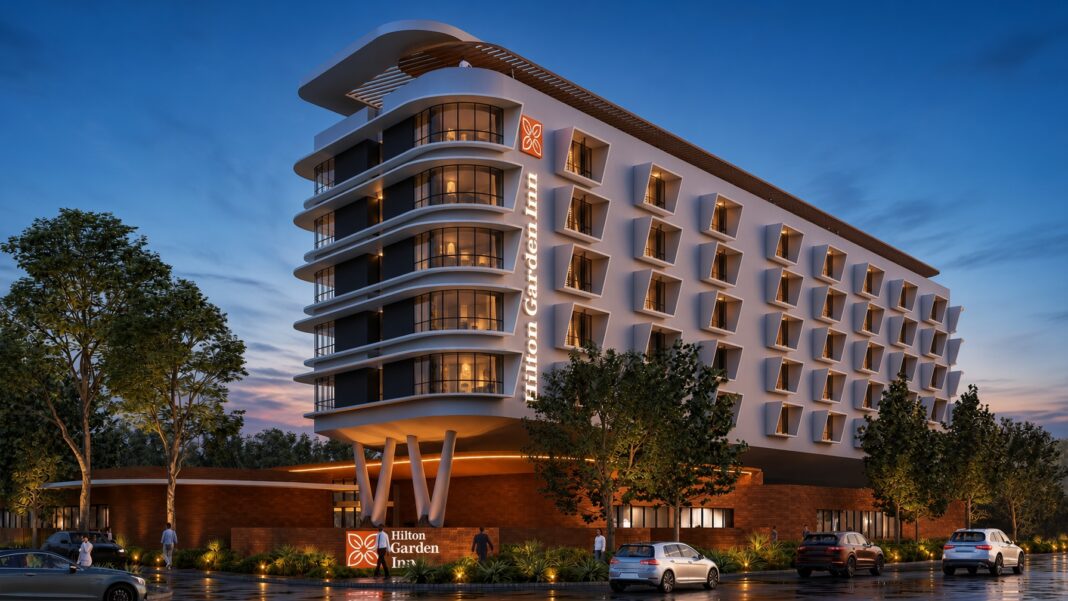
HARARE — Global hospitality group Hilton is set to make its first entry into Zimbabwe after signing an agreement with property developer Terrace Africa to establish a 140-room Hilton Garden Inn in Harare’s affluent Highlands district, signalling growing international confidence in the country’s hospitality and commercial property markets.
The hotel is expected to open in early 2029 as part of the Highlands Precinct, a large mixed-use development combining office space, retail, restaurants, residential accommodation and conferencing facilities.
The project was announced at ZimReal, Zimbabwe’s leading property investment forum, at a time when the country’s tourism industry is recording stronger activity and international visitor numbers continue to recover.
According to The Herald, Hilton’s entry will see the global hospitality group establish a presence in Zimbabwe for the first time, with the proposed hotel positioned to serve business travellers, tourists and regional visitors using Harare as a commercial and diplomatic hub.
The development is located within one of Harare’s established residential and diplomatic areas and is approximately 20 to 25 kilometres from Robert Gabriel Mugabe International Airport.
Global brand enters a recovering market
The Hilton Garden Inn will offer 140 rooms alongside an all-day restaurant, lobby café and bar, gymnasium, swimming pool and terrace, as well as meeting facilities.
Carlos Khneisser, Hilton’s Chief Development Officer for the Middle East and Africa, said Zimbabwe represented an increasingly attractive market within the group’s African expansion strategy.
“Entering Zimbabwe marks an important milestone in Hilton’s continued expansion across Africa and reflects our confidence in the country’s long-term hospitality potential,” Khneisser said, according to The Herald.
“With Harare serving as a key commercial, diplomatic and regional gateway, we see strong opportunity to bring Hilton Garden Inn to a market where demand from business and leisure travellers continues to grow.”
Analysts who spoke to The Zimbabwe Financial Mail said Hilton’s decision was significant because international hotel groups generally undertake extensive assessments of market demand, investment conditions, connectivity and long-term revenue prospects before committing to new properties.
“This is more than a hotel announcement. A global operator of Hilton’s scale attaching its brand to a Zimbabwean property project provides an important signal about how international investors are beginning to assess the country’s medium-term economic prospects,” one hospitality and property analyst told The Zimbabwe Financial Mail.
The analyst said the investment could also have a wider demonstration effect, particularly if Zimbabwe continues improving macroeconomic stability and restoring confidence among international investors.
Highlands Precinct gains global anchor
For Terrace Africa, the Hilton agreement provides an international anchor for the Highlands Precinct and strengthens its proposition as a mixed-use commercial destination.
Terrace Africa director Brett Abrahamse said the partnership was consistent with the developer’s ambition to build an integrated urban environment capable of serving Zimbabwe’s changing demographic and business requirements.
“Our Highlands Precinct has been designed to reflect Harare’s growth and evolving lifestyle needs,” Abrahamse said, according to The Herald.
“Partnering with Hilton to introduce its first hotel in Zimbabwe is a defining milestone for the precinct and reinforces our ambition to create high-quality, mixed-use environments that serve residents, businesses and visitors alike.”
The development comes as Harare’s property market increasingly shifts towards mixed-use projects that combine commercial, residential, hospitality and retail components rather than relying exclusively on traditional office developments.
Analysts said this model could become increasingly important as developers seek to diversify revenue streams and create destinations capable of generating activity throughout the day.
“Mixed-use developments are becoming increasingly attractive because they create an ecosystem rather than a standalone property,” another analyst told The Zimbabwe Financial Mail. “The presence of a globally recognised hotel brand can increase footfall, strengthen surrounding property values and make the entire precinct more attractive to corporate tenants and investors.”
Tourism growth strengthens investment case
The Hilton development comes against a backdrop of renewed growth in Zimbabwe’s tourism sector.
International arrivals exceeded 1.7 million in 2025, according to figures cited in the announcement, strengthening the case for additional quality accommodation as the country seeks to expand its tourism and business-travel infrastructure.
Harare is particularly important because it functions not only as Zimbabwe’s political capital but also as the country’s principal corporate, diplomatic and financial centre.
The city also serves as a gateway for regional business travel, conferences and government-related activity.
The proposed Hilton Garden Inn therefore has a customer base extending beyond conventional leisure tourism.
“The most important part of this investment is that Hilton is not necessarily betting exclusively on holiday tourism,” the first analyst said. “Harare has a substantial business, diplomatic and conference economy, and that provides a diversified demand base for a hotel of this nature.”
Hilton expands African footprint
Hilton’s Zimbabwean investment forms part of a broader expansion across Africa.
The group currently operates more than 70 hotels on the continent and has more than 100 additional properties in its development pipeline, with more than half of those projects located in Sub-Saharan Africa.
Its Hilton Garden Inn brand has more than 1,100 hotels across 65 countries and territories globally.
Analysts said the decision to introduce the brand into Zimbabwe could potentially improve the country’s positioning within international hospitality networks.
“The significance goes beyond the 140 rooms,” the second analyst said. “A global hotel operator brings international distribution channels, standards, reservation systems and a customer base that can help integrate Harare more closely into the international business and tourism economy.”
Property sector could benefit from renewed confidence
Terrace Africa, which was established in 2011, has delivered property projects worth more than US$230 million across Zimbabwe, Zambia, Mozambique and South Africa. The company is also the asset manager of Tigere REIT, which is listed on the Zimbabwe Stock Exchange.
The Hilton agreement consequently comes against a broader evolution of Zimbabwe’s property investment landscape, where developers are increasingly seeking institutional-quality assets and internationally recognised operating partners.
The investment could also provide a useful test of whether Zimbabwe’s improving macroeconomic environment can translate into greater foreign participation in long-term physical assets.
Zimbabwe has spent years grappling with currency instability, inflation, financing constraints and weak investor confidence. More recently, however, improved monetary conditions, stronger foreign-currency inflows and renewed investment activity have provided a more supportive backdrop for selected sectors.
For the property industry, analysts said the challenge will be converting that relative stability into sustained investment.
“International brands will not solve Zimbabwe’s structural investment challenges, but their presence can help change the perception of the market,” one analyst said. “If Hilton succeeds, it could encourage other international operators and institutional investors to examine opportunities that they previously considered too risky.”
The first Hilton hotel in Zimbabwe is therefore likely to be watched well beyond the hospitality sector. Its success could become an indicator of whether Harare is beginning to regain its position as an investable regional business and tourism destination, and whether Zimbabwe’s broader economic stabilisation is finally translating into long-term international capital commitments.