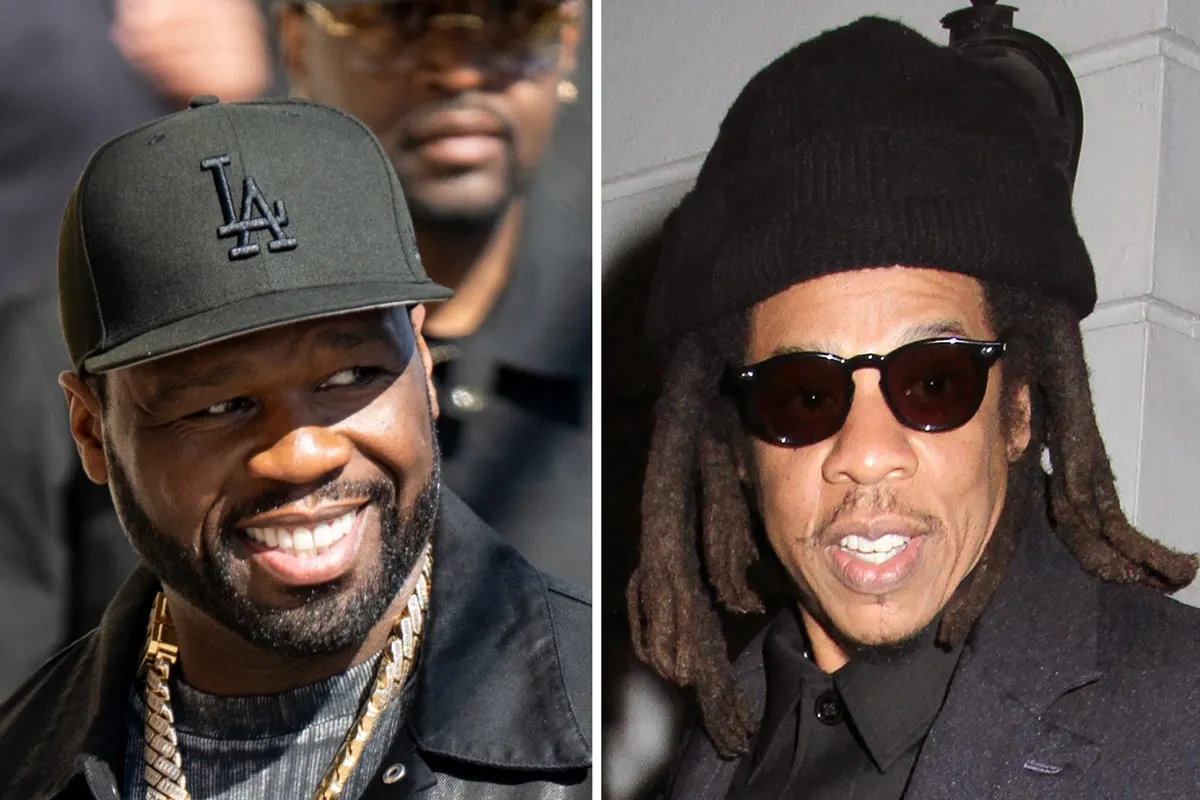
Rapper and entrepreneur Curtis “50 Cent” Jackson has acknowledged that Jay-Z adopted a more effective long-term business strategy in developing artists, conceding that the Roc Nation founder was “technically a better businessman.”
According to AllHipHop.com, Jackson made the remarks in an interview recorded in October 2025 with Brian J. Roberts that was previously unreleased and surfaced online this week. In the discussion, the Queens-born rapper reflected on the contrasting approaches he and Jay-Z took in building their respective music empires.
“Jay-Z was not on his artists’ singles until they were doing well enough to not need him on the singles,” Jackson said. “So that helps him. When you’re an older artist and you’re with a new artist, it makes you current and makes the new audience accept you.”
Jackson argued that the strategy allowed Jay-Z to maintain relevance while ensuring his artists established independent credibility before benefiting from his star power. He described the approach as firmly rooted in commercial calculation rather than personal loyalty.
“This would make him technically a better businessman because I beat myself up looking out for them,” Jackson said. “He’s positioning it as business and working with you when it’s good for business.”
By contrast, Jackson said his own approach with G-Unit artists such as Lloyd Banks, Tony Yayo and Young Buck was driven by personal allegiance. He frequently appeared on their early singles to accelerate their rise.
“I’m positioning it as they’re my people. I have to get them into the right space,” he said. “So I work them into a good space regardless.”
The strategy initially paid off. At the height of his success, Jackson was selling more than 13 million copies of Get Rich or Die Tryin’ and pushed for a G-Unit group album. However, he said record label executives preferred a solo follow-up, believing his individual momentum was too strong to divert.
“When you look at Young Buck getting these different records, I was on the singles to launch them properly,” Jackson said. “I didn’t have to be involved at all.”
Jackson acknowledged that his heavy involvement later became a source of tension within G-Unit, with some artists feeling their success was attributed more to his presence than to their own talent.
“I’ve had guys be angry with me because it felt like you made them a star,” he said. “And I’m like, what? They had talent — it was the timing that made it happen.”
The interview also touched on Sean “Diddy” Combs’ artist development model, which Jackson characterised as highly visible and hands-on.
“Diddy needed to be in the video. Diddy needed to be in everything,” he said. “He stayed next to the artist and kept warm and did what he had to do.”
While acknowledging that Combs effectively maximised his artists’ commercial potential, Jackson contrasted that style with Jay-Z’s more measured distance. The reflections mark a rare moment of self-assessment from Jackson, better known for his confrontational public persona.
As AllHipHop.com notes, the interview highlights Jackson’s evolution from chart-dominating rapper to seasoned executive, capable of analysing business decisions with the same precision he once reserved for lyrical rivalries.