

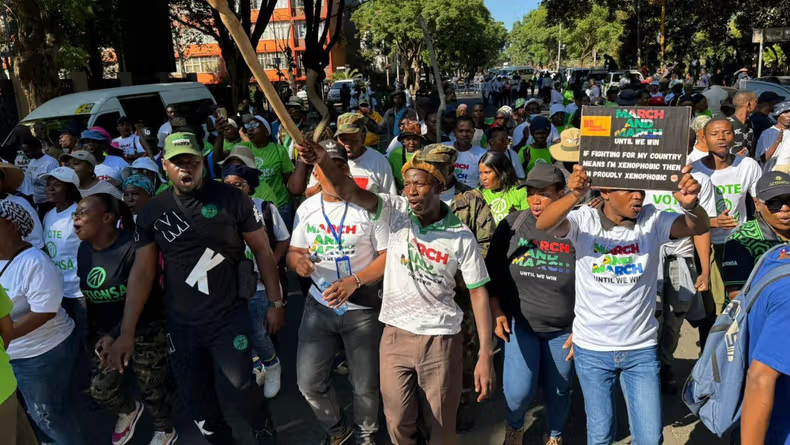
JOHANNESBURG – More than 120 civil society organisations, trade unions, faith-based groups and community movements have united in an unprecedented national campaign aimed at defusing escalating tensions surrounding immigration in South Africa, amid growing fears that anti-immigrant mobilisation could trigger social unrest and economic disruption.
The coalition’s intervention comes as pressure mounts ahead of a widely publicised June 30 ultimatum issued by anti-immigration activists demanding that undocumented foreign nationals leave the country. The campaign, which has gained significant traction on social media and in several urban centres, has heightened concerns among policymakers, business leaders and human rights groups about the potential impact on social cohesion and investor confidence.
According to reports cited by Business Insider Africa, the coalition is seeking to redirect public frustration away from migrants and towards what it describes as deeper structural problems, including unemployment, inequality, weak economic growth and persistent failures in public service delivery.
In a joint statement, the organisations rejected what they called the growing normalisation of xenophobia and vigilante-style immigration enforcement, warning that migrants are increasingly being blamed for problems rooted in long-standing economic and governance challenges.
The coalition argued that foreign nationals have become convenient scapegoats for broader frustrations arising from South Africa’s sluggish economy, which has struggled to generate sufficient jobs despite being the continent’s most industrialised nation.
The intervention comes against the backdrop of unemployment levels that remain among the highest in the world, particularly among young people, while economic growth continues to lag behind emerging market peers.
Several communities in KwaZulu-Natal, Gauteng and the Western Cape have reported heightened anxiety among migrant populations following the circulation of messages calling for undocumented foreigners to leave the country by the end of June.

Community organisations say some foreign nationals have already relocated from areas perceived to be vulnerable to possible unrest, while others have sought temporary accommodation through religious institutions and humanitarian groups.
The issue has also drawn political attention.
The opposition-led Democratic Alliance has called for urgent parliamentary intervention and requested a joint sitting of Parliament’s security cluster committees to address growing concerns surrounding public safety and the rule of law.
DA Chief Whip Advocate Glynnis Breytenbach warned that failure by authorities to respond decisively could create a vacuum in which non-state actors attempt to assume law enforcement functions.
Government officials have repeatedly stressed that immigration enforcement remains the responsibility of state institutions and cannot be delegated to private groups or vigilante movements.
Justice Minister Mamoloko Kubayi has stated that government operations targeting undocumented migration have been intensified across land, sea and air entry points. However, she also cautioned citizens against taking immigration enforcement into their own hands, emphasising that all actions must occur within the framework of the law.
The developments place the Government of National Unity in a delicate position. On one hand, public concerns over illegal immigration have become increasingly prominent in domestic political debates. On the other, South Africa’s post-apartheid foreign policy has historically been rooted in pan-African solidarity and regional integration.
Business leaders are also closely monitoring developments.
Economists warn that prolonged tensions could have implications beyond social stability, potentially affecting tourism, labour mobility, regional trade and investment flows. South Africa serves as a major gateway economy for the continent, attracting workers, entrepreneurs and investors from across Africa.
Any escalation in anti-immigrant sentiment could also complicate broader continental integration efforts under the African Continental Free Trade Area, which seeks to promote the freer movement of goods, services and investment across African borders.
Corporate executives have increasingly highlighted the importance of social stability in sustaining economic growth, particularly as South Africa seeks to attract investment, expand industrial production and address persistently high unemployment.
Analysts note that while immigration remains a politically sensitive issue, long-term solutions are likely to require stronger economic growth, job creation and more effective border management rather than confrontational approaches that risk deepening divisions within society.
As the June 30 deadline approaches, attention is now focused on how authorities, civil society groups and community leaders manage rising tensions in a country where economic hardship and migration have become increasingly intertwined in the national debate.