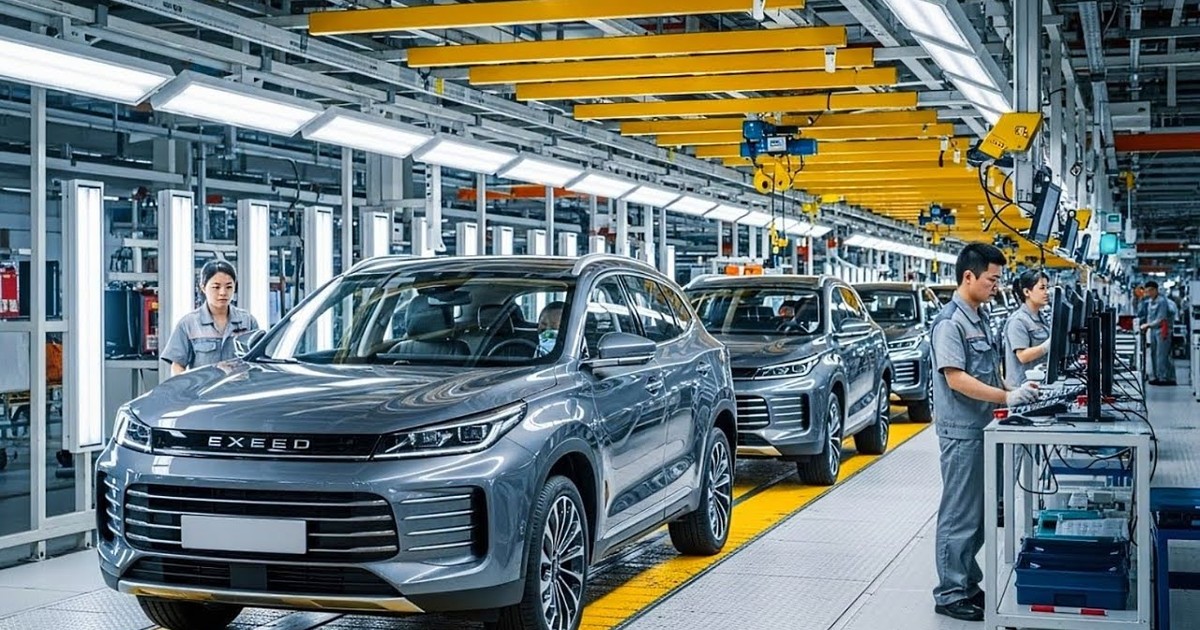
JOHANNESBURG — Chinese automotive manufacturer Chery is preparing to begin production of its Omoda C4 crossover in South Africa, transforming a former Nissan assembly plant into a manufacturing and export base as Chinese carmakers accelerate their expansion across Africa.
The investment marks a significant shift in Chery’s regional strategy, moving beyond vehicle imports and dealership expansion towards local manufacturing, component sourcing and potentially research and development.
According to a report published by Business Insider Africa on Thursday, Chery intends to manufacture the Omoda C4 at the former Nissan facility in Rosslyn, north of Pretoria, which it acquired in 2026.
The vehicle is expected to reach South African showrooms in 2027, with petrol, hybrid and fully electric variants planned.
The development comes as South Africa’s automotive industry faces growing competition from Chinese manufacturers whose combination of competitive pricing, advanced vehicle technology and expanding model ranges is challenging established European, Japanese and American brands.
From Nissan to Chery: A new chapter for Rosslyn
Chery’s decision to acquire an existing manufacturing facility rather than construct a factory from scratch could shorten its route to production while reducing some of the costs associated with establishing a new industrial operation.
Rosslyn has long been an important centre of South African vehicle manufacturing, supported by established logistics infrastructure, industrial suppliers and a skilled automotive workforce.
The former Nissan plant provides Chery with a manufacturing platform in a market where industrial capacity, supplier relationships and export infrastructure are critical to competitiveness.
The Chinese group expects production to begin ramping up during the second half of 2027.
Reuters, cited by Business Insider Africa, reported that Chery is targeting approximately 15,000 vehicles during the initial production phase in the third and fourth quarters of 2027, with longer-term annual output potentially reaching 50,000 units.
These targets remain dependent on successful factory preparations, market demand and the company’s ability to establish efficient production and supply arrangements.
The Omoda C4 is expected to be followed by additional models, potentially including vehicles from the Jetour brand and a Chery pickup.
For South Africa, the importance of the investment extends beyond the number of vehicles assembled. Its wider economic contribution will depend on how much manufacturing value is created locally rather than imported through semi-knocked-down or completely knocked-down vehicle kits.
A US$15.2 billion market with room for expansion
South Africa’s automotive market was valued at approximately US$15.2 billion in 2025, according to estimates from IMARC Group cited in the report.
The research firm projects that the market could reach US$23.7 billion by 2034, representing compound annual growth of about 4.93% between 2026 and 2034.
Those projections reflect expectations of expanding vehicle demand, technological change and continued investment in the automotive industry.
For Chery, local manufacturing could provide advantages over a business model dependent entirely on imports.
Vehicle producers operating inside a market can potentially reduce certain logistics costs, improve delivery times and respond more quickly to consumer demand.
Local production can also provide access to industrial incentives and regional trade opportunities, subject to applicable rules of origin and domestic-content requirements.
However, the economics of vehicle assembly depend heavily on production volumes.
Automotive manufacturing involves substantial fixed costs, including machinery, tooling, factory maintenance and workforce training. Higher output allows those costs to be spread across more vehicles, improving unit economics.
Chery’s longer-term production target of 50,000 vehicles annually would therefore be important in determining whether the Rosslyn operation becomes a competitive manufacturing centre rather than a relatively small assembly facility.
Local suppliers could be the biggest beneficiaries
One of the most consequential elements of Chery’s investment is its proposed localisation programme.
The company intends to increase the participation of South African suppliers in its manufacturing operations, potentially creating opportunities for producers of automotive components, electrical systems, plastics, seating, glass and other industrial inputs.
The distinction between vehicle assembly and a deeply integrated automotive manufacturing industry is economically significant.
A factory that imports most components may generate employment and some domestic value added, but its contribution to the wider industrial economy is more limited than an operation supported by an extensive local supplier network.
Greater localisation can strengthen industrial capabilities, create demand for smaller manufacturers and encourage technology transfer.
It can also reduce exposure to shipping disruptions and foreign exchange movements, although locally sourced components must remain competitive on cost and quality.
South Africa already possesses a substantial automotive supplier industry developed around manufacturers such as BMW, Mercedes-Benz, Toyota, Volkswagen and Ford.
Chery’s arrival could introduce additional demand into that network, while also increasing pressure on suppliers to meet the pricing and production standards associated with Chinese automotive manufacturing.
For local component manufacturers, winning supply contracts would be more economically significant than the nationality of the company operating the assembly line.
Electric vehicles change the competitive equation
The Omoda C4 is expected to be offered in conventional petrol, hybrid and fully electric versions.
This approach allows Chery to compete across different consumer segments rather than relying exclusively on electric vehicles in a market where charging infrastructure and affordability remain constraints.
The crossover is expected to feature advanced driver-assistance technology, an AI-enabled voice assistant and a 540-degree camera system.
These features illustrate the growing importance of software, electronics and digital interfaces in vehicle competition.
Chinese manufacturers have increasingly used technology-rich models and aggressive pricing strategies to challenge established brands in international markets.
Their expansion is also being driven by intense competition at home, where manufacturers are seeking overseas markets capable of absorbing additional production.
For South Africa, the arrival of more technologically advanced vehicles could accelerate consumer adoption of hybrid and electric powertrains.
Nevertheless, electric vehicle demand will depend on affordability, charging availability, electricity reliability and the overall cost of ownership.
Local assembly alone will not eliminate those barriers.
A strategic challenge for established manufacturers
Chery’s move raises important questions for traditional automotive manufacturers operating in South Africa.
For decades, the country’s automotive industry has relied heavily on multinational producers from Europe, Japan and the United States.
Chinese companies are now entering the market with increasingly competitive products and ambitions extending beyond retail sales.
A locally manufactured Chery vehicle could compete not only on purchase price but also on delivery availability, after-sales support and regional distribution.
Established manufacturers may respond through product improvements, pricing adjustments, increased localisation or new investment.
The consequences for consumers could be favourable if stronger competition leads to better-equipped vehicles at more accessible prices.
For the industry, however, increased competition can place pressure on margins, particularly where manufacturers face high operating costs and relatively modest domestic sales volumes.
The outcome will depend on whether South Africa can attract sufficient investment and export demand to support a larger, more diversified manufacturing base.
What the investment means for Southern Africa
Chery’s plans could also have implications for neighbouring markets, including Zimbabwe, Botswana, Zambia and Mozambique.
South Africa is already a major supplier of vehicles, automotive components and industrial goods to the wider region.
A successful Rosslyn operation could eventually improve the availability of Chinese-manufactured vehicles through established regional distribution channels.
Regional exports would depend on Chery’s commercial strategy, applicable trade arrangements and the competitiveness of locally assembled vehicles.
For Zimbabwe, where imported vehicles dominate the market, greater regional production could potentially influence vehicle sourcing and distribution costs.
However, there is no confirmed indication in the reported announcement that Chery has established a specific export allocation for Zimbabwe or other neighbouring countries.
The broader industrial lesson is that vehicle manufacturing increasingly depends on the integration of production capacity, technology, supplier networks and access to regional markets.
South Africa has an advantage in possessing an established automotive ecosystem, but sustaining that advantage will require reliable infrastructure, competitive operating costs and continued investment in skills.
China’s African automotive strategy enters a new phase
Chery’s acquisition of the former Nissan facility reflects a wider change in China’s commercial engagement with Africa.
Chinese automotive companies initially expanded across many African markets through imported vehicles and distribution agreements.
Manufacturing investments represent a deeper form of economic participation, requiring long-term commitments to factories, employees, suppliers and local regulatory systems.
Other Chinese manufacturers, including BYD and Great Wall Motor, are also pursuing international expansion as competition intensifies in their domestic market.
For African governments, these developments create opportunities to negotiate greater local content, skills development and industrial investment.
The challenge is to ensure that manufacturing projects contribute to domestic productive capacity rather than merely relocating the final stages of assembly.
Chery’s Rosslyn investment will therefore be judged by more than the success of the Omoda C4.
Its lasting significance will depend on production volumes, supplier localisation, employment creation and the ability to establish South Africa as a competitive export platform.
For now, the transformation of a former Nissan factory into a Chinese automotive production base illustrates how rapidly the balance of competition in Africa’s vehicle industry is changing.
The next test will come when the first locally assembled Omoda C4 vehicles begin rolling off the production line in 2027.