HARARE — When a private equity investor takes a company public, the conventional story is one of growth. A business has reached the point where it needs broader ownership, deeper capital and a stock exchange listing to finance its next stage of development. The founding investors realise some of their investment, the company receives fresh money, and new shareholders participate in its future.
By Munyaradzi Hoto | Business and Markets Analysis
Amalgamated Brands Limited’s proposed listing on the Victoria Falls Stock Exchange (VFEX) deserves closer examination because the economics of the transaction point to a different priority. This is principally a liquidity event for Takura Capital, the private equity firm behind the consumer goods group, rather than a substantial capital injection into its manufacturing operations.
There is nothing inherently improper about a private equity fund exiting through a stock exchange. Selling investments is central to the industry’s business model. Fund managers acquire businesses, restructure them, improve their performance and eventually realise value for their investors.
The more interesting question is whether the price, financial disclosures and ownership arrangements offer incoming shareholders a sufficiently attractive proposition.
Amalgamated Brands owns businesses associated with some of Zimbabwe’s familiar consumer brands, including Cairns Foods. Its products occupy an important position in the domestic food market, where established distribution networks, manufacturing capacity and brand recognition can provide meaningful competitive advantages.
But a good business and a good investment are not necessarily the same thing. The difference often lies in the price paid, the quality of earnings and the rights attached to ownership.
A public offering structured around the seller
The proposed US$20 million transaction illustrates that distinction.
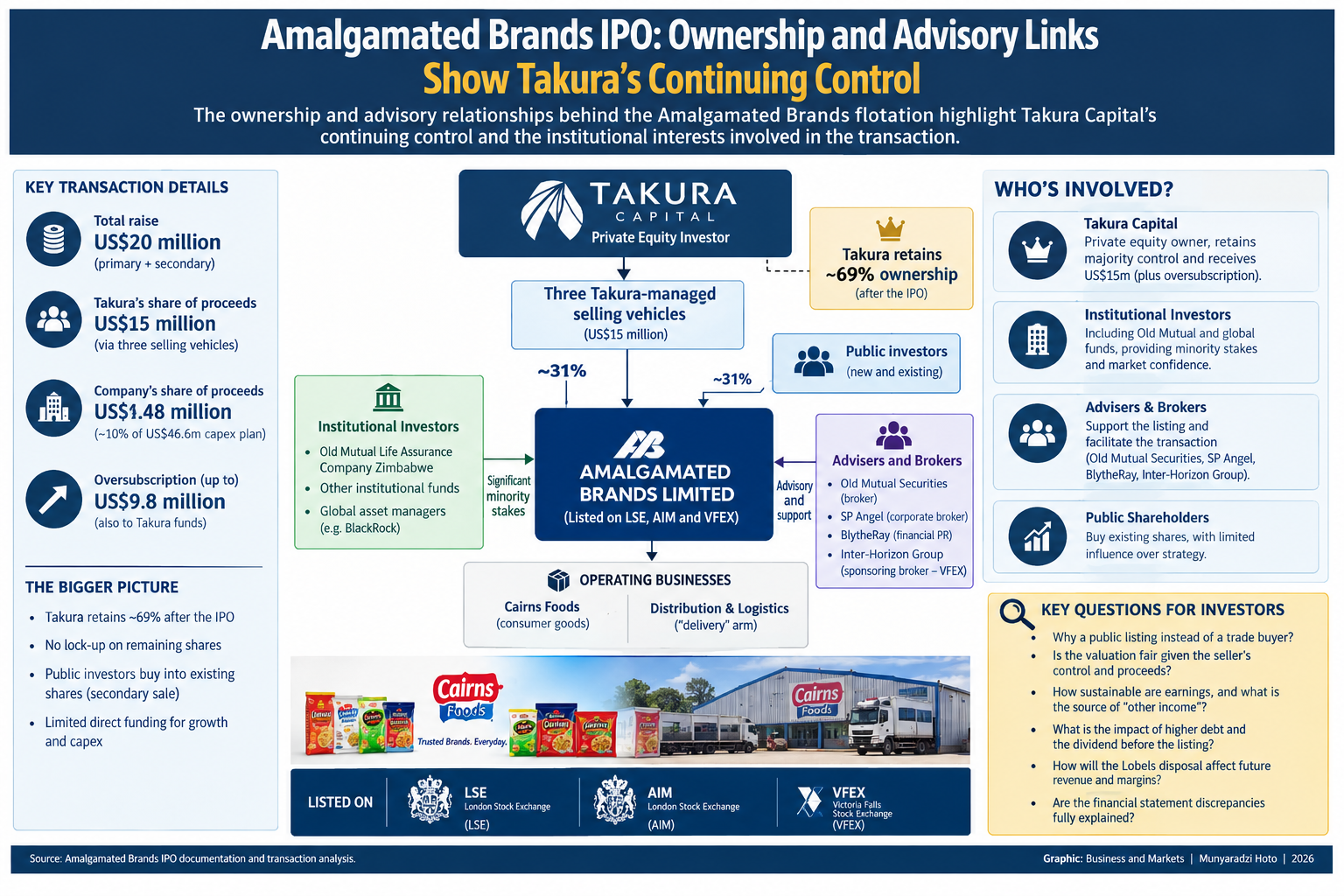
Of the base offering, approximately US$15 million is earmarked for three selling vehicles managed by Takura Capital. Amalgamated Brands itself is expected to receive about US$4.48 million in new capital.
An additional US$9.8 million could be raised through oversubscription, but those proceeds would also accrue to selling shareholders rather than the company.
That means the bulk of the money committed by investors will purchase existing shares. It will not directly finance new production lines, factories or working capital.
The distinction between a primary and secondary share offering is fundamental to equity valuation. In a primary issue, investors subscribe for newly created shares and their money strengthens the company’s balance sheet. In a secondary sale, investors purchase shares from existing owners, and the proceeds go to those sellers.
Amalgamated Brands combines both mechanisms, but the secondary component dominates.
The company has outlined a capital expenditure programme of approximately US$46.6 million. Its expected IPO proceeds would cover less than one-tenth of that amount.
The remaining investment requirement must therefore be financed through operating cash generation, borrowing, future capital raising or some combination of these sources.
This does not make the listing commercially unjustifiable. A company may pursue a listing to establish a market valuation, widen its shareholder base or create a platform for future fundraising.
It does, however, weaken any suggestion that the offering itself provides the financial resources required to execute the group’s entire investment programme.
For Takura, the immediate benefit is much clearer: it converts part of a relatively illiquid private investment into cash while retaining control of the underlying business.
The dividend that preceded the listing
The financial sequence before the proposed flotation raises further questions about the allocation of cash.
According to the figures presented in the transaction analysis, Amalgamated Brands generated just US$64,000 in net operating cash during the first six months of 2026.
Over the same period, the group borrowed approximately US$4.25 million and distributed a US$3.25 million dividend.
These are materially different orders of magnitude.
A company producing only a modest amount of operating cash while simultaneously increasing borrowings and making a substantial distribution to shareholders warrants closer scrutiny, particularly when those shareholders are preparing to sell part of their investment to the public.
It would be simplistic to conclude that the borrowing directly funded the dividend. Cash is fungible, and a proper assessment requires the full cash flow statement, opening balances, debt movements and working capital analysis.
Nevertheless, the economic effect is important. The business entered the listing process with a more leveraged balance sheet after a substantial cash distribution had been made to its existing owners.
A dividend is ordinarily a return on invested capital. In a mature, cash-generative business, it may reflect surplus funds that are not required for reinvestment.
In a business planning significant capital expenditure, however, the relationship between dividends, new borrowing and future financing needs becomes especially relevant.
Incoming shareholders are entitled to ask whether the distribution was consistent with the company’s investment requirements and whether the balance sheet presented in the offer documents adequately captures its more recent financial position.
The debt figure investors need to examine
The description of Amalgamated Brands as effectively ungeared requires particular care.
The company reportedly recorded net debt of approximately US$1.8 million at December 2025. By June 2026, the figure had increased to about US$5.1 million.
That is nearly three times the earlier amount.
Net debt measures financial borrowings less cash and cash equivalents, subject to the precise definition used in the financial statements. It is a useful indicator of financial leverage, although it should not be considered independently of profitability, cash generation, debt maturity and borrowing costs.
A business with US$5.1 million in net debt is not necessarily financially distressed. Indeed, that level may be manageable relative to sustainable earnings.
The concern is instead one of presentation and timing.
If investors are invited to assess the company’s financial strength primarily through its December balance sheet, while subsequent figures show a significant increase in indebtedness, the more recent position deserves equal prominence.
The issue becomes more consequential when the same period includes a substantial dividend and limited cash generation from operations.
Equity investors do not buy historical accounting profits alone. They buy a residual claim on future cash flows after creditors, suppliers, employees and tax authorities have been paid.
A credible valuation must therefore begin with the most relevant available balance sheet, not merely the most favourable historical snapshot.
The missing quarter in the growth narrative
Amalgamated Brands’ earnings record also requires careful interpretation.
The reported nine-month growth figures appear encouraging, but comparisons can be distorted when the underlying periods do not have consistent accounting treatment or when a weak intervening quarter receives limited attention.
Reconstructing the fourth quarter of 2025 from the audited full-year results and the preceding nine-month figures produces an EBITDA estimate of approximately US$1.07 million, equivalent to a margin of 5.3%.
The same calculation indicates an after-tax loss of roughly US$300,000 for that quarter. These figures matter because they provide context for the subsequent recovery in reported earnings.
A business that experiences a weak final quarter and then reports stronger growth in the following year may genuinely be improving. But investors need to understand whether the improvement reflects higher sales volumes, better pricing, improved manufacturing efficiency, changes in product mix or non-recurring accounting items.
According to the supplied analysis, EBITDA in the first half of 2026 increased by only 0.3%.
That suggests the stronger nine-month performance was concentrated in the third quarter rather than evenly distributed across the reporting period.
There is an important distinction between a sustained improvement in underlying profitability and a strong quarter that lifts the cumulative result.
The former may justify a higher earnings multiple. The latter requires evidence that the performance can be repeated.
The US$1 million item that changes the earnings picture
The third-quarter results reportedly included US$1.01 million of other income, more than five times the amount forecast by directors for the entire 2026 financial year.
Without a clear explanation of the source, classification and recurrence of that income, investors cannot determine how much weight to place on it when assessing sustainable profitability.
Other income is not automatically suspicious. It can arise from legitimate commercial transactions, insurance recoveries, foreign exchange movements, asset disposals, rental income or other accounting events.
But the distinction between recurring trading earnings and exceptional income is central to valuation.
If a company earns US$1 million from an activity that is unlikely to recur, capitalising that income at the same multiple as its ordinary manufacturing profits risks overstating the value of the business.
This is particularly important in consumer goods manufacturing, where operating margins depend on production efficiency, raw material costs, energy availability, distribution expenses and consumer purchasing power.
Investors need to know how much of the earnings improvement came from selling more goods profitably, rather than from income outside the core business.
The appropriate response is not to assume misconduct. It is to require a reconciliation that allows shareholders to distinguish operating performance from accounting effects.
The tax rate that makes profit growth look stronger
The divergence between profit before tax and profit after tax provides another important clue. Nine-month profit before tax reportedly increased by 9.8%, while profit after tax rose by 31.6%.
The difference is largely attributable to a lower effective tax rate, which fell from approximately 28.9% to 14.9%. The company’s projections reportedly anticipate a return to a 25.75% tax rate from 2027.
This has significant implications for valuation.
Profit after tax is the earnings measure most commonly used in calculating a price-to-earnings ratio. A temporarily lower tax charge can therefore make a company’s shares appear cheaper, or its earnings growth stronger, than would be the case under a normalised tax rate.
For example, a company generating US$10 million in profit before tax would retain US$8.51 million after tax at a 14.9% effective rate. At 25.75%, the same pre-tax profit would produce US$7.425 million.
Nothing about the underlying trading business would have changed, yet reported earnings attributable to shareholders would be approximately 13% lower.
That is why sophisticated investors often normalise tax expenses before comparing companies or assigning valuation multiples.
If Amalgamated Brands is being offered at approximately 13.5 times its previous annual profit, the earnings base underlying that multiple deserves close attention.
The central question is whether the valuation reflects the group’s sustainable capacity to generate profits after a normal tax charge, rather than a particularly favourable reporting period.
A public company, but not necessarily public control
The ownership arrangements are equally significant.
The transaction analysis identifies three Takura-managed selling vehicles, with the private equity group expected to retain approximately 69% of Amalgamated Brands following the listing.
This would leave Takura with a controlling position.
Control is not inherently undesirable. A dominant shareholder may provide strategic continuity, managerial discipline and a long-term investment horizon.
But minority investors must understand the practical limits of their influence.
With a holding of that size, Takura would ordinarily be capable of determining the outcome of resolutions decided by a simple majority, assuming the shares carry equivalent voting rights and the relevant legal requirements are met.
Certain major corporate decisions may require higher voting thresholds, but the balance of power would remain firmly in the controlling shareholder’s favour.
The accompanying ownership diagram also indicates that no lock-up arrangement applies to Takura’s remaining shares after the listing.
A lock-up restricts existing shareholders from selling their holdings for a specified period. Such arrangements are common in public offerings because they provide some assurance that major shareholders will not immediately increase the supply of shares available for sale.
Without a lock-up, the possibility of further disposals becomes an additional consideration for investors.
This does not establish that Takura intends to sell its remaining holding immediately. It means the contractual restriction that might prevent such a disposal is absent.
In a relatively illiquid market, that distinction matters.
A substantial future sale by a controlling shareholder could place pressure on the share price if demand is insufficient to absorb the stock.
Why a stock exchange rather than a trade buyer?
Private equity firms typically have several exit routes. They can sell a business to an industry competitor, another financial investor, management or the investing public.
Each route involves different trade-offs.
A strategic buyer may pay a premium for manufacturing capacity, established brands, distribution networks or cost savings achievable through integration.
But a trade sale also involves concentrated negotiations, extensive due diligence, warranties, indemnities and often complex questions about future management and control.
A public offering distributes ownership among multiple investors and establishes a market price through the offer process.
It may also allow the seller to retain a substantial interest while realising part of its investment.
The suggestion that public investors necessarily pay more and ask fewer questions is too broad to be accepted as a universal rule. Institutional investors can be demanding, and securities regulation imposes disclosure obligations that do not necessarily arise in a private transaction.
Nevertheless, the structure of this offering creates an obvious analytical question: why is Takura choosing a partial public-market exit rather than selling control to an industrial buyer?
The answer may be entirely commercial. The fund could consider the company undervalued by prospective strategic purchasers, wish to preserve its exposure to future growth or prefer a staged exit.
But incoming shareholders should evaluate whether the offering price adequately compensates them for the financial and governance risks they assume.
The Lobels disposal and a continuing commercial dependency
The disposal of Lobels introduces another layer of complexity. The bakery business was reportedly sold in May 2026 after accounting for approximately 63% of the former group’s revenue.
That is not a peripheral transaction. It represents a fundamental change in the composition of the business whose shares are being offered to the public.
Investors valuing the post-disposal group must therefore distinguish the historical financial performance of the former business from the earnings capacity of the assets that remain.
The consideration received for the Lobels disposal has not been identified in the supplied analysis.
That information is material to understanding the transaction’s effect on cash, debt, shareholder distributions and the group’s financial restructuring.
More importantly, selling a business does not necessarily eliminate the commercial relationship with it.
Lobels reportedly accounts for 18.5% of sales by the remaining listed business and approximately 70.5% of the revenue generated by its delivery subsidiary.
The relevant commercial arrangement is understood to expire in 2027. These figures point to customer concentration risk.
If a substantial portion of a subsidiary’s revenue depends on a single customer, the renewal, pricing and termination provisions of the contract become important to future earnings.
The risk is not that Lobels will necessarily stop purchasing goods or services. It is that investors need to understand what happens if the commercial terms change, volumes decline or the agreement is not renewed.
The same issue applies to the valuation of the distribution business. A revenue stream that depends heavily on one contractual relationship may deserve a different risk assessment from a diversified portfolio of customers.
Old Mutual’s multiple positions deserve transparency
The transaction’s network of investors and advisers is another area where disclosure matters.
The ownership chart identifies Old Mutual Life Assurance Company Zimbabwe among the institutional investors in Takura’s funds. It also lists Old Mutual Securities among the brokers involved in the offering.
This creates an apparent overlap between an institution with exposure to the selling investment vehicles and a group company participating in the distribution of the shares.
Such arrangements are not automatically improper. Large financial groups frequently operate investment management, insurance, securities brokerage and advisory businesses under separate governance and regulatory structures.
However, the relationships should be sufficiently transparent for investors to understand potential conflicts and the measures used to manage them.
The central questions concern the economic interests involved, the independence of advice and the disclosure of any fees or incentives connected with the transaction.
The diagram also identifies Gaylord Tadafadzwa Nyamayi, a partner at Takura Capital, as a non-executive director of Amalgamated Brands and a related group company.
His involvement illustrates the continuing relationship between the private equity sponsor and the listed business.
Such representation can support continuity, but minority shareholders should be clear about the distinction between the interests of the company and those of its controlling investor.
The unresolved financial reconciliations
Perhaps the most consequential issues are the reported inconsistencies in the interim financial information.
The supplied analysis identifies six figures in the first-half 2026 accounts that do not reconcile as expected, including differences involving borrowings, payables, receivables and equity, with several discrepancies exceeding US$2 million.
It also identifies approximately US$1.67 million in preference shares whose subsequent treatment is not explained in the material provided. Accounting discrepancies can have legitimate explanations.
Differences may arise from consolidation adjustments, reclassifications, discontinued operations, changes in reporting boundaries, timing or the distinction between company-level and group-level accounts.
It would be irresponsible to infer wrongdoing without examining the underlying statements, notes and reconciliation schedules. But the size of the reported differences means they cannot simply be dismissed as immaterial presentation issues.
Investors should be able to trace changes in borrowings, working capital and shareholders’ equity across reporting periods. They should also understand how preference shares were redeemed, converted, reclassified or otherwise treated.
These are not obscure accounting concerns. They determine the financial claims ranking ahead of ordinary shareholders and the resources available to support the business.
Before assigning a valuation to the company, investors need financial statements that can be reconciled consistently.
A credible business is not automatically an attractive IPO
Amalgamated Brands operates in an industry with genuine commercial opportunities.
Zimbabwe imports a substantial range of processed foods, and domestic manufacturers with recognised brands and established distribution networks have potential to capture market share through product development, improved capacity and better supply-chain execution.
A successful expansion could strengthen local manufacturing, support employment and reduce dependence on imported consumer goods.
The VFEX also stands to benefit from attracting companies outside its traditional concentration in mining and resource-related businesses.
A sizeable consumer goods listing could broaden the exchange’s sector representation and give investors access to businesses driven more directly by household spending.
Those are legitimate arguments in favour of the flotation.
But the capital market’s role is not merely to provide an exit route for existing shareholders. It is to allocate savings towards investments offering an appropriate return for the risks assumed.
In this transaction, the seller receives most of the proceeds, retains control and faces no disclosed lock-up restriction. The company receives a comparatively modest sum relative to its investment plans.
Meanwhile, the available figures raise questions about operating cash conversion, increased borrowing, the timing of shareholder distributions, the sustainability of reported earnings, the effective tax rate, customer concentration and financial statement reconciliations.
None of these matters, considered individually, establishes that the offer is unsuitable or that the company is improperly managed. Taken together, however, they justify a demanding standard of disclosure and valuation.
For Takura Capital, the flotation offers a commercially attractive route to partial realisation while preserving exposure to future gains. For investors, the calculation is different.
They must decide whether the offer price sufficiently reflects the company’s underlying cash-generating capacity, the risks embedded in its financial structure and the limited influence available to minority shareholders.
The ultimate test of the Amalgamated Brands IPO is not whether Takura can sell its shares successfully.
It is whether those buying them will earn an adequate return after the seller has taken its money off the table.
Munyaradzi Hoto | Business and Markets Analyst

Munyaradzi Hoto writes on Zimbabwe’s business environment, financial markets, corporate governance and investment trends. His analysis focuses on company valuations, financial performance, capital raising, private equity and the relationship between corporate strategy and shareholder interests.
He brings a critical, evidence-based perspective to developments on the Zimbabwe Stock Exchange and Victoria Falls Stock Exchange, examining their implications for investors and the wider economy. This article is based on Amalgamated Brands transaction figures and offer terms.
Editorial Disclaimer
The Zimbabwe Mail | Amalgamated Brands IPO Analysis
The analysis of the Amalgamated Brands Limited initial public offering, written by Munyaradzi Hoto and with additional contributions from our insights team, is an independent examination of the transaction’s financial structure, shareholder arrangements, valuation and associated investment risks.
The article draws on publicly disclosed transaction information, financial figures and the author’s interpretation of the proposed listing. Questions raised concerning financial reconciliations, earnings quality, related-party relationships and corporate governance are matters for scrutiny and clarification. They should not be construed as allegations or findings of fraud, misconduct or regulatory non-compliance by Amalgamated Brands, Takura Capital, their directors, investors or advisers.
The views and conclusions expressed are those of the author and do not constitute investment advice or a recommendation to buy, sell or hold any securities. Financial information and projections may be subject to revision, and readers should consult the official prospectus, audited financial statements, subsequent disclosures and appropriately qualified financial advisers before making investment decisions.
The Zimbabwe Mail remains committed to accuracy, fairness and responsible financial journalism. Amalgamated Brands, Takura Capital and other parties mentioned in the analysis are welcome to submit factual corrections, clarifications or a right of reply for editorial consideration.