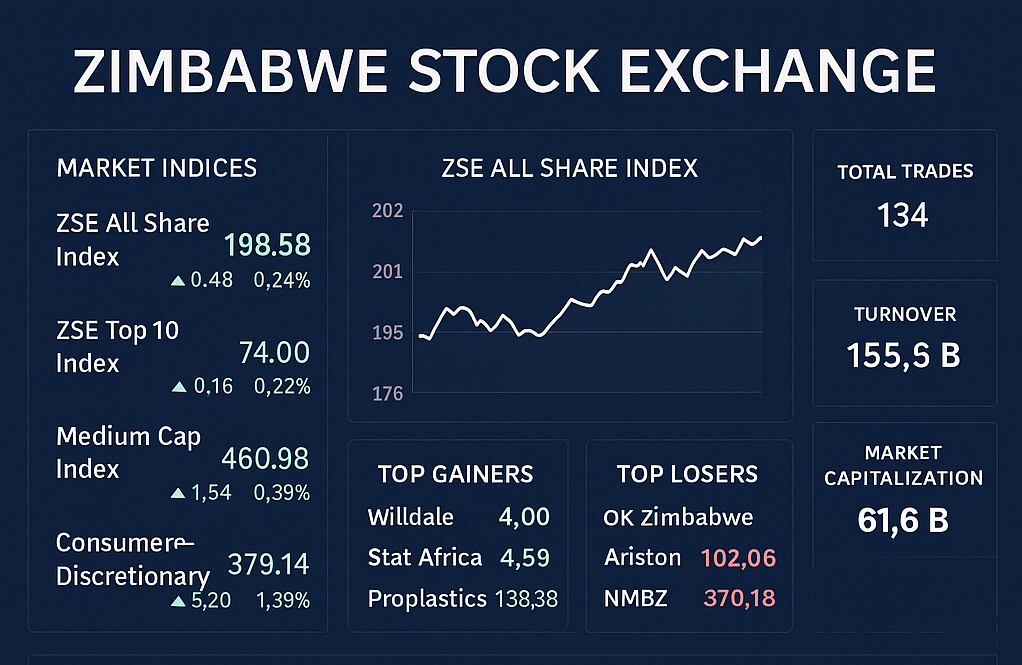
HARARE — Zimbabwean equities opened the week on a weaker footing, with the Zimbabwe Stock Exchange’s All Share Index falling 1.31% on Monday as investors appeared to take a cautious stance amid thin trading and sharp losses in selected counters.
The All Share Index closed at 453.00 points, while the ZSE Top 10 Index declined 1.41% to 450.13 points. The Top 15 Index fell 1.20% to 462.45 points, while the Mid Cap Index eased 0.89% to 495.37 points.
The Small Cap Index was unchanged at 100.11 points.
Market activity was subdued, with just 67 trades recorded during the session. Turnover amounted to ZWG7.46 million, significantly below the levels seen during more active trading sessions, while total market capitalisation stood at ZWG101.15 billion.
Analysts who spoke to The Zimbabwe Financial Mail said the decline should be viewed alongside the relatively low level of trading activity, arguing that Monday’s market performance reflected a combination of selective selling, limited liquidity and investor caution rather than a wholesale exit from equities.
“The headline decline is significant, but the relatively low turnover tells us that this was not necessarily a broad-based liquidation,” one equities analyst told The Zimbabwe Financial Mail. “Liquidity remains one of the defining characteristics of the Zimbabwean market, and relatively small transactions can produce substantial movements in individual counters.”
Sharp divergence among counters
The session was characterised by considerable divergence between gainers and losers.
Seed Co International was the strongest performer, rising 7.53% to 450 cents. Turnall Holdings gained 2.92% to 35.05 cents, while Standard Chartered Bank Zimbabwe increased 1.28% to 5.02 cents.
Zimbabwe Reinsurance Company edged 0.30% higher to 70 cents, while FBC Holdings rose 0.17% to 1,343.40 cents.
The biggest losses were concentrated among a handful of counters. Tanganda fell 14.77% to 352 cents, while Rainbow Tourism Group plunged 13.92% to 142.03 cents.
Delta Corporation declined 1.75% to 2,790.79 cents, Willdale lost 1.70% to 7.02 cents and Mashonaland Holdings eased 0.89% to 167 cents.
The sharp fall in Rainbow Tourism Group was reflected in the sectoral indices, with the Consumer Discretionary Index dropping 13.92%.
“The market is increasingly becoming stock-specific,” a second analyst told The Zimbabwe Financial Mail. “Investors are differentiating between companies according to their earnings prospects, currency exposure and corporate developments rather than moving uniformly into or out of equities.”
Financial stocks provide some support
Financial counters were among the more resilient areas of the market, with the Financials Index rising 0.15% to 536.67 points.
The performance provided a modest counterweight to declines across several other sectors and reflects continued investor interest in companies positioned to benefit from Zimbabwe’s evolving monetary and financial environment.
The broader economy remains in a period of transition, with businesses adapting to the Zimbabwe Gold currency framework while continuing to manage foreign-currency requirements and changing financing conditions.
Analysts said banks and other financial institutions could remain relatively well positioned if monetary stability continues to improve and credit activity gradually recovers.
“Financials are one of the sectors investors will continue watching closely because monetary stability, interest rates and credit growth have a direct bearing on earnings,” the second analyst said.
Agriculture and consumer stocks retreat
The ZSE Agriculture Index fell 1.68%, while the Consumer Staples Index declined 1.63%. The Modified Consumer Staples Index was down 1.40%.
The weakness comes against a difficult operating environment for businesses exposed to household consumption, where consumers remain sensitive to price increases and income constraints despite improvements in macroeconomic stability.
Zimbabwean companies are also navigating a market where pricing, procurement and working-capital decisions increasingly depend on the availability of foreign currency.
Analysts said this makes companies with strong balance sheets, diversified revenue streams and the ability to generate foreign-currency earnings particularly attractive.
“Corporate performance remains closely tied to the quality of a company’s cash flows,” the first analyst said. “In Zimbabwe, investors are looking beyond reported nominal growth and asking how much of that growth is actually translating into real earnings and shareholder value.”
Mining remains unchanged
The Mining Index was flat at 169.11 points, suggesting little movement among the country’s listed mining counters.
The sector remains strategically important to Zimbabwe’s economy, with mining continuing to generate substantial export earnings and foreign-currency inflows.
However, analysts said commodity exposure alone was no longer sufficient to guarantee strong share-price performance.
“The mining story remains compelling from a macroeconomic perspective, but investors still have to assess individual companies on production volumes, commodity prices, capital expenditure and cash generation,” one analyst said.
REITs offer a more defensive picture
Zimbabwe’s listed real estate investment trusts presented a somewhat more stable picture.
Revitus REIT remained unchanged at 213.25 cents, with market capitalisation of approximately ZWG785.5 million. Tigere REIT, however, rose 1.22% to 104.77 cents and had a market capitalisation of about ZWG1.9 billion.
The performance of Tigere provided one of the few positive signals from the property segment as investors continued to assess real assets as a potential hedge against monetary and inflationary risks.
The Real Estate Index was broadly flat, declining just 0.03% to 692.37 points.
Analysts said property-linked investments could continue attracting attention as investors seek assets capable of generating rental income and preserving value.
ETFs remain stable
Exchange-traded funds were unchanged during the session, with CSAG at 13.50 cents, DMCS at 8.50 cents, MCMS at 170 cents and MIZ at 12 cents.
The ZSE ETF Index consequently remained unchanged at 597.97 points.
The stability of ETFs contrasted with the volatility seen in individual equities and highlights the increasingly diverse range of instruments available to Zimbabwean investors.
Corporate developments in focus
The market was also digesting a series of corporate announcements issued in the days around the opening of the trading week.
Seed Co International published board changes and AGM results on Monday, while PPC disclosed director dealings on September 4. NMB Holdings issued a dividend notice and Hippo Valley Estates published an AGM notice.
Analysts said such corporate developments could become increasingly important in determining individual share performance as investors place greater emphasis on corporate governance, capital allocation and shareholder returns.
“The market is becoming more sensitive to corporate actions,” one analyst said. “Dividend announcements, board changes, director dealings and strategic decisions can all influence sentiment, particularly when liquidity is low.”
Macro stability versus market weakness
Monday’s decline comes despite signs that Zimbabwe’s broader macroeconomic environment has become more stable compared with the severe monetary disruptions experienced in previous years.
Inflation has moderated, monetary conditions have begun easing and foreign-currency receipts remain an important source of support for economic activity.
The Reserve Bank of Zimbabwe has also reduced its policy rate from 35% to 30%, potentially creating more favourable conditions for businesses and borrowers if the easing cycle is sustained.
However, analysts cautioned that macroeconomic stability does not automatically translate into immediate gains on the stock market.
“Improved macroeconomic stability is necessary, but it is not sufficient,” the second analyst told The Zimbabwe Financial Mail. “Ultimately, investors want to see stronger corporate earnings, improved liquidity and greater confidence that businesses can convert economic stability into sustainable returns.”
For the ZSE, the immediate challenge remains deepening liquidity and broadening participation. Monday’s 67 trades and ZWG7.46 million turnover underline the relatively thin nature of the market, even as listed companies continue to provide an important avenue for domestic capital formation.
The week’s opening session therefore leaves investors with a mixed picture: financial stocks and selected counters showed resilience, while sharp declines in Tanganda and Rainbow Tourism Group weighed heavily on the broader market.
With Zimbabwe’s economic environment continuing to evolve, analysts expect stock selection, rather than broad market exposure, to remain central to investment strategies in the weeks ahead.