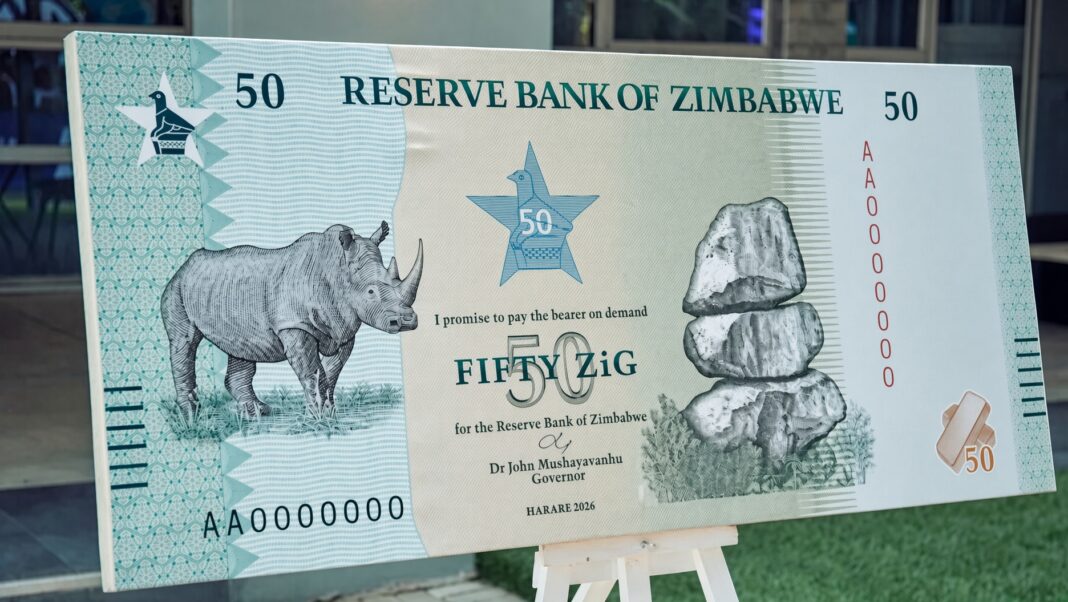
HARARE — Zimbabwe’s Reserve Bank is using its ZiG Denominated Term Deposit Facility (ZiGDTDF) to begin constructing the financial-market infrastructure required to make the Zimbabwe Gold a functioning domestic currency, moving monetary reform beyond exchange-rate management towards market-based liquidity and interest-rate formation, according to analysts speaking to The Zimbabwe Financial Mail.
The latest ZiGDTDF tender, with results released on Thursday, September 9, is significant because the facility is not simply another savings product. It gives the Reserve Bank of Zimbabwe a market instrument through which ZiG liquidity can be absorbed from the financial system while providing investors with a short-dated, interest-bearing domestic asset.
The 30-day facility carries an annual interest rate of 8% and is available to financial institutions, corporates, individuals, pension and insurance funds and deposit-taking microfinance institutions. Its prescribed-asset and liquid-asset characteristics, together with its eligibility as collateral for central-bank accommodation, increase its relevance to banks and institutional investors.
The significance is that Zimbabwe is beginning to create an investable domestic asset denominated in ZiG around which short-term liquidity can be priced.
An academic specialising in monetary economics told The Zimbabwe Financial Mail that the development should be viewed as part of a broader attempt to rebuild the transmission mechanism of monetary policy.
“A currency becomes economically meaningful when it supports a financial system in which liquidity has a price, savings earn a return and credit can be intermediated through domestic financial institutions. The ZiGDTDF is potentially an important building block in that architecture.”
From currency stabilisation to market development
Zimbabwe’s currency reforms have historically been dominated by the exchange rate, inflation and the availability of foreign currency. The next stage is more demanding: creating the domestic financial markets that allow the local currency to intermediate savings and investment.
The ZiGDTDF gives the RBZ a mechanism to withdraw ZiG liquidity from circulation for a defined period rather than relying solely on administrative measures.
For banks, this creates a new short-term instrument for treasury and liquidity management. For corporates, it potentially provides an alternative to holding excess working capital in cash or immediately converting it into foreign currency. For pension funds and insurers, it introduces another domestic asset capable of generating a return.
A senior banking executive said the significance for commercial banks lies in the potential emergence of a domestic benchmark for short-term funding.
“The banking system needs a credible risk-free or near-risk-free reference point from which ZiG deposit and lending rates can eventually be priced. Without that reference structure, monetary policy has a much weaker transmission mechanism.”
That distinction is important. The objective is not simply to persuade businesses and households to hold ZiG. It is to create financial reasons for them to save, invest and transact in ZiG.
The beginning of a ZiG yield curve
The 30-day maturity provides an initial reference point for the short end of what could eventually become a broader ZiG yield curve.
If the facility is developed alongside other market instruments with different maturities, investors will begin to observe how the price of ZiG liquidity changes over time.
That would allow banks to improve pricing of deposits, loans and treasury assets, while giving institutional investors a framework for allocating domestic-currency portfolios.
A university economist said the development of a yield curve would be one of the most important tests of whether Zimbabwe’s currency reform is becoming institutional rather than administrative.
“The ultimate objective should not be a collection of RBZ instruments. It should be a functioning market in which the price of money emerges from interaction between monetary policy, liquidity conditions, inflation expectations and credit demand.”
That would represent a significant change from a financial system in which the US dollar has historically provided the dominant store of value, unit of account and pricing benchmark.
Why banks matter
The banking system will be central to whether the ZiG money market develops beyond the central bank’s own balance sheet.
Commercial banks need instruments through which they can manage daily liquidity, meet regulatory requirements and deploy temporary surpluses. A deeper interbank market could eventually allow banks with excess ZiG liquidity to lend to institutions facing temporary shortages, creating a more efficient allocation of liquidity.
The ZiGDTDF can therefore provide an alternative destination for surplus liquidity while establishing a monetary-policy transmission channel between the RBZ and commercial banks.
A banking-sector executive told The Zimbabwe Financial Mail: “The critical issue is liquidity management. Banks cannot build a sophisticated domestic-currency lending market if there are no reliable instruments for managing their own liquidity. The development of ZiG money-market assets is therefore as important to banking reform as the currency itself.”
Business needs investable ZiG assets
The implications extend beyond banks.
Zimbabwean businesses routinely hold cash for payroll, procurement, tax obligations, inventories and other working-capital requirements. In a shallow domestic money market, those balances can remain unproductive or be shifted into foreign currency as a hedge against monetary risk.
A credible short-term ZiG market changes that calculation.
A corporate treasurer said the attraction would ultimately depend on whether ZiG instruments provide predictable returns, liquidity and confidence in the value of the currency.
“Companies will hold ZiG because it makes commercial sense, not because they are instructed to do so. If businesses can earn a competitive return on surplus liquidity while retaining predictable access to funds, you begin changing the economics of dollarisation.”
That is a crucial distinction for Zimbabwe’s currency reforms. Administrative measures can create demand for a currency temporarily; financial markets create sustained demand by giving economic agents useful assets denominated in that currency.
Monetary policy becomes more market-based
The ZiGDTDF also gives the RBZ a more conventional monetary-policy tool.
When liquidity is excessive, the central bank can absorb funds through the facility. When monetary conditions tighten, the broader framework can potentially work alongside other instruments to influence liquidity and funding conditions.
That creates a stronger link between the central bank’s policy stance and the rates faced by banks and businesses.
An economist said this is essential if Zimbabwe wants monetary policy to influence economic activity through conventional channels.
“The transmission mechanism has to run from the RBZ to money-market rates, from money-market rates to bank funding costs, and from funding costs to household and corporate decisions. That chain has historically been distorted by dollarisation and shallow financial markets.”
From the money market to capital formation
The larger opportunity is what happens after a functioning short-term money market is established.
A credible ZiG money market can become the foundation for a broader domestic capital market encompassing government securities, corporate debt, investment funds, pension assets and eventually longer-duration infrastructure and development finance.
For Zimbabwe, that would connect currency reform directly to capital formation.
Business leaders have argued that domestic savings need to be mobilised more efficiently if the country is to finance infrastructure, manufacturing, agriculture, housing and other productive investment without excessive dependence on external capital.
A business executive told The Zimbabwe Financial Mail: “The endgame cannot be simply stabilising the exchange rate. The endgame is mobilisation of domestic savings into productive investment. The money market is the first layer of that financial architecture.”
That makes the ZiGDTDF strategically important. It is potentially the first link between currency reform, banking liquidity, domestic savings and investment.
The test is whether a market emerges
The immediate success of the facility should therefore not be measured solely by the amount subscribed in individual tenders.
The more important question is whether repeated issuance creates a reliable market in which participants begin to form expectations about ZiG interest rates, liquidity and risk.
That will require consistent issuance, transparent pricing, credible monetary policy, reliable settlement infrastructure and eventually secondary-market activity.
The objective should be to move from a central-bank facility to an ecosystem in which banks, pension funds, insurers, corporates and investment managers actively trade and manage ZiG-denominated instruments.
An academic familiar with financial-market development said: “The real achievement would be when the ZiGDTDF ceases to be viewed as simply an RBZ product and becomes part of a broader market infrastructure. At that point, Zimbabwe will have begun rebuilding the domestic monetary system rather than merely introducing another currency.”
For the ZiG, that is the critical transition.
Currency reform creates the unit of account. Money-market reform creates a price for liquidity. Capital-market reform ultimately determines how effectively savings can be converted into investment.
The September 9 ZiGDTDF tender is therefore an early but potentially important step in building the financial architecture around which Zimbabwe’s new currency can develop into a genuine domestic monetary and investment system.