
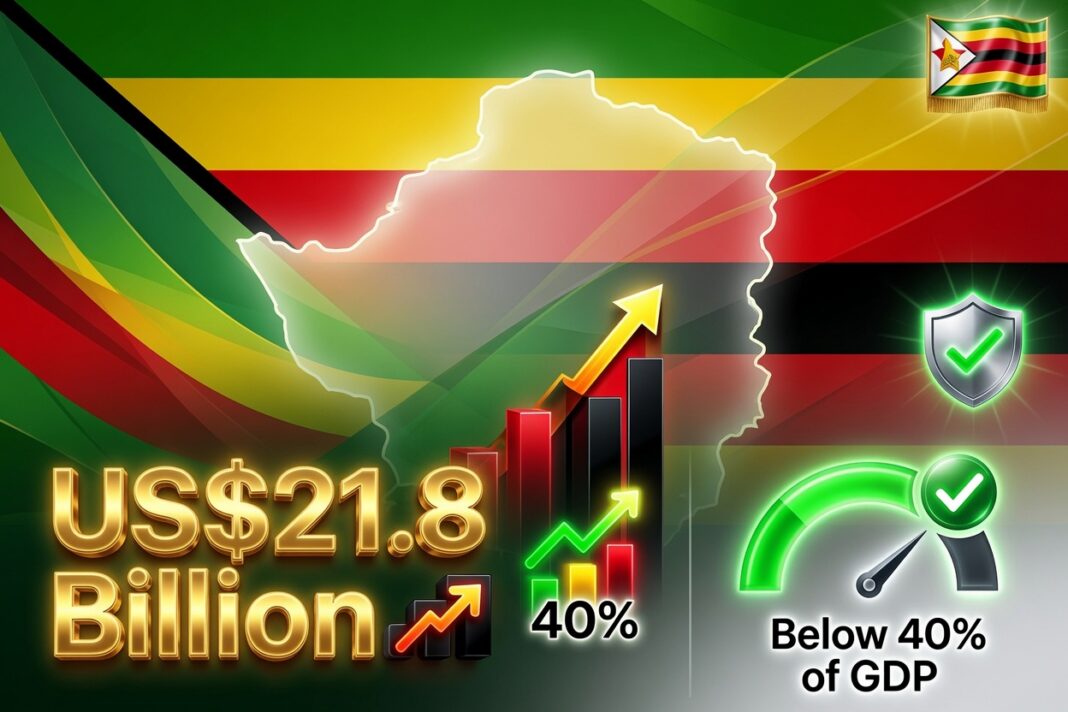
HARARE – Zimbabwe’s total public and publicly guaranteed debt increased modestly to US$21.8 billion at the end of 2025, equivalent to 37.4% of Gross Domestic Product (GDP), remaining comfortably below internationally recognised debt sustainability thresholds and well within the country’s fiscal borrowing limits.
The latest debt figures released in the Mid-Term Budget Review show total public debt rose by 1.4% from US$21.5 billion in 2024, reflecting a cautious borrowing strategy as the government balances infrastructure financing needs with fiscal consolidation.
The debt portfolio remains almost evenly split between external and domestic obligations. External debt stood at US$11.8 billion, accounting for 53.9% of total debt, while domestic debt amounted to US$10.1 billion, representing 46.1%.
Despite the relatively moderate debt-to-GDP ratio, the figures continue to highlight one of Zimbabwe’s biggest economic challenges: the overwhelming burden of external arrears.
External Arrears Continue to Constrain Economic Recovery
Of Zimbabwe’s US$11.8 billion external debt, approximately US$8.1 billion—or 69.3%—consists of arrears, accumulated over more than two decades of limited access to international capital markets.
The bilateral debt stock totals US$6.5 billion, including US$4.2 billion owed to Paris Club creditors and US$2.3 billion to non-Paris Club lenders.
Multilateral institutions remain significant creditors, with Zimbabwe owing approximately US$1.6 billion to the World Bank, US$759 million to the African Development Bank (AfDB), US$758 million to the Trade and Development Bank (TDB) and US$1.2 billion to Afreximbank, among other lenders.
Although Government serviced US$307.5 million in external debt during 2025, the size of accumulated arrears continues to restrict Zimbabwe’s access to concessional financing from international financial institutions.
Economists have long argued that resolving Zimbabwe’s external debt overhang is critical to unlocking long-term economic growth.
Former World Bank Chief Economist Carmen Reinhart, whose research has focused extensively on sovereign debt crises, has argued that countries burdened by prolonged debt arrears often experience what she describes as a “debt overhang,” where uncertainty over unresolved liabilities discourages investment and constrains growth by limiting access to affordable external finance.
Debt Ratio Compares Favourably with Regional Peers
While Zimbabwe’s debt burden remains sizeable in absolute terms, the debt-to-GDP ratio of 37.4% compares favourably with many emerging and developing economies.
The figure remains well below the 60% benchmark commonly used by multilateral institutions as a broad indicator of debt sustainability for developing countries.
It also remains significantly below Zimbabwe’s own statutory borrowing framework.
Government borrowing during 2025 amounted to only 1.5% of GDP, considerably lower than the 5.75% ceiling established under the Public Debt Management Act.
“This demonstrates a commitment to fiscal discipline,” said John Maynard Keynes’ intellectual successors in modern macroeconomic policy debates, who argue that public borrowing is not inherently problematic if it finances productive investment and remains sustainable relative to economic output. The critical issue, economists note, is not the size of debt alone but whether borrowed resources generate sufficient economic returns to support future repayment.
Domestic Borrowing Reflects Greater Confidence in Local Capital Markets
The Government raised US$246 million in new domestic financing during 2025 from local financial institutions including Ecobank Zimbabwe, CBZ Bank and Stanbic Bank.
Economists view the increasing use of domestic financial markets as a positive development, provided borrowing does not crowd out private sector credit.
“When governments rely excessively on domestic banks, private firms may find it more difficult or more expensive to access credit,” explains economist Richard Portes, Professor of Economics at London Business School, whose work on sovereign debt and financial markets has highlighted the importance of balancing public borrowing with private sector financing needs.
Zimbabwe’s relatively modest level of domestic borrowing, however, suggests that this risk remains contained for now.
Power Sector Remains a Major Fiscal Risk
The Government also issued a US$210 million guarantee to the Zimbabwe Electricity Transmission and Distribution Company (ZETDC) to facilitate electricity imports and meet related obligations.
Although the outstanding guarantee exposure had fallen to US$102.3 million by year-end, economists caution that contingent liabilities associated with state-owned enterprises remain one of the country’s hidden fiscal vulnerabilities.
Energy shortages continue to impose substantial costs on Zimbabwe’s productive sectors.
Manufacturers, miners and commercial farmers have repeatedly cited unreliable electricity supplies as one of the biggest constraints to investment and competitiveness.
Supporting electricity imports therefore carries immediate fiscal costs but may also prevent much larger losses in industrial output and export earnings.
Transparency Gains Strengthen Investor Confidence
Perhaps the most encouraging aspect of the latest debt report is Zimbabwe’s continued progress in strengthening debt governance.
According to the World Bank’s debt management assessment framework, Zimbabwe reduced the number of “red-rated” areas in public debt management from four in 2020 to just one in 2025.
Improved debt transparency represents an important milestone in rebuilding credibility with international investors and development finance institutions.
The Institute of International Finance (IIF) has consistently argued that transparent public debt reporting lowers sovereign risk premiums because investors can more accurately assess fiscal sustainability and repayment capacity.
For Zimbabwe, improving debt disclosure may prove almost as important as reducing debt itself.
Debt Is Not Zimbabwe’s Biggest Economic Problem
While public debt often dominates headlines, several economists argue that Zimbabwe’s greater challenge lies not in the size of its debt stock but in the country’s limited access to long-term, affordable capital.
Former IMF Chief Economist Olivier Blanchard has argued that debt sustainability should be assessed in relation to economic growth, borrowing costs and a country’s ability to generate future income, rather than through arbitrary numerical thresholds alone.
By international standards, Zimbabwe’s debt-to-GDP ratio remains moderate.
The more pressing issue is that the large stock of external arrears effectively locks the country out of concessional lending from institutions such as the World Bank and African Development Bank. As a result, Zimbabwe is often forced to rely on more expensive commercial borrowing or domestic financing, increasing the cost of funding infrastructure and development projects.
Debt Resolution Could Unlock Investment
Economists broadly agree that successfully concluding Zimbabwe’s Structured Dialogue Platform with international creditors would transform the country’s financing prospects.
Resolving arrears would restore access to cheaper multilateral financing, lower sovereign borrowing costs, improve the country’s creditworthiness and encourage greater foreign direct investment.
It would also reduce financing costs for local businesses, improve liquidity within the banking sector and support infrastructure investment in transport, power generation, water systems and digital connectivity.
A Positive Fiscal Story, But Structural Challenges Remain
Overall, Zimbabwe’s latest public debt figures tell a more balanced story than headline numbers alone suggest.
The Government has maintained borrowing well below statutory limits, kept the debt-to-GDP ratio below 40%, expanded domestic financing cautiously and made measurable progress in strengthening debt transparency.
However, the persistence of US$8.1 billion in external arrears remains the defining constraint on the country’s economic prospects. Until those arrears are resolved, Zimbabwe will continue to face higher borrowing costs, limited access to concessional finance and slower investment inflows.
For investors, the latest figures offer cautious optimism. Fiscal discipline appears to be strengthening, but the next phase of Zimbabwe’s economic recovery will depend less on managing existing debt and more on restoring normal financial relations with international creditors, deepening structural reforms and mobilising long-term investment to drive sustainable economic growth.