

Zimbabwe’s business environment has, for years, been shaped by extreme volatility in inflation, currency instability, and shifting monetary policy frameworks. Many firms operating in Harare, Bulawayo, and across the formal and informal sectors have had to develop survival instincts rather than long-term pricing discipline. In such an environment, pricing became reactive, often indexed to daily exchange rate movements, fuel costs, and imported input prices.
By Brighton Musonza
However, as inflationary pressures begin to ease in relative terms and the economy enters a more disinflationary phase—particularly under tighter monetary policy coordination and greater stability in certain USD-linked transactions—many businesses are facing a new and less familiar challenge. The temptation is to relax pricing discipline, assume stability will persist, and revert to simplistic pricing models. That would be a strategic mistake.
Disinflation does not mean stability. It often masks underlying cost pressures, fragmented demand recovery, and persistent currency duality that continues to distort real pricing power.
Why Disinflation is Not a Return to Normal
In theory, falling inflation should ease pressure on businesses. Input costs stabilise, consumer purchasing power improves, and planning becomes more predictable. In practice, Zimbabwe’s situation is more complex. The coexistence of USD pricing in formal retail, ZIG or ZWL-linked transactions in selected segments, and informal market pricing creates a multi-layered pricing ecosystem.
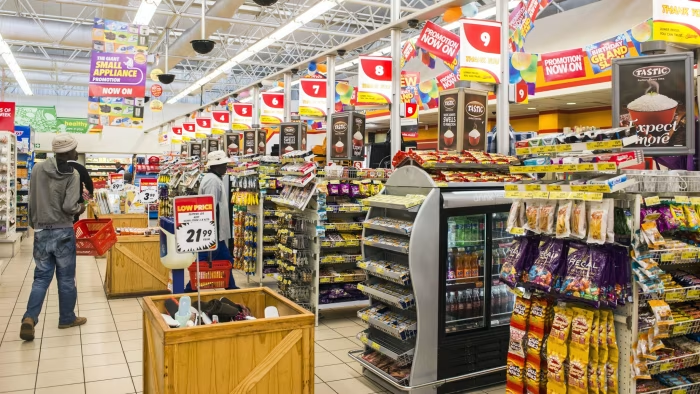
For example, a supermarket chain such as OK Zimbabwe may price basic commodities in USD while still navigating local currency obligations such as wages, utilities, and certain regulatory fees. At the same time, informal traders in Mbare or markets in Bulawayo operate with far more flexible, real-time pricing based on daily exchange rate expectations rather than formal inflation indices.
This dual structure means that disinflation does not simplify pricing—it redistributes pricing power unevenly across sectors.
The Silent Margin Squeeze in a Cooling Inflation Environment
One of the most overlooked risks in a disinflationary economy is the erosion of margins. During high inflation periods, firms typically increase prices aggressively, sometimes ahead of cost increases, to preserve margins. When inflation slows, customers become more resistant to further price increases, even if input costs remain structurally high.
In Zimbabwe, this is particularly visible in manufacturing and retail. A company like Delta Corporation, operating in beverages, faces relatively stable demand but must still absorb fluctuations in packaging imports, energy costs, and logistics expenses. Passing these costs through becomes more difficult when consumers perceive inflation as “under control”, even if business input costs remain elevated in USD terms.
Similarly, telecommunications players such as Econet Wireless Zimbabwe operate in a market where consumers are highly price-sensitive, yet network expansion, dollar-denominated equipment imports, and energy backup costs remain sticky. This creates a structural squeeze: revenues stabilise while cost bases do not fall at the same pace.
Regional and Sectoral Fragmentation of Demand
Zimbabwe’s demand environment is not uniform. Urban formal markets behave differently from rural and informal economies, and export-oriented firms operate under entirely different pricing logic.
Export-linked agriculture, for instance, often benefits from USD revenues, providing a natural hedge. Tobacco growers and exporters may experience relatively stable pricing power through global markets. In contrast, local consumer goods producers selling into a soft domestic demand environment face intense pressure to balance affordability with profitability.
In retail, this fragmentation is even more visible. High-income consumers in Borrowdale or Avondale may prioritise quality and brand consistency, while mass-market consumers in high-density suburbs such as Kuwadzana or Mkoba are far more responsive to small price changes. A single national price strategy therefore becomes increasingly ineffective.
The End of One-Size-Fits-All Pricing
One of the biggest strategic shifts required in Zimbabwe’s disinflationary phase is the move away from blanket pricing strategies. During inflationary peaks, many firms adopted uniform price increases across product lines to simplify execution and protect margins quickly. That approach is no longer sustainable.
Businesses now need to understand pricing at a granular level. This means segmenting customers not only by income level but by currency preference, payment behaviour, and consumption frequency. For example, a mobile money user transacting in small daily values behaves very differently from a corporate client paying in bulk USD invoices.
A furniture manufacturer in Harare selling both locally and into the region must adopt different pricing logic for domestic buyers paying in instalments versus export buyers purchasing in bulk. Treating these as a single pricing pool leads to either lost volume or margin leakage.
Value-Based Pricing as a Competitive Advantage
As inflation slows, the ability to justify price differences becomes more important than the ability to simply raise prices. Businesses that succeed in Zimbabwe’s next pricing cycle will be those that clearly articulate value rather than relying on cost-plus logic.
Consider the agricultural inputs sector. A fertiliser distributor that can demonstrate yield improvement per hectare, improved drought resistance, or higher crop output per input unit can command stronger pricing power than competitors simply adjusting prices based on import cost fluctuations.
Similarly, logistics companies that can prove faster delivery times, reduced breakage, or fuel efficiency gains can justify premium pricing even in a cautious market. Value, not cost, becomes the anchor of pricing power.
Revenue Management Beyond Price Adjustments
Effective pricing in disinflation is no longer just about setting a price point. It requires integrated revenue management across discounts, promotions, product mix, and customer negotiation strategies.
In Zimbabwe’s retail sector, for example, promotional activity often replaces formal price reduction strategies. However, poorly structured promotions can erode long-term profitability without increasing sustainable demand. A supermarket offering frequent discounts on staple goods may attract short-term volume but weaken brand positioning and margin recovery potential.
In B2B sectors such as construction materials, pricing negotiations are often fragmented, with different customers receiving different informal discount structures. Without a centralised revenue management approach, companies risk margin leakage that is difficult to trace.
The Role of Data and Pricing Discipline
One of the structural weaknesses in many Zimbabwean firms is the lack of real-time pricing intelligence. Pricing decisions are often made reactively, based on competitor observation or input cost changes, rather than predictive analytics.
However, even basic data discipline can transform outcomes. Tracking customer purchase frequency, price sensitivity across products, and response to promotions allows businesses to identify where pricing power truly exists.
A cement distributor, for example, may discover that large contractors are far less price-sensitive than individual builders purchasing small volumes. This insight allows for differentiated pricing strategies that protect margins while maintaining competitiveness.
Execution Speed in a Fast-Changing Economy
Even in disinflation, Zimbabwe remains a fast-moving economic environment. Currency shifts, policy announcements, fuel price adjustments, and supply chain disruptions can quickly alter cost structures.
This requires pricing systems that are flexible rather than rigid. Monthly or quarterly pricing reviews are becoming more relevant than annual adjustments, particularly for import-dependent businesses.
Companies that delay pricing updates risk either losing margin recovery opportunities or pricing themselves out of the market when conditions shift unexpectedly.
Conclusion: Pricing as a Strategic Capability
The shift from inflationary pressure to disinflation does not reduce the importance of pricing strategy—it increases it. In Zimbabwe’s complex, multi-currency, and structurally fragmented economy, pricing is no longer a financial adjustment exercise. It is a strategic capability that determines competitiveness, resilience, and long-term survival.
Businesses that treat disinflation as a return to simplicity will likely lose ground. Those that use this period to build sharper segmentation, stronger value articulation, and more disciplined revenue management systems will be better positioned for the next cycle of volatility, which in Zimbabwe is never far away.
Brighton Musonza (University of Leeds Business School, UK: BSc Business Management and Bradford School of Management, UK: MBA ). He is a Fellow of the Chartered Management Institute (FCMI), (Wharton University Business School, US: Business Analytics), IIBA Certified Business Analyst (CCBA) and SAP S/4 HANA ERP Technologies Consultant. He can be found at mmusonza@aol.com.