

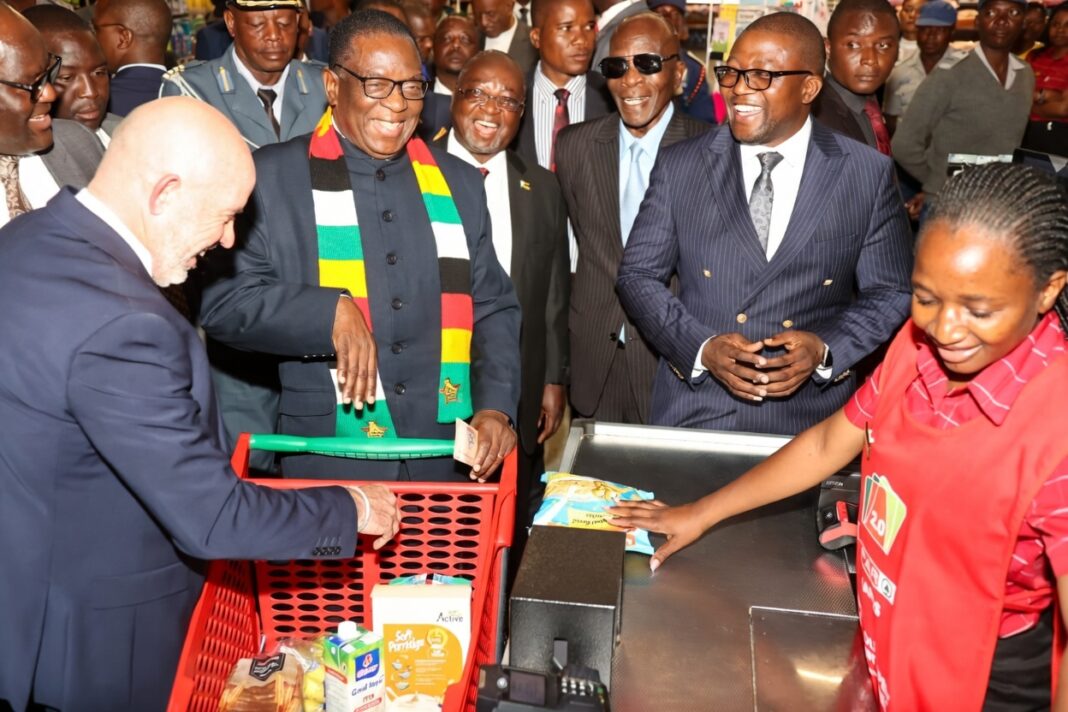
HARARE – President Emmerson Mnangagwa on Friday toured and officially commissioned the Greenfields Retail Centre in Belvedere, Harare, using the occasion to call for the expedited completion of a comprehensive Wholesale and Retail Sector Policy aimed at consolidating gains in Zimbabwe’s evolving commercial landscape.
During the tour, the President explored the facility—described as a modern, integrated shopping and community hub—engaging with tenants and gaining first-hand insight into its operational structure and infrastructure. He later unveiled a commemorative plaque at the on-site SPAR outlet, formally marking the centre’s entry into Zimbabwe’s structured retail ecosystem.
In his keynote address, Mnangagwa directed the Ministry of Industry and Commerce to accelerate the development of an inclusive and coherent sector policy, positioning it as a critical tool for sustaining growth, enhancing competitiveness, and aligning the retail industry with national development priorities.
“To sustain the progress in this sector, the Ministry of Industry and Commerce is directed to complete the Wholesale and Retail Sector Policy. I exhort business leaders, entrepreneurs and consumers alike to participate in the stakeholder consultations,” he said.
The commissioning of the Greenfields Retail Centre represents a significant milestone under Zimbabwe’s National Development Strategy 2 (NDS2), which prioritises private sector-led growth, industrialisation, and the formalisation of economic activity. Strategically located near the Zimbabwe Agricultural Show grounds, the development forms part of a broader effort to modernise urban retail infrastructure while re-integrating fragmented informal trade into formal, regulated systems.
The retail complex features a diverse tenant mix, including formal retail outlets, fast-food franchises, banking institutions, and mobile service providers. This integrated model is expected to improve consumer convenience, enhance service delivery, and stimulate localised economic activity within Harare’s western suburbs.
From a macroeconomic perspective, such developments are increasingly viewed as instruments of formalisation, with the potential to broaden the tax base, improve transaction traceability, and strengthen linkages between retail and domestic manufacturing. The President underscored this linkage, urging retailers to prioritise locally produced goods as part of a wider push towards economic sovereignty.
“My Government is intensifying our economic sovereignty. Under NDS2, our goal entails that malls should not be full of imported goods, but with quality ‘Made in Zimbabwe’ products, reflective of our nation’s industrial capacity,” Mnangagwa said.
This policy emphasis reflects growing concern over import dependency and the need to stimulate domestic value chains. By anchoring retail growth in local production, authorities aim to create a reinforcing cycle of demand, industrial expansion, and employment generation.
The President further commended the retail sector as a key driver of employment, investment, and wealth creation, particularly in an economy characterised by high levels of informality.
“The retail sector is applauded for being a reliable source of employment, wealth creation and investment. Developments such as this should inspire entrepreneurs to create jobs, stimulate demand for local manufacturing, and provide platforms for formalised business activity,” he said.
The Greenfields Retail Centre itself is a product of a public-private partnership between the Zimbabwe Agricultural Society and a consortium of private investors, reflecting a growing reliance on private capital to drive commercial real estate development in Zimbabwe. This model aligns with government efforts to leverage private sector efficiency and investment capacity amid constrained fiscal space.
However, analysts caution that while such developments signal progress, their long-term impact will depend on broader macroeconomic stability, including exchange rate alignment, inflation control, and policy consistency. Without these foundational conditions, formal retail centres risk operating alongside—rather than displacing—the entrenched informal sector.
Crucially, Zimbabwe’s path towards a more structured and formalised economy will require the revitalisation of the wholesale sector as a cornerstone of rebuilding the domestic supply chain infrastructure. A functional wholesale layer is essential for linking producers to retailers, improving distribution efficiency, stabilising prices, and restoring scale within formal trade channels.
Yet this structural renewal cannot occur in isolation. It must be supported by a well-functioning domestic financial system capable of extending adequate short-term working capital. Without access to affordable and reliable trade finance—particularly for inventory financing, supplier credit, and cash-flow management—wholesalers will remain constrained, limiting the effectiveness of broader formalisation efforts.
In this regard, the challenge extends beyond sectoral reform to one of systemic alignment between finance, trade, and production. Only through such coordination can Zimbabwe rebuild a resilient, efficient, and formalised domestic supply chain ecosystem.
The commissioning of the Greenfields Retail Centre therefore underscores not only progress in commercial infrastructure, but also the scale of reform required to reposition Zimbabwe’s economy within a more stable, rules-based, and investment-driven framework.