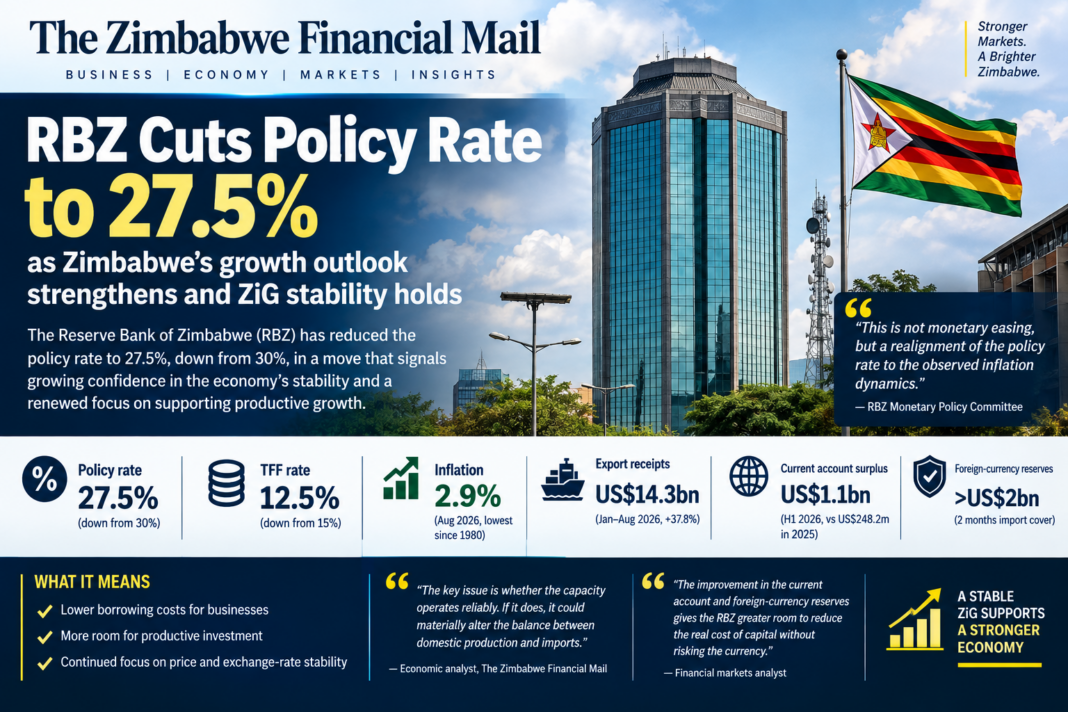
HARARE — The Reserve Bank of Zimbabwe (RBZ) has cut its benchmark policy rate to 27.5%, marking another step towards monetary-policy normalisation as falling inflation, stronger foreign-currency reserves and an improving external position give policymakers greater room to support economic activity.
The Monetary Policy Committee (MPC), meeting on 28 September 2026, reduced the Bank policy rate from 30% with immediate effect. The move represents a cumulative 7.5 percentage-point reduction since June 2026, signalling a gradual shift away from the exceptionally tight monetary conditions that followed Zimbabwe’s previous episodes of currency and price instability.
The central bank simultaneously cut the interest rate on its Targeted Finance Facility (TFF) from 15% to 12.5%, while keeping the statutory reserve requirements at 30% for demand deposits and 15% for savings and time deposits.
The MPC said the reductions reflected the country’s “continued benign inflation environment” and the need to support the economy’s growth prospects, while stressing that the policy-rate reduction should not be interpreted as a broad monetary loosening.
RBZ seeks lower borrowing costs without reopening inflation risks
An economist who spoke to The Zimbabwe Financial Mail said the decision represented a delicate balancing act for the central bank.
“This is not the RBZ abandoning monetary discipline. It is a recalibration made possible by a materially different inflation and foreign-exchange environment. The central bank now has more room to reduce the real cost of capital without immediately destabilising the currency.”
That distinction is important for Zimbabwean businesses, which have operated for years with extremely high nominal interest rates and limited access to affordable local-currency financing.
Lower policy rates could gradually reduce the cost of working-capital finance and investment loans, particularly for companies able to borrow in ZiG. However, the transmission into actual commercial lending rates will depend on banks’ funding costs, risk assessments and liquidity conditions.
The MPC explicitly said the reduction “does not signal monetary easing, but a realignment of the policy rate to the observed inflation dynamics”, while maintaining that future adjustments would depend on monetary and financial conditions.
ZiG inflation remains firmly contained
The policy adjustment follows a significant improvement in Zimbabwe’s inflation environment.
According to the RBZ, annual ZiG inflation declined to 2.9% in August 2026, its lowest level since 1980, before rising moderately to 3.7% in September. The increase reflected higher international oil prices and escalating conflict in the Middle East.
The central bank said inflation expectations remained well anchored, with annual average inflation expected to remain at about 4% for the January-to-September period and annual inflation projected to remain in single digits, below 7%, by the end of 2026.
A second analyst told The Zimbabwe Financial Mail that the inflation data were central to understanding why the RBZ could begin reducing rates without abandoning its credibility.
“The key change is that Zimbabwe is no longer cutting rates from a position of uncontrolled inflation. The RBZ is responding to a period in which inflation expectations have become considerably better anchored. That gives monetary policy a more conventional transmission mechanism.”
For businesses, that stability is potentially as important as the nominal reduction in borrowing costs.
Predictable inflation improves the ability of companies to prepare budgets, price contracts, manage inventories and make investment decisions.
Economy remains on course for 5% growth
The MPC maintained its expectation that Zimbabwe’s economy will grow by approximately 5% in 2026, supported particularly by agriculture and mining.
The central bank said growth had been underpinned by stronger agricultural performance, robust mining activity and improved economic resilience.
It also reported that export earnings had increased, driven particularly by mining and diaspora remittances. Export receipts rose by 37.8% to US$14.3 billion during January-August 2026, compared with US$10.3 billion during the corresponding period in 2025.
The current account has also strengthened sharply.
Preliminary data showed a US$1.1 billion surplus in the first half of 2026, compared with US$248.2 million during the corresponding period of 2025. The RBZ expects the full-year current-account surplus to increase from US$2.1 billion in 2025 to US$3.5 billion in 2026.
An analyst said the external position was becoming an important pillar of Zimbabwe’s monetary stability.
“The improvement in the current account changes the policy environment. Zimbabwe is generating more foreign exchange through exports and remittances, while stronger reserves provide the central bank with greater capacity to manage exchange-rate pressures.”
Foreign-currency reserves exceed US$2 billion
The RBZ said foreign-currency reserves backing the ZiG had exceeded US$2 billion in September, equivalent to approximately two months of import cover.
Improved foreign-currency reserves have also increased liquidity in the interbank foreign-exchange market, helping to support exchange-rate stability within the ZiG25–27 per US$1 range, according to the central bank.
That development is particularly significant for Zimbabwean businesses.
Exchange-rate volatility has historically been one of the biggest sources of uncertainty for companies importing machinery, raw materials and other inputs. A more stable exchange rate can reduce the need for aggressive precautionary pricing and improve the predictability of import costs.
It could also strengthen confidence in the ZiG as a medium-term savings and settlement currency.
ZiG money markets deepen
The MPC also highlighted strong uptake of the ZiG-Denominated Term Deposit Facility (ZiGDTDF) during the second quarter.
The facility has supported the development of a short-term yield curve for domestic-currency financial instruments, which the RBZ said was important for deepening Zimbabwe’s money and capital markets.
The central bank said the ZiGDTDF was providing investors with local-currency savings instruments and allowing economic agents to preserve the value of their savings and incomes.
The development could become increasingly important if Zimbabwe is to build a functional domestic capital market around the ZiG rather than leaving businesses and investors heavily dependent on foreign currency.
“The emergence of a local-currency yield curve is arguably as important as the rate cut itself,” a financial-market analyst told The Zimbabwe Financial Mail.
“If Zimbabwe can develop credible ZiG instruments across different maturities, businesses and institutional investors can begin making genuine investment decisions in local currency. That is a prerequisite for a deeper domestic financial market.”
IMF programme provides additional policy anchor
The RBZ also pointed to progress under the IMF Staff-Monitored Programme, saying the IMF had met its quantitative targets and structural benchmarks for the first and second reviews.
The central bank said the combination of monetary stability, improved external balances and progress under the IMF programme was supporting confidence in the economic adjustment process.
For Zimbabwe, the policy challenge now is to ensure that monetary stability translates into productive investment rather than simply lower headline interest rates.
The country’s private sector remains constrained by high operating costs, infrastructure gaps, limited long-term finance and a large informal economy.
A reduction in the policy rate can improve financial conditions, but it cannot by itself solve those structural constraints.
Banks could see improved credit conditions
The TFF rate reduction to 12.5% could nevertheless provide a more direct channel through which monetary policy reaches productive businesses.
The facility is designed to support lending into productive sectors, potentially lowering the cost of financing for companies investing in agriculture, manufacturing and other economic activities.
An analyst said the policy would be most valuable if banks passed lower funding costs into productive-sector lending.
“The transmission mechanism is now the issue. If banks simply retain wide lending margins, the reduction will have limited impact on investment. If it feeds through into cheaper working capital and capital expenditure finance, it could support the 5% growth target.”
That creates a test not only for the RBZ but also for commercial banks.
Risks remain on the horizon
Despite the improved domestic picture, the MPC warned of external risks.
International oil prices had already exceeded US$100 a barrel on 9 September, while geopolitical tensions in the Middle East could create renewed inflationary pressure.
The central bank also cited risks associated with the 2026/27 agricultural season and the El Niño weather outlook.
Those risks explain why the RBZ has been careful to describe the rate reductions as normalisation rather than aggressive monetary easing.
The MPC said it would continue monitoring monetary and financial conditions and would respond to emerging risks while keeping inflation expectations anchored.
Zimbabwe’s policy transition enters a more important phase
The latest decision represents a notable change in Zimbabwe’s monetary-policy landscape.
The RBZ is attempting to move from crisis management towards a more conventional framework in which interest rates, liquidity, exchange rates and domestic financial markets can influence economic activity without triggering another currency crisis.
The cumulative 7.5 percentage-point reduction since June is therefore significant, but the central bank’s insistence that this is policy normalisation rather than monetary easing is equally important.
For businesses, the immediate benefit could be lower financing costs and improved predictability. For investors, the combination of low inflation, stronger reserves and a developing ZiG yield curve could gradually create a more credible domestic financial market.
For policymakers, however, the challenge is maintaining those gains while allowing sufficient credit to reach the productive economy.
As one analyst told The Zimbabwe Financial Mail: “The RBZ has earned some policy space, but that space must be used carefully. The objective should be to lower the cost of capital while preserving the currency and inflation stability that created the opportunity in the first place.”
The September decision therefore marks less a dramatic monetary pivot than another step in Zimbabwe’s attempt to establish a stable, lower-inflation monetary regime capable of supporting investment-led growth without returning to the currency instability of the past.