HARARE — Zimbabwe’s health sector is entering a critical financing transition after the United States confirmed that its support for American-funded health programmes will end at the close of September, following the collapse of negotiations over a new bilateral health agreement.
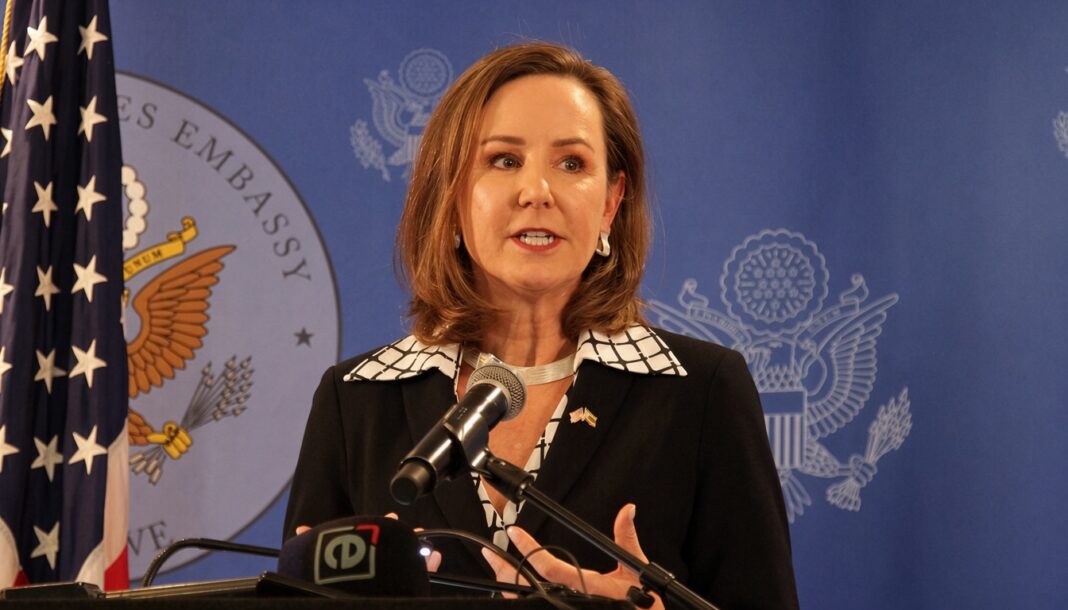
US Ambassador Pamela Tremont said Washington respected Zimbabwe’s decision to decline the proposed Health Memorandum of Understanding (MoU), while confirming that the US Embassy was working with Zimbabwe’s Ministry of Health and Child Care and other partners on a responsible handover.
The announcement marks a significant change after more than two decades of American involvement in Zimbabwe’s health system, particularly in HIV prevention and treatment, tuberculosis, malaria, laboratory capacity, health-worker support and community health programmes.
Tremont said the partnership had helped Zimbabwe achieve HIV epidemic control, with more than 95% of people living with HIV receiving treatment. She cited figures showing that 97% of people living with HIV know their status, 98% of those diagnosed are receiving antiretroviral therapy and 96% of people on treatment have achieved viral suppression.
Funding transition exposes health-sector financing gap
The immediate economic question is how quickly Zimbabwe can replace external health financing with predictable domestic resources without disrupting essential services.
Analysts in the health sector who spoke to The Zimbabwe Financial Mail said the issue should be viewed not only as a public-health challenge but also as a question of fiscal capacity, institutional resilience and domestic capital formation.
“The central issue is continuity. Zimbabwe has to move from a donor-dependent health financing model towards a system in which government, insurers, employers, households and private healthcare providers collectively create a deeper domestic funding base,” one health-sector analyst said.
Another analyst said the withdrawal could accelerate a necessary restructuring of healthcare financing, but warned that the transition would be difficult if domestic funding did not rise sufficiently.
“Health sovereignty ultimately requires financial sovereignty. You cannot sustainably operate a modern healthcare system when critical programmes depend on funding decisions made in another country,” the analyst told The Zimbabwe Financial Mail.
Data-sharing dispute became a major sticking point
The collapse of negotiations followed Zimbabwe’s concerns about provisions relating to health data and biological information.
Zimbabwean officials have argued that the proposed arrangement raised questions over access to sensitive health information, sovereignty and the country’s relationship with international health institutions. The US side has maintained that its revised assistance model is designed around greater partnership and co-investment by recipient countries.
The two sides therefore emerged from the negotiations with fundamentally different assessments of the proposed framework.
The disagreement illustrates a wider tension in international development financing: donors increasingly want recipient governments to assume greater responsibility for financing programmes, while governments receiving assistance remain concerned about the conditions attached to that money.
Health becomes an economic policy issue
The consequences extend beyond hospitals and clinics because health expenditure is itself an important component of economic productivity.
A prolonged deterioration in access to medicines, diagnostics, prevention and treatment can increase household healthcare costs, reduce labour productivity and place additional pressure on employers and government budgets.
For Zimbabwe, the challenge is particularly important because the country is attempting to rebuild formal economic activity while operating with constrained fiscal resources.
“Healthcare is productive infrastructure. If workers are healthier, firms lose fewer working days, households face lower catastrophic medical expenditure and the economy retains more human capital,” an economist who spoke to The Zimbabwe Financial Mail said.
The transition therefore creates an incentive for Zimbabwe to develop a more integrated domestic health-financing market involving medical insurers, pension funds, banks, employers, pharmaceutical companies and private healthcare providers.
Opportunity for domestic health investment
Analysts said the end of US health assistance could ultimately create an opportunity for Zimbabwe to develop stronger domestic financing mechanisms, provided policymakers treat the transition as a structural reform rather than simply a budgetary problem.
Greater participation by insurance companies could expand pre-funded healthcare, while pension and investment funds could potentially provide long-term capital for hospitals, diagnostic centres, pharmaceutical manufacturing and medical infrastructure.
Banks could also play a larger role in financing healthcare businesses, while the capital market could support larger projects through corporate debt, equity and infrastructure investment vehicles.
Such a model would gradually shift healthcare from a predominantly aid-supported sector towards a broader domestic economic ecosystem.
Zimbabwe needs a stronger pharmaceutical industry
The financing transition also highlights Zimbabwe’s dependence on imported medicines and medical equipment.
A stronger domestic pharmaceutical and medical-supplies industry could reduce exposure to foreign-exchange shortages, international shipping disruptions and changes in donor procurement arrangements.
Analysts said the country has an opportunity to link healthcare reform with industrial policy by encouraging investment in pharmaceutical manufacturing, laboratory supplies, medical consumables and equipment servicing.
“The long-term answer is not simply finding another donor. It is creating an ecosystem in which Zimbabwe can finance, manufacture and deliver a larger proportion of its own healthcare requirements,” an industry specialist said.
That would create potential benefits beyond healthcare, including skilled employment, industrial investment and foreign-exchange savings.
US relationship shifts towards trade and investment
The funding withdrawal does not represent a complete break in US-Zimbabwe relations.
Tremont said Washington’s relationship with Harare would increasingly move from one centred on health and humanitarian assistance towards trade, investment and broader economic cooperation. The US Embassy has identified areas including agriculture, technology, energy, infrastructure, climate-smart solutions, artificial intelligence and mining as potential areas of engagement.
That shift could eventually produce a different form of economic relationship, with private investment replacing some elements of traditional development assistance.
For Zimbabwe, however, attracting investment will depend on the country’s ability to provide predictable policy, reliable infrastructure, credible financial institutions and a business environment capable of supporting long-term capital.
Africa faces a wider health-financing challenge
Zimbabwe’s situation is part of a much broader African debate over health sovereignty and donor dependence.
African governments and regional institutions have increasingly argued that domestic financing must assume a greater role in healthcare as international development assistance becomes less predictable. The Africa CDC has warned of a major financing crisis across the continent, while recent US policy has placed greater emphasis on bilateral arrangements and recipient-country co-financing.
Other African governments have also raised concerns over aspects of new US health agreements, demonstrating that the debate is not confined to Zimbabwe.
The wider lesson is that African health systems cannot indefinitely depend on external funding for programmes that have become essential components of national healthcare.
The test now is domestic capacity
For Zimbabwe, the immediate priority is to protect continuity of HIV, tuberculosis, malaria and other essential programmes during the transition.
The more difficult task is to establish a financing architecture capable of sustaining those services over decades.
That means expanding the domestic tax base, improving public financial management, deepening health insurance, mobilising institutional savings and attracting private capital into healthcare infrastructure and pharmaceutical production.
The end of US health funding therefore represents both a significant near-term risk and a structural test for Zimbabwe’s economic policy.
The country has made substantial progress in public health with international support. The next stage will require converting those gains into nationally financed and institutionally sustainable systems.
As one analyst told The Zimbabwe Financial Mail: “The objective should not be to replace one donor with another. It should be to build a health economy that can finance itself.”