NEW YORK – Zimbabwe has been selected for a new United Nations programme designed to help resource-rich countries capture more economic value from critical minerals, placing the country’s lithium and broader mineral-processing ambitions within a rapidly changing global industrial landscape.
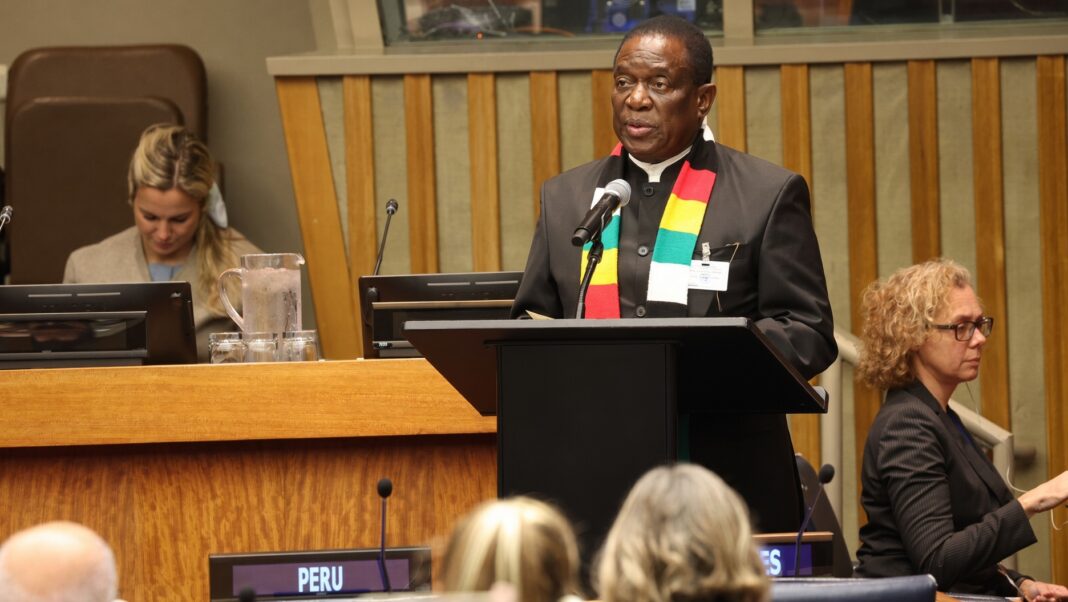
The initiative, announced by UN Secretary-General Antonio Guterres in New York, covers six countries — Zimbabwe, Zambia, Nigeria, Guinea and Madagascar in Africa, together with Indonesia — and is aimed at moving mineral economies beyond the traditional model of extracting and exporting raw materials.
For Zimbabwe, the timing is significant. The country has emerged as an important supplier of lithium, a mineral increasingly associated with batteries, electric vehicles and renewable-energy technologies. The central economic question is no longer simply how much mineral Zimbabwe can extract, but how much industrial activity, employment, technology and capital formation can be generated around that resource.
From mineral exports to industrial capacity
The UN programme will provide policy and legal advice, environmental and social safeguards and support for the development of mineral value chains. The intention is to help participating countries build industries around their mineral resources rather than remain primarily exporters of unprocessed commodities.
Zimbabwe has already moved in this direction by restricting exports of unprocessed lithium ore and suspending exports of tungsten and antimony, reflecting a broader policy attempt to encourage domestic beneficiation.
An industry analyst who spoke to The Zimbabwe Financial Mail said the opportunity should be viewed as an industrial-policy challenge rather than simply a mining opportunity.
“The real value of critical minerals begins after extraction. Zimbabwe needs to develop the processing, engineering, energy, logistics, financial and technical services that sit around the mine. That is where a mineral boom can become an industrialisation cycle.”
Zimbabwe needs to capture the multiplier effect
The economic prize extends well beyond the mine gate. Processing plants require electricity, engineering services, transport, insurance, banking, construction, chemicals, machinery maintenance and skilled labour. Those activities create secondary demand throughout the domestic economy.
A second industry expert told The Zimbabwe Financial Mail that Zimbabwe should use its mineral endowment to rebuild productive capacity rather than allowing mineral exports to become another enclave of the economy.
“The objective should be to create an ecosystem around mining. A mine should generate suppliers, manufacturers, engineers, financial institutions and technology companies. That is how natural resources become a platform for broader economic development.”
This is particularly important for Zimbabwe because the country retains an industrial base, agricultural supply chains and a relatively developed financial and professional-services sector that could potentially support deeper mineral value chains.
A global race for critical minerals
The UN initiative comes as governments worldwide seek greater security over supplies of minerals needed for the energy transition. The organisation expects demand for critical minerals to increase sharply as renewable-energy investment and electric-vehicle production expand.
That creates both an opportunity and a risk for African producers. Countries with substantial deposits have greater bargaining power, but that advantage can disappear if they compete primarily to export ore while importing the technology and finished products generated from those same resources.

Zambia is seeking to increase the domestic value generated by its copper industry, while Guinea is attempting to leverage its position as a major bauxite producer. Madagascar has deposits of cobalt, graphite and nickel, while Indonesia has built a much more aggressive industrial strategy around nickel processing.
The lesson for Zimbabwe is straightforward: mineral abundance does not automatically translate into industrial development.
The financing question
The next challenge is capital.
Beneficiation requires large, long-term investments in processing plants, reliable electricity, transport infrastructure and specialised equipment. Zimbabwe will therefore need to mobilise domestic banks, pension funds, insurers, private equity, development-finance institutions and international investors.
Analysts said the country’s mineral strategy should consequently be linked to wider reforms in its financial system.
“Zimbabwe cannot build a modern mineral-processing economy on short-term trading capital alone. It needs investment finance capable of funding infrastructure, processing plants and industrial equipment over long horizons,” another analyst said.
That places monetary stability, predictable investment rules and credible capital markets alongside mining policy. The stronger the domestic financial architecture becomes, the greater Zimbabwe’s ability to retain part of the economic surplus generated by its natural resources.
The opportunity for Zimbabwean industry
The most important question is whether mineral beneficiation can reconnect Zimbabwe’s mining sector with domestic manufacturing.
Lithium processing, for example, can create demand for industrial chemicals, electrical equipment, fabrication, transport, engineering and maintenance. Mining companies can become anchor customers for domestic manufacturers, while local engineering firms can develop capabilities that eventually serve markets beyond Zimbabwe.
That multiplier effect is what could turn the country’s mineral resources into a foundation for reindustrialisation.
The UN’s intervention therefore arrives at an important point for Zimbabwe. Its support is not a substitute for domestic policy, investment or institutional reform, but it can provide technical expertise and international credibility as the country attempts to build more sophisticated mineral value chains.
From extraction to economic sovereignty
For Zimbabwe, the strategic objective should ultimately be to move from being a mineral-producing country to becoming a mineral-processing and industrial economy.
The country’s selection alongside major resource economies such as Indonesia, Guinea and Zambia gives Harare an opportunity to benchmark its policies against countries confronting similar questions. The UN says the participating countries were selected partly on the basis of their mineral potential, government commitment, financing prospects and the possibility that their experience could be replicated elsewhere.
The test will therefore be whether Zimbabwe can convert its mineral advantage into productive investment, skilled employment, export diversification and stronger domestic supply chains.
As one analyst told The Zimbabwe Financial Mail: “The mineral is only the beginning of the economic story. The real test is what Zimbabwe builds around it.”