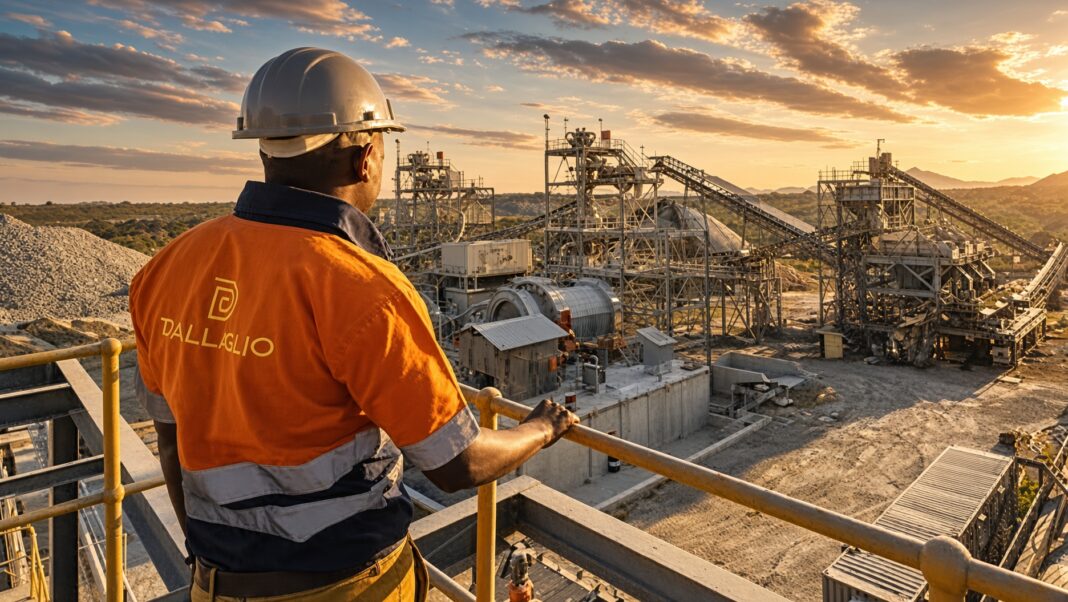
HARARE — Padenga Holdings has emerged as one of the clearest beneficiaries of Zimbabwe’s gold-led earnings cycle after its profit after tax more than tripled to US$82.75 million in the six months to June 2026, with stronger bullion prices, higher production and improved mine performance combining to transform the group’s financial position.
The company’s mining subsidiary, Dallaglio Investments, generated US$182.34 million in revenue, up 48% year-on-year, after producing 1,345kg of gold, a 4% increase from 1,299kg in the comparable period. Gold sales volumes rose 13% to 43,228 ounces.
The results underline the growing importance of mining to Padenga, with Dallaglio now accounting for approximately 97% of continuing-operations revenue. The group’s continuing-operations revenue increased 44% to US$187.74 million, while EBITDA more than doubled to US$100.82 million.
The earnings expansion was considerably larger than the increase in physical gold production, highlighting the extraordinary leverage Zimbabwean producers currently have to the international bullion price.
An analyst who spoke to The Zimbabwe Financial Mail said the results should be read as both a commodity-price story and an operational story.
“The important point is that Padenga did not simply benefit from a higher gold price. Production also increased, recoveries improved and the company continued investing in its mines. That gives the earnings growth a stronger operational foundation, although investors should not assume that the current gold-price environment will continue indefinitely.”
Gold prices have been exceptionally supportive for producers during 2026, providing Zimbabwe’s mining sector with an unusually strong source of foreign-currency earnings and internal capital. The average realised gold price at Dallaglio rose sharply during the period, allowing a relatively modest increase in ounces to translate into a much larger increase in revenue.
Gold price amplifies Zimbabwe mining earnings
Padenga’s numbers illustrate the operating leverage inherent in gold mining.
Dallaglio’s gold production increased by only 4%, yet revenue rose 48%. At group level, profit after tax increased 212%, demonstrating how rapidly margins can expand when a producer has relatively fixed operating costs and receives a substantially higher price for its output.
Another analyst told The Zimbabwe Financial Mail that the more important question for investors is whether Padenga can convert the current bullion windfall into sustainable production capacity.
“The market should distinguish between price-driven earnings and production-driven earnings. The gold price has done much of the heavy lifting, but Padenga is also putting capital into Pickstone Peerless and Eureka. If those investments translate into additional ounces and longer mine lives, the current cycle could leave the company with a structurally stronger earnings base.”
That distinction is increasingly important across Zimbabwe’s mining industry.
Caledonia Mining’s Blanket Mine, for example, produced about 999kg in the first half, down 19% year-on-year, yet its realised gold price increased 48% to US$4,502 an ounce. Revenue nevertheless rose 17% to US$142.3 million and profit after tax increased 41% to US$48.9 million.
Padenga therefore enters the current gold cycle from a comparatively favourable operating position: it is benefiting from the same bullion-price environment while simultaneously increasing production.
Cash generation gives Padenga room to invest
The strongest feature of the results, however, may be the improvement in cash generation.
Operating cash flow rose to approximately US$90.3 million, up 126%, giving the group considerably greater capacity to fund mine development without relying excessively on external financing.
Capital expenditure reached US$13.24 million, while net assets increased 65% to US$231.62 million.
The board also increased the interim dividend to 3.19 US cents per share, from 1.15 cents, representing a 177% increase.
This creates an important capital-allocation test for the group. Padenga is simultaneously distributing more cash to shareholders and reinvesting in the mining assets responsible for the windfall.
An investment analyst who spoke to The Zimbabwe Financial Mail said this was likely to become a defining issue for the stock.
“The dividend is attractive, but the bigger strategic question is what Padenga does with the cash generated by Dallaglio. In a high gold-price environment, the best use of surplus cash may be to expand reserves, improve recoveries, reduce operational bottlenecks and extend mine life. That is what ultimately determines whether today’s exceptional earnings become tomorrow’s sustainable earnings.”
Pickstone and Eureka become central to the investment case
Padenga is directing capital towards its existing mining portfolio rather than relying solely on acquisitions.
At Pickstone Peerless, the underground development programme is progressing, while at Eureka the Cyclone Cluster Upgrade Project is expected to come online in November 2026. The company is also developing additional solar capacity at Eureka.
The strategy is significant for Zimbabwe’s mining sector, where unreliable power, foreign-currency requirements, infrastructure constraints and the cost of developing deeper ore bodies have historically affected production economics.
Renewable-energy investment could also become increasingly important as large mines seek to improve electricity resilience and reduce exposure to interruptions in grid supply. Padenga has already commissioned solar facilities at Eureka and Pickstone Peerless as part of its broader operating strategy.
The wider Zimbabwean economic environment makes such investment particularly valuable.
Large-scale miners remain among the country’s most important generators of export receipts, foreign currency and tax revenue. A sustained increase in gold production therefore has implications beyond individual company earnings, potentially strengthening formal foreign-currency inflows and supporting investment in productive capacity.
The 90,000-ounce test
For investors, the next major test will be whether Dallaglio can turn the strong first half into the production growth promised for the full year.
Padenga is targeting 90,000–95,000 ounces of attributable gold production in 2026. Dallaglio’s first-half production of approximately 43,230 ounces means the company has already completed almost half of that target. It therefore needs roughly 46,800–51,800 ounces during the second half to reach the guidance range.
That puts considerable emphasis on Pickstone’s underground development, Eureka’s processing improvements and the quality of ore being delivered to the plants.
The company’s previous guidance has already attracted market attention. IH Securities said earlier this year that rising gold prices were the defining feature of Padenga’s earnings outlook and forecast FY2026 revenue of about US$426.6 million, principally driven by mining.
Padenga increasingly looks like a gold company
The structural transformation of Padenga is perhaps the most significant message from the half-year numbers.
The group began with a diversified identity centred on crocodile farming and mining. The economics have now shifted decisively towards gold.
Dallaglio’s US$182.34 million in first-half revenue represented roughly 97% of Padenga’s continuing-operations revenue, making the mining subsidiary overwhelmingly more important to the group’s valuation and earnings outlook.
The crocodile and broader agribusiness therefore increasingly resembles a secondary business, while Eureka and Pickstone Peerless determine the investment case.
That concentration brings both opportunity and risk.
If gold stays elevated and production keeps rising, Padenga could generate substantial free cash flow and keep expanding its asset base. But a sharp correction in bullion prices would expose the company to the other side of the same operating leverage driving its exceptional profitability.
The World Gold Council noted that gold reached record levels early in 2026 before entering a correction, underscoring the volatility of the international bullion market.
For Zimbabwean investors, Padenga consequently represents more than a single-company earnings story. It is increasingly a listed proxy for the country’s formal gold economy, exposing shareholders to the interaction between global bullion prices, domestic mining productivity, foreign-currency policy and capital investment.
One analyst told The Zimbabwe Financial Mail: “Padenga is now at the point where the market has to value the quality of its ounces, not merely the quantity of its earnings. The question is whether management can use this exceptional cash-generation period to build a larger, lower-risk and longer-life mining operation.”
The first-half numbers provide encouraging evidence. But the next stage of the story will be determined less by another surge in the gold price than by whether 1,345kg of first-half production becomes the foundation for sustained growth in ounces, mine life and free cash flow.
That is likely to be the key measure for investors as Padenga moves into the second half of 2026.