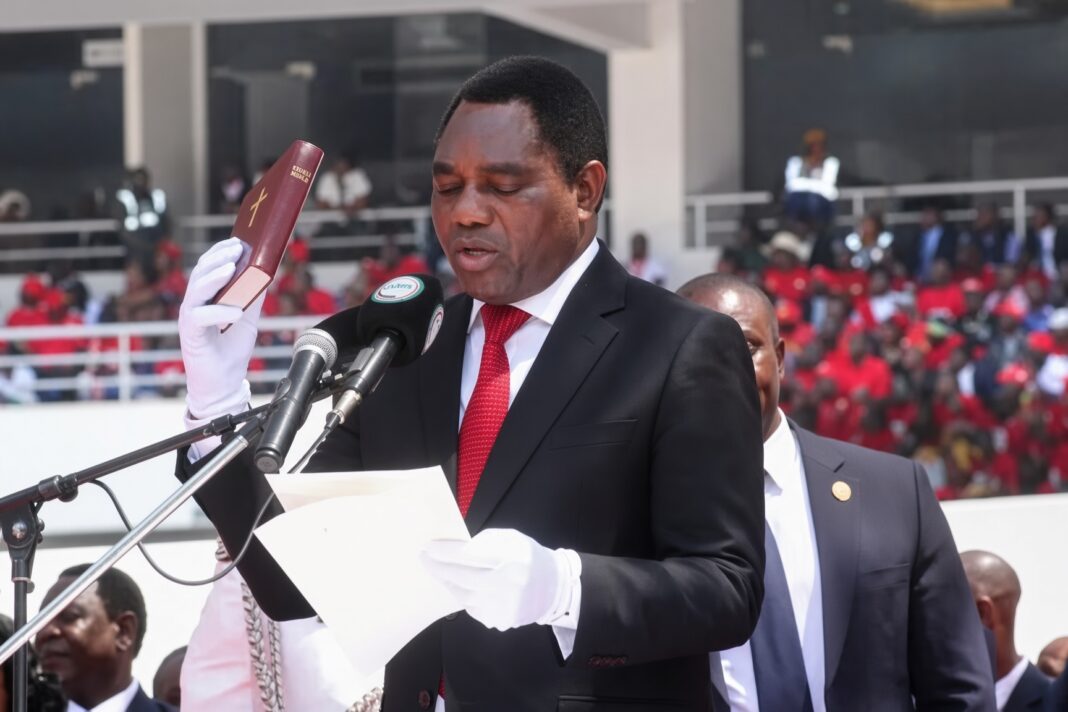
LUSAKA — Zambian President Hakainde Hichilema was sworn in for a second term on Tuesday amid continuing controversy over the election that returned him to office, with opposition figures arrested and the courts closed to appeals challenging the result.
Hichilema took the oath of office before thousands of supporters at the National Heroes Stadium in Lusaka, beginning another five-year term after the Electoral Commission of Zambia declared him the winner of the August 18 presidential election with about 60% of the vote.
The Associated Press reported that the inauguration came against a backdrop of heightened political tensions, following the arrest of opposition leaders and the closure of the country’s courts to legal challenges against the election outcome.
The disputed vote has raised fresh questions about Zambia’s democratic trajectory, particularly in a country that has historically been regarded as one of the more politically stable multiparty democracies in the region.
Opposition faces arrests
The post-election environment has been marked by a crackdown on opposition figures, according to the AP, adding a contentious political dimension to Hichilema’s return to office.
The arrests have intensified concerns among opposition supporters over political freedoms and the ability of rival parties to challenge the government through established democratic and judicial institutions.
The closure of the courts has also become a central issue because Zambia’s legal system traditionally provides an important avenue for challenging electoral disputes.
The combination of arrests and restrictions on judicial appeals means that Hichilema begins his second term with questions not simply about the legitimacy of the election result, but about the institutional environment in which that result is being contested.
A different political landscape from 2021
Hichilema first came to power in 2021 after defeating then-President Edgar Lungu in an election widely welcomed as a peaceful democratic transfer of power.
His victory at the time generated considerable optimism about Zambia’s democratic institutions and marked the culmination of several unsuccessful presidential campaigns by Hichilema.
The political atmosphere surrounding his second inauguration is considerably more contentious.
The AP noted that Zambia has held largely peaceful elections since returning to multiparty politics, making the current disputes particularly significant for the country’s democratic reputation.
The challenge facing Hichilema is therefore no longer simply securing an electoral mandate.
It is demonstrating that the institutions surrounding that mandate remain sufficiently independent and credible to command public confidence.
Economic pressures shadow second term
The political controversy comes as Hichilema begins his second term with a substantial economic agenda.
Zambia remains heavily dependent on copper exports, making the performance of the mining sector, global commodity prices and investment in new production critical to economic growth.
The government also faces the continuing challenge of managing public finances following the country’s sovereign debt crisis and restructuring process.
For investors, the political environment will matter alongside macroeconomic policy.
Zambia needs continued foreign investment in mining, energy, infrastructure and manufacturing, while maintaining confidence in its institutions and rule of law.
A perception of political instability or weakening democratic institutions could complicate that investment environment.
Second term begins under scrutiny
Hichilema’s inauguration gives his administration another five years to deliver on its economic and political promises.
But the disputed election means that the legitimacy of the second term will be judged not only by the size of his electoral margin but also by how his government treats political opponents and responds to challenges through the courts and other institutions.
The AP reported that Hichilema secured approximately 60% of the presidential vote, a result that provides a substantial electoral mandate on paper.
The political test now is whether that mandate can be converted into stable and inclusive governance.
For Zambia, the stakes extend beyond one election or one presidency.
The country has long cultivated an image of relative political stability within southern Africa. Maintaining that reputation will depend heavily on whether the government can reassure citizens, opposition parties and investors that electoral competition, judicial review and political dissent remain legitimate components of the country’s democratic system.
Hichilema’s second term therefore begins with a paradox: a decisive electoral victory accompanied by a contested political environment.
How his administration manages that tension could ultimately define the credibility of Zambia’s democratic institutions over the next five years.