

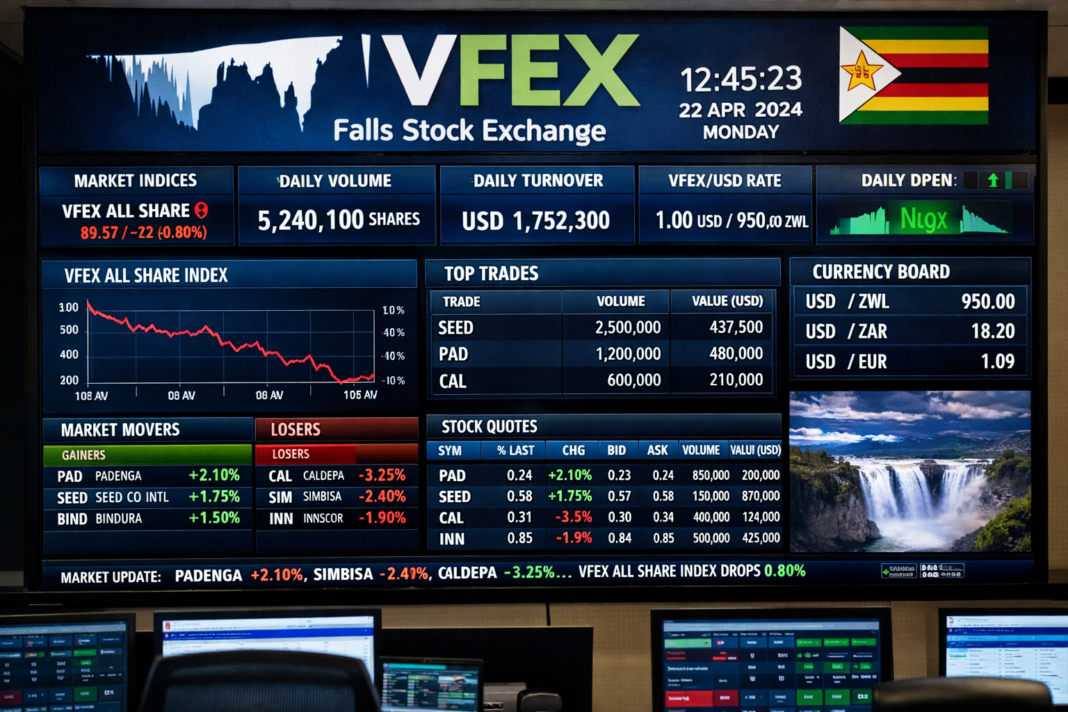
HARARE — The Victoria Falls Stock Exchange has changed the way it calculates market capitalisation for cross-listed companies, a move that could significantly increase the headline size of Zimbabwe’s US dollar-denominated bourse without necessarily bringing a corresponding increase in domestic liquidity or new capital.
Under the new methodology, effective August 13, 2026, VFEX will calculate the market capitalisation of a cross-listed company by multiplying its prevailing VFEX share price by its total global issued share capital, rather than limiting the calculation to shares represented on the Zimbabwean register.
The change comes immediately after Old Mutual Limited resumed trading on VFEX, giving the new methodology an unusually high-profile first test.
Old Mutual immediately changes the numbers
Old Mutual closed its first VFEX session at US$0.7817, broadly in line with its Johannesburg Stock Exchange valuation after an unrestricted first-day price-discovery process.
With approximately 4.67 billion shares issued at the end of 2025, applying the new methodology gives Old Mutual an implied market capitalisation of about US$3.65 billion at its VFEX closing price.
That figure is striking because it is comparable with the entire value of VFEX before the Old Mutual listing.
The exchange had reached approximately US$3.54 billion in market capitalisation by late May, already putting it ahead of the Zimbabwe Stock Exchange, whose market value was around US$3.26 billion at the time.
The new calculation could therefore make VFEX appear substantially larger almost overnight, even though no equivalent amount of fresh money has entered the Zimbabwean capital market.
A bigger market does not mean more liquidity
That distinction will be critical for investors and analysts interpreting future VFEX statistics.
Market capitalisation represents the value assigned to a company’s shares at the prevailing market price. It is not the amount of money raised on an exchange, nor does it represent the value of shares actually owned or traded by domestic investors.
At Old Mutual’s first VFEX closing price, for example, the exchange can now report a global corporate valuation of roughly US$3.65 billion. Yet only 46,402 shares worth approximately US$36,274 changed hands during the opening session.
On the JSE, by comparison, roughly 19.9 million Old Mutual shares worth R251.8 million traded during the comparable session.
The contrast illustrates the difference between corporate valuation and market depth.
VFEX can host a multibillion-dollar company while still having a relatively shallow local order book.
The reform addresses comparability, not undervaluation
The rule change also needs to be distinguished from Zimbabwe’s broader problem of depressed equity valuations.
A company trading at US$0.50 remains worth US$0.50 per share regardless of whether an exchange calculates its market capitalisation using one million locally represented shares or one billion shares issued globally.
The methodology changes the scale of the reported market capitalisation, not the underlying price of the security.
That means VFEX’s reform should be viewed primarily as a market-statistics and comparability reform, rather than a mechanism for solving Zimbabwe’s longstanding valuation discount.
The latter is more closely connected to liquidity, foreign participation, currency risk, investor demand and the ability of investors to enter and exit positions efficiently.
Why the change matters for VFEX
Nevertheless, the reform has strategic importance.
A multinational company listed primarily in another jurisdiction is still one corporate entity. Its economic value is determined by the entire issued equity base, rather than only the fraction of shares that happens to be traded through a secondary market.
Counting the full global share base therefore gives international investors a more recognisable representation of the company’s size and could make VFEX more attractive to companies considering secondary listings.
That could become increasingly important as VFEX attempts to evolve from an exchange dominated by Zimbabwean companies migrating from the ZSE into a genuine cross-border capital-market platform.
Old Mutual represents a different type of issuer from companies that have migrated their primary trading from the ZSE. Its principal market, shareholder base and liquidity remain outside Zimbabwe, while VFEX functions as a secondary venue.
The new methodology recognises that structural difference.
VFEX’s market-capitalisation lead could widen
The implications for exchange rankings could be significant.
If other large international companies follow Old Mutual onto VFEX, their entire global equity values could be reflected in the exchange’s headline market capitalisation.
That could rapidly push VFEX higher in African exchange rankings even if actual trading activity in those securities remains relatively small.
The development therefore creates a potential statistical paradox: VFEX could become much larger by market capitalisation without becoming proportionately deeper in liquidity.
That makes it increasingly important for analysts to distinguish between the size of companies represented on an exchange and the amount of capital actually circulating through that market.
A case for two market-capitalisation measures
One possible solution would be for VFEX to publish two complementary measures: a global issuer market capitalisation reflecting the full value of cross-listed companies, and a domestic market value reflecting the portion of securities represented within Zimbabwe’s market.
Such a distinction would preserve international comparability while giving investors a clearer picture of the actual scale of Zimbabwean trading activity.
This becomes particularly important because market capitalisation alone says little about liquidity.
A US$3.65 billion company generating only tens of thousands of dollars in daily VFEX turnover is not equivalent, from a trading perspective, to a US$3.65 billion company generating hundreds of millions of dollars in daily transactions.
The bigger battle is liquidity
For VFEX, the real prize is therefore not simply a larger market-capitalisation figure.
It is whether Old Mutual and future cross-listed companies can attract institutional investors, foreign participation, market makers and sustained trading volumes.
That is where the reform could have a more meaningful long-term economic effect.
A more internationally recognisable exchange could attract additional multinational listings. More high-quality issuers could increase the relevance of VFEX to international investors. Greater participation could deepen liquidity, reduce the market impact of large trades and ultimately improve price discovery.
The methodology itself cannot create that liquidity, but it forms part of the institutional infrastructure required to accommodate a more internationally oriented exchange.
VFEX and ZSE increasingly follow different paths
The change also highlights the growing structural divergence between Zimbabwe’s two equity markets.
The ZSE remains primarily a domestic-currency market, where companies have faced persistent concerns around currency risk, limited foreign participation and weak liquidity.
VFEX, by contrast, is increasingly positioning itself around US dollar settlement, cross-border investment and internationally oriented companies.
That distinction has already become visible through the migration of several Zimbabwean businesses to VFEX and the return of Old Mutual through a secondary listing.
The latest rule change takes that differentiation a step further.
For VFEX, the challenge now is to ensure that its rapidly expanding headline market value is accompanied by equally meaningful improvements in turnover, liquidity, foreign participation and genuine capital formation.
Otherwise, the exchange may become bigger on paper long before it becomes deeper in practice.