

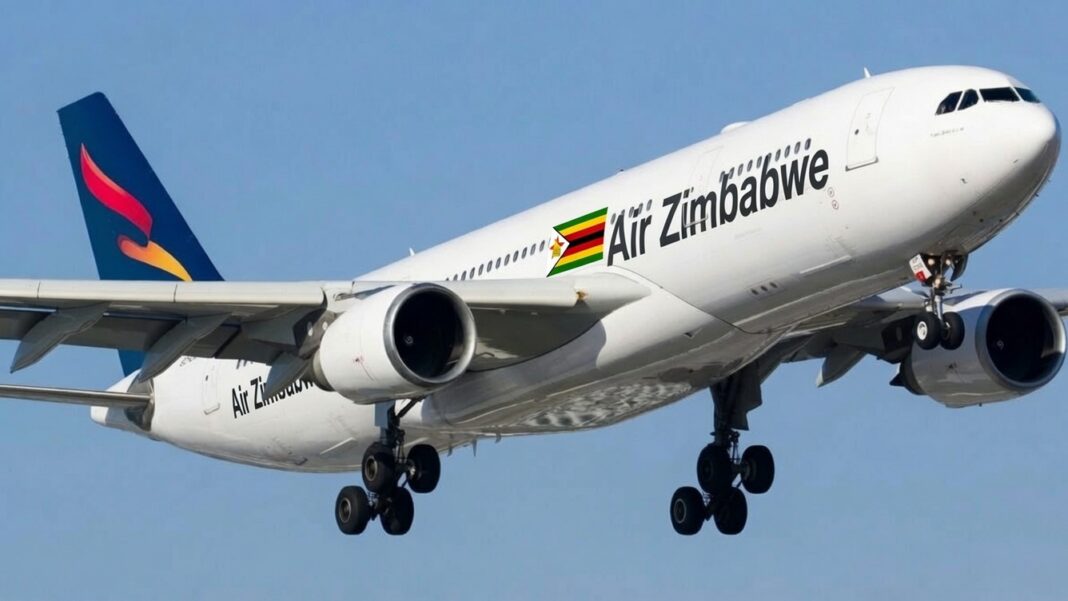
HARARE — Air Zimbabwe has rescheduled one of its newly reinstated Harare–London Gatwick services after an operational delay, underscoring the logistical challenges that often accompany the launch of long-haul international routes while leaving the airline’s broader revival strategy intact.
The national carrier confirmed that Flight UM724, originally scheduled to depart Harare on Friday, 31 July, will now leave on Saturday, 1 August, at approximately 9:00 p.m., arriving at London Gatwick at around 6:00 a.m. on Sunday. The corresponding return service is expected to depart London later on Saturday and land in Harare on the same day.
Air Zimbabwe attributed the disruption to unspecified operational reasons and apologised to passengers affected by the schedule change.
“Flight UM724 has been rescheduled to Saturday, 1 August 2026 at 9:00 p.m. We sincerely apologise for the inconvenience and appreciate our passengers’ understanding as we continue to provide safe and reliable services,” the airline said.
Early Reliability Test for Flag Carrier
The postponement comes only days after Air Zimbabwe restored direct scheduled passenger services between Harare and London for the first time in sixteen years, making the disruption an early test of the airline’s operational resilience and customer confidence.
Industry analysts note that isolated delays during the initial weeks of a long-haul route launch are not uncommon, particularly where operations involve new aircraft, international regulatory coordination, ground handling arrangements and unfamiliar scheduling across multiple jurisdictions.
For Air Zimbabwe, maintaining schedule integrity will be essential as it seeks to rebuild its reputation after years of financial difficulties, fleet constraints and reduced international operations.
Strategic Route with Economic Importance
The Harare–London service represents one of the airline’s most commercially significant routes, reconnecting Zimbabwe directly with one of its largest diaspora markets while strengthening links for tourism, business travel, education and investment.
The airline currently operates three weekly services, departing Harare on Sundays, Wednesdays and Fridays, with return flights from London Gatwick on Mondays, Thursdays and Saturdays.
The restoration of the route forms part of Air Zimbabwe’s wider strategy to rebuild its international network and reposition itself as a competitive regional and long-haul carrier.
Government officials have previously described the London service as a strategic aviation asset capable of supporting Zimbabwe’s broader economic engagement with the United Kingdom through improved connectivity for exporters, investors and international visitors.
ACMI Leasing Model Reduces Operational Risk
Unlike previous attempts to restore international operations using its own fleet, Air Zimbabwe is operating the London route through an Aircraft, Crew, Maintenance and Insurance (ACMI) wet lease agreement with Spanish airline Plus Ultra Líneas Aéreas.
Under the arrangement, Plus Ultra supplies the Airbus A330-300 aircraft together with flight crews, maintenance support and insurance coverage, while Air Zimbabwe manages ticket sales, passenger services, marketing and the commercial operation of the route.
The ACMI model has become increasingly common among airlines reopening international routes because it enables operators to launch services without immediately committing to the substantial capital expenditure required to acquire and maintain wide-body aircraft.
Passenger Confidence Remains Critical
While a single operational delay is unlikely to undermine the long-term viability of the Harare–London service, aviation experts argue that consistency and reliability will be critical to sustaining demand in a highly competitive market served by established international carriers.
Business travellers, in particular, place a premium on schedule reliability, while leisure passengers increasingly compare service quality, punctuality and network connectivity when selecting airlines.
For Air Zimbabwe, the successful stabilisation of the London route will be closely watched by investors, regulators and the travelling public alike, as the airline seeks to demonstrate that its international revival is both commercially sustainable and operationally dependable.
Although the postponement is disappointing for affected passengers, industry observers view such early operational adjustments as part of the normal maturation process for newly relaunched long-haul services. The more important measure of success will be the airline’s ability to deliver consistent performance over the coming months as it rebuilds confidence in Zimbabwe’s flag carrier.