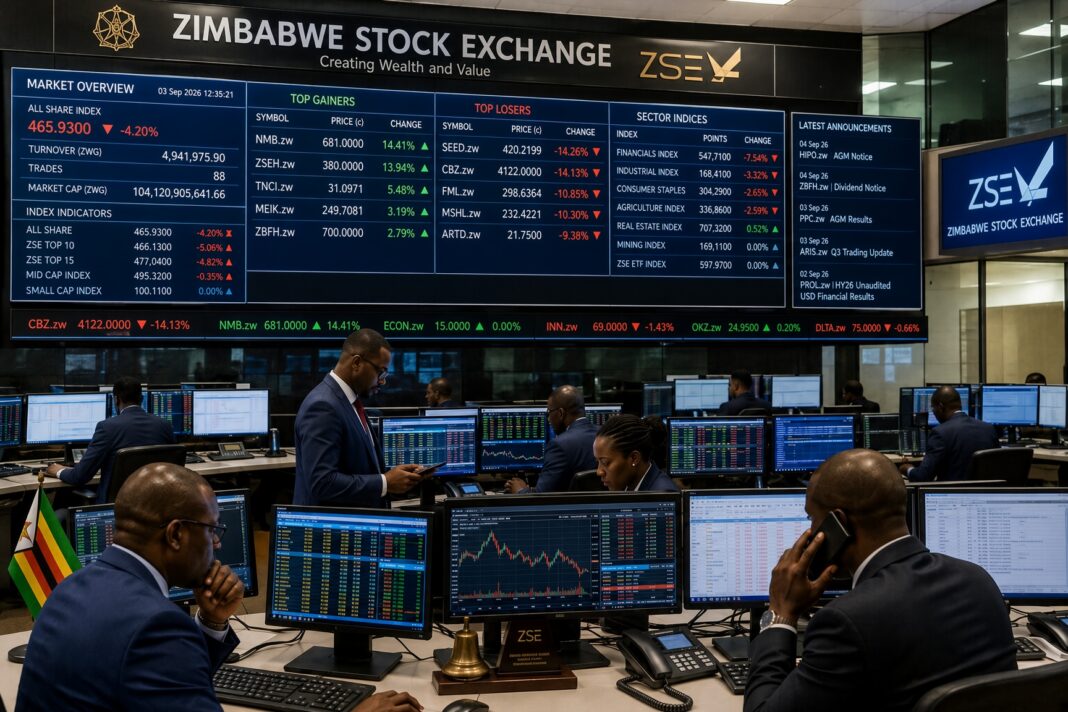
HARARE — Zimbabwean equities suffered a sharp reversal on Friday, with the Zimbabwe Stock Exchange’s main indices falling more than 4% as financial stocks led a broad market sell-off, despite strong gains in a handful of counters.
The All Share Index fell 4.20% to 465.93 points, while the ZSE Top 10 declined 5.06% to 466.13 points and the Top 15 shed 4.82% to 477.04 points.
The Mid Cap Index was comparatively resilient, slipping 0.35% to 495.32 points, while the Small Cap Index was unchanged at 100.11 points.
Trading remained relatively thin, with 88 trades generating ZWG4.94 million in turnover against reported market capitalisation of ZWG104.12 billion. The combination of a substantial index decline and modest turnover again highlighted the shallow liquidity underpinning Zimbabwe’s equity market.
As an equity analyst recently told The Zimbabwe Financial Mail, “The market continues to show pockets of strong price performance, but liquidity remains the structural constraint.”
Financials bear the brunt
Financial stocks were at the centre of Thursday’s retreat, with the ZSE Financials Index plunging 7.54%.
CBZ Holdings fell 14.13% to 4,122 cents, while First Mutual Holdings dropped 10.85% to 298.64 cents. The declines came despite NMB Bank surging 14.41% to 681 cents, illustrating the increasingly selective nature of investor positioning within the financial sector.
ZB Financial Holdings gained 2.79% to 700 cents.
The divergence suggests investors are no longer treating the banking sector as a single trade. Instead, balance-sheet quality, earnings visibility, liquidity, credit deployment and prospective returns are increasingly determining where capital is allocated.
That selectivity comes as Zimbabwe’s banks adjust to a changing monetary environment. Recent Financial Mail analysis has highlighted a growing distinction between balance-sheet expansion and the quality of earnings generated from that expansion, with investors increasingly interested in whether deposits and capital are being converted into productive, adequately priced assets.
Sharp gains amid broad weakness
The market’s overall decline masked substantial price dispersion.
Dawn Properties was Thursday’s strongest performer, rising 14.80% to 574 cents. ZSE Holdings gained 13.94% to 380 cents, while TN CyberTech Investments advanced 5.48% to 31.10 cents.
Meikles rose 3.19% to 249.71 cents.
The simultaneous presence of double-digit gains and losses demonstrates the extent to which Zimbabwe’s market remains stock-specific. Rather than broad-based buying or selling, investors appear to be reallocating capital between individual counters according to expectations around earnings, valuation and balance-sheet strength.
At the opposite end, Seed Co declined 14.26% to 420.22 cents, CBZ fell 14.13%, First Mutual dropped 10.85%, Mashonaland Holdings lost 10.30% to 232.42 cents and ART Corporation declined 9.38% to 21.75 cents.
Liquidity remains the structural constraint
Thursday’s turnover of ZWG4.94 million was small relative to the exchange’s reported ZWG104.12 billion market capitalisation.
That disparity remains one of the central structural problems confronting the ZSE.
In a shallow market, relatively modest transactions can produce sizeable movements in share prices, particularly where free floats are limited. Consequently, a large percentage movement does not necessarily represent a corresponding change in the fundamental value of a company.
This is particularly important in Zimbabwe, where nominal asset values and share prices can be influenced by monetary and exchange-rate dynamics.
The market therefore needs to distinguish between price appreciation and genuine market deepening.
Financial Mail analysts have similarly argued that investors are becoming more discriminating, with earnings visibility, balance-sheet resilience, cash generation and sustainable returns increasingly important in determining investment decisions.
Corporate fundamentals come under greater scrutiny
The changing investment environment is also placing greater emphasis on corporate results.
Ariston Holdings released its third-quarter trading update on Thursday, while Proplastics published unaudited half-year results in both Zimbabwe-dollar and US-dollar terms on Wednesday. PPC also released the results of its annual general meeting.
Such disclosures are becoming increasingly important as investors attempt to separate nominal financial growth from genuine improvements in operating performance.
As another analyst told The Zimbabwe Financial Mail, “The market is moving into a phase where operational performance matters more. Revenue growth, margins, working capital and cash generation will ultimately determine whether recent share-price gains are sustainable.”
The implication is significant. In an economy undergoing monetary stabilisation, investors are increasingly being forced to examine what sits behind reported revenue growth: whether companies are defending margins, generating cash, managing working capital efficiently and producing returns that can ultimately support dividends and reinvestment.
Consumer and industrial stocks weaken
The weakness extended beyond financials.
The Consumer Staples Index declined 2.65%, while the Modified Consumer Staples Index fell 2.31%. Agriculture lost 2.59%, Materials declined 1.02% and the New Industrial Index fell 3.32%.
The Old Industrial Index dropped 4.22%, while the ZSE Top 25 declined 4.39%.
The performance reflects the difficult operating environment still facing Zimbabwean businesses, where formal companies must contend with constrained consumer purchasing power, competition from informal businesses, working-capital pressures and continuing adjustments in the currency regime.
For manufacturers and retailers in particular, the challenge is increasingly to convert nominal sales growth into real profitability and cash generation.
Property provides a rare pocket of resilience
Listed property moved against the broader market.
The Real Estate Index gained 0.52%, while Tigere REIT rose 1.79% to 109.94 cents, giving it a market capitalisation of approximately ZWG2 billion.
Revitus REIT was unchanged at 213.25 cents, with a market capitalisation of about ZWG785.5 million.
The relative resilience of listed property provides a notable contrast with the weakness in financials and consumer-facing counters, reflecting continued investor interest in income-generating real assets as Zimbabwe’s economy transitions towards greater monetary stability.
A market still caught between recovery and fragility
Thursday’s sell-off should not necessarily be interpreted as a collapse in investor confidence.
Rather, it illustrates the contradictory character of Zimbabwe’s capital market: valuations can rise sharply, selected companies can attract strong demand, yet the underlying market remains thin and vulnerable to abrupt price movements.
That distinction is particularly important after a period in which Zimbabwean equities have delivered substantial nominal gains.
For much of the recent market cycle, investors have had to contend with inflation, currency depreciation and the preservation of real wealth. As monetary conditions become more predictable, however, the investment calculus is gradually shifting.
The central question is becoming less about where the share price is going and more about what the company can fundamentally earn.
That transition is visible in the banking sector, where analysts have increasingly focused on whether expanding deposits and lending are translating into sustainable earnings rather than merely larger balance sheets.
It is also visible in the broader equity market, where investors are becoming increasingly selective about companies capable of producing reliable cash flows.
The deeper economic challenge
The ZSE’s immediate weakness also reflects a broader structural issue in Zimbabwe’s financial system.
The country needs deeper domestic capital markets capable of mobilising savings into productive investment. That requires more institutional participation, greater trading liquidity, a broader investable universe and stronger links between corporate capital raising and economic expansion.
The challenge is particularly important as Zimbabwe attempts to move beyond years of monetary instability and rebuild domestic financial intermediation.
A stable currency and moderating inflation can improve the environment for capital formation, but they do not automatically create a deep equity market.
Liquidity must be built.
Institutional savings must be mobilised.
Companies must demonstrate sustainable earnings.
And investors must have confidence that they can enter and exit positions without materially moving prices.
Thursday’s ZWG4.94 million turnover against a ZWG104 billion market capitalisation shows how far that process still has to go.
Investors become more selective
The day’s performance ultimately reinforces a more fundamental shift underway on the ZSE.
The market is no longer simply a contest between bulls and bears over the direction of the index. Investors are increasingly differentiating between companies on the basis of earnings quality, capital allocation, balance-sheet strength and cash generation.
That is potentially a healthier stage of market development.
But it also means that companies whose valuations have risen faster than their underlying earnings may face greater scrutiny.
Thursday’s sharp divergence — from NMB’s 14.41% gain to Seed Co’s 14.26% decline, and from ZSE Holdings’ 13.94% advance to CBZ’s 14.13% fall — captures the market’s current character.
Zimbabwean equities remain capable of producing spectacular returns.
But in a market where liquidity remains shallow, spectacular price movements can run well ahead of fundamentals.
The next phase of the ZSE’s recovery will therefore depend not simply on higher share prices, but on whether economic stabilisation can translate into stronger corporate earnings, deeper liquidity and sustained institutional participation.
For now, Thursday’s 4.20% fall in the All Share Index serves as a reminder that Zimbabwe’s equity-market recovery remains both selective and structurally fragile.