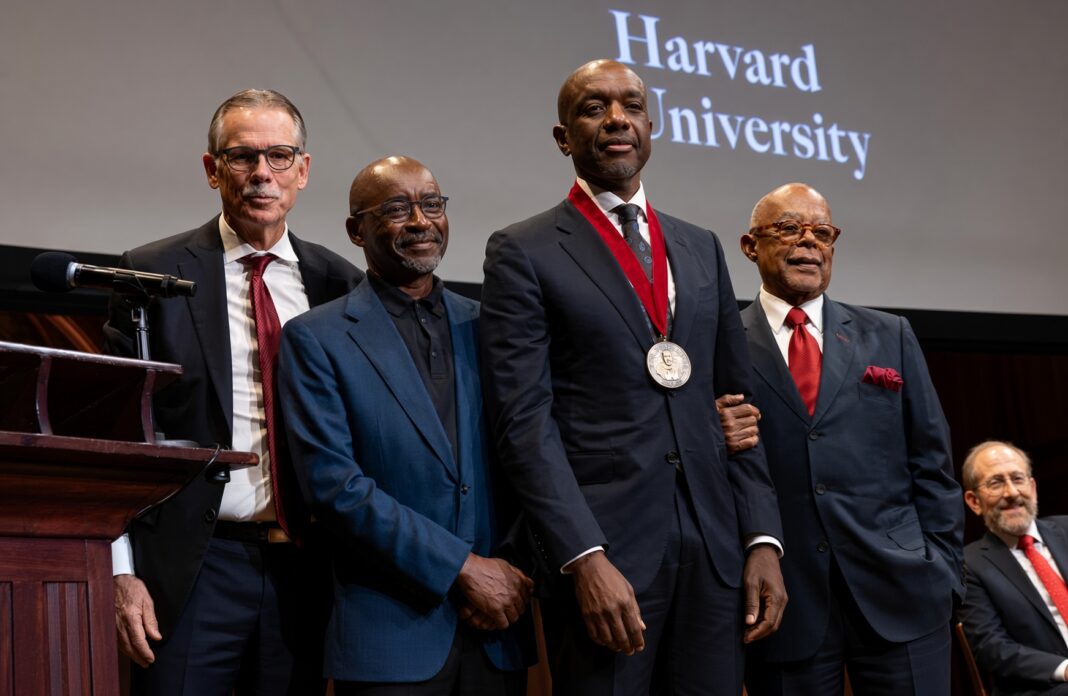
MASSACUSSETS, US — Zimbabwe-born technology executive James Manyika has been awarded Harvard University’s prestigious W.E.B. Du Bois Medal, recognising a career that has taken him from engineering studies at the University of Zimbabwe to the leadership of artificial intelligence research at Google and Alphabet.
The award, according to The Harvard Current Focus, was presented during the Hutchins Centre Honours ceremony at Harvard’s Sanders Theatre in Cambridge, Massachusetts, on Thursday, October 8, with Zimbabwean telecommunications entrepreneur and philanthropist Strive Masiyiwa, himself a recipient of the medal in 2024, taking part in the presentation.
The occasion brought together two Zimbabwean figures whose careers have helped shape different generations of technological development: Masiyiwa through telecommunications infrastructure and digital connectivity, and Manyika through artificial intelligence, advanced computing and scientific research.
Manyika was among eight recipients recognised by Harvard’s Hutchins Center for African and African American Research, alongside actress Angela Bassett, musician Mavis Staples, former footballer Didier Drogba, Netflix co-founder Reed Hastings, artist Theaster Gates, filmmaker Lena Waithe and the late American lawyer Fletcher Wiley.
The W.E.B. Du Bois Medal, first awarded in 2000, is Harvard’s highest honour in African and African American studies. Previous recipients include civil rights leader John Lewis, writers Toni Morrison and Maya Angelou, and boxing legend Muhammad Ali.
Zimbabwean engineering foundations
Manyika’s journey into the upper ranks of the global technology industry began with electrical engineering at the University of Zimbabwe, where he graduated with first-class honours before proceeding to Oxford University as a Rhodes Scholar.
At Oxford, he pursued advanced studies in artificial intelligence, robotics, mathematics and computer science, earning postgraduate qualifications including a doctorate.
His academic foundation preceded a distinguished career in international management consulting, where he spent more than two decades at McKinsey & Company and subsequently led the McKinsey Global Institute.
There, Manyika became an influential voice in research examining productivity, automation, globalisation, employment and the economic implications of technological change.
His work helped establish a bridge between technological innovation and economic policymaking, particularly as governments and businesses began confronting the implications of artificial intelligence for labour markets, competitiveness and productivity.
He later joined Google, where his responsibilities expanded across research, artificial intelligence, computing, science and the wider social implications of technological development.
Manyika’s work places him at the intersection of some of the world’s most consequential technological developments, including the application of AI to scientific discovery and the challenge of ensuring that increasingly powerful systems deliver broad economic and social benefits.
Harvard recognises science, leadership and public service
Announcing the 2026 recipients, Henry Louis Gates Jr., director of Harvard’s Hutchins Center, said the honourees represented exceptional achievement across several fields.
“This year’s W.E.B. Du Bois Medalists represent the highest traditions of excellence, imagination, and public service,” Gates said in Harvard’s official announcement.
The university said the awards recognised individuals whose work had advanced understanding, opportunity and public life through achievements in science, business, culture, philanthropy and other disciplines.

The ceremony also highlighted the intellectual legacy of W.E.B. Du Bois, the American scholar, sociologist and civil rights advocate who became the first Black person to earn a doctorate from Harvard in 1895.
His work combined scholarship, social analysis and political advocacy, establishing a tradition of intellectual achievement that the annual medals seek to recognise.
Manyika’s inclusion is particularly significant because artificial intelligence is increasingly shaping economic and social questions once examined principally through conventional industrial and labour-market analysis.
His career reflects the growing importance of technological leadership in debates about productivity, employment, inequality and the future distribution of economic opportunity.
Two Zimbabweans, one global technology story
The presentation by Masiyiwa gave the ceremony a particularly significant Zimbabwean dimension.
Masiyiwa, the founder of Econet, built his international business interests around telecommunications and digital infrastructure, helping expand connectivity across African markets.
Manyika’s career represents a subsequent phase of technological development, in which artificial intelligence, scientific computing and digital research are increasingly influencing industrial productivity and economic competitiveness.
Their respective careers illustrate the progression from building the infrastructure needed to connect people and businesses to developing technologies capable of transforming how economies operate.
For Zimbabwe, the recognition also highlights the international contribution of professionals whose early education and intellectual development took place within the country’s institutions.
Artificial intelligence and Africa’s economic future
Manyika’s recognition comes as artificial intelligence becomes an increasingly important consideration in economic development, industrial strategy and international competitiveness.
The technology has potential applications across agriculture, healthcare, financial services, mining, manufacturing and education, sectors that are central to Zimbabwe’s economic development ambitions.
For emerging economies, however, the benefits of AI will depend on more than access to advanced software.
Reliable electricity, affordable connectivity, computing infrastructure, technical skills and effective institutions will influence whether businesses can adopt the technology productively.
Manyika has consistently examined the relationship between technological innovation and its wider economic consequences, including the potential effects of automation on employment, productivity and inequality.
In an interview published by Bloomberg earlier this month, he also emphasised that the artificial intelligence industry cannot be left entirely to regulate itself, arguing for shared responsibility among technology companies, governments and society.
His perspective reflects a growing recognition that the economic gains from AI will depend partly on the institutions and safeguards governing its development and use.
For African countries, the challenge is to move beyond consuming imported technologies towards developing the skills, research capabilities and commercial ecosystems required to participate meaningfully in the emerging AI economy.
A reminder of Zimbabwe’s intellectual capital
Manyika’s achievements also raise a broader question about Zimbabwe’s ability to develop, retain and benefit from its highly educated workforce.
The country has produced engineers, scientists, economists, entrepreneurs and other professionals who have established influential careers internationally.
Such success demonstrates the potential of Zimbabwe’s educational foundations, but it also highlights the importance of creating domestic conditions in which advanced skills can support local enterprise, research and industrial development.
International recognition does not automatically translate into domestic economic benefits. Those depend on whether Zimbabwe can establish stronger connections between its universities, private businesses, research institutions and global professional networks.
For policymakers, the opportunity lies in turning international expertise into practical collaboration through research partnerships, technical training, investment and technology transfer.
Manyika’s career illustrates what is possible when scientific education is combined with access to international research institutions and commercially significant technological innovation.
His recognition at Harvard is therefore both a personal achievement and a reminder of the intellectual resources Zimbabwe possesses, including those represented by its diaspora.
From the University of Zimbabwe to Oxford, Silicon Valley and now Harvard’s Sanders Theatre, Manyika’s professional journey has crossed some of the world’s most influential academic and technological institutions.
The medal recognises that contribution. For Zimbabwe, it offers another example of how talent developed at home can help shape the future of technology far beyond its borders.