
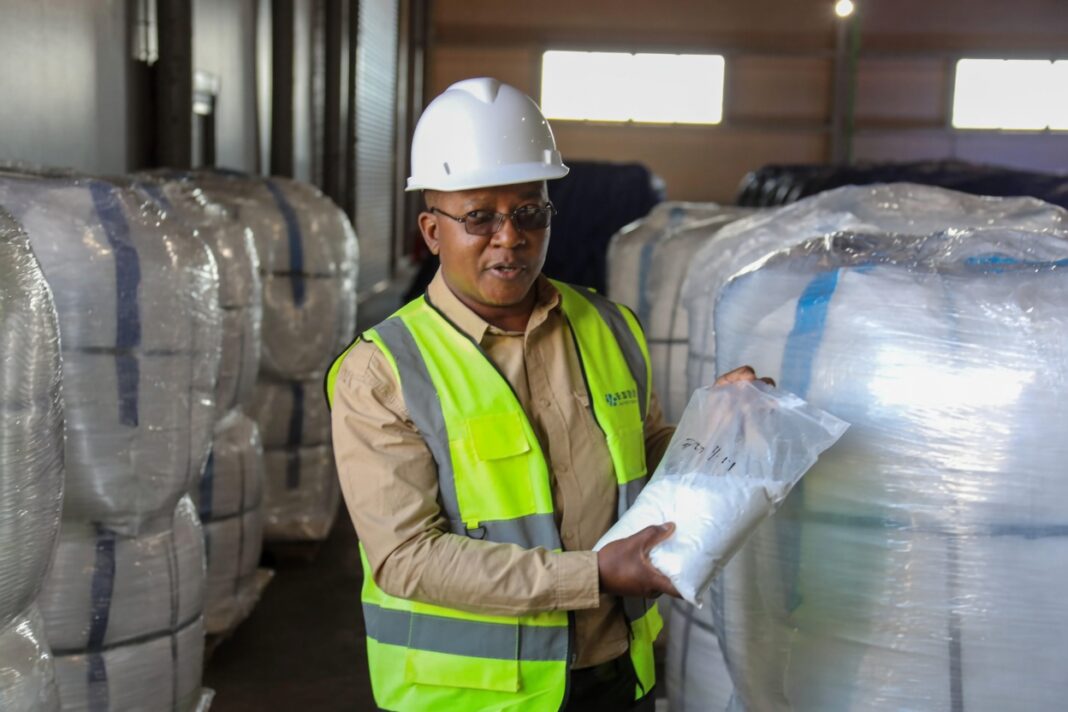
HARARE – Zimbabwe has reached a significant milestone in its drive to move beyond raw mineral exports after successfully producing Africa’s first battery-grade lithium sulphate with a purity of at least 99.5%, marking a major step towards building an integrated electric vehicle (EV) battery materials industry.
Mines and Mining Development Minister Polite Kambamura was presented with the high-purity lithium sulphate this week, a development that industry experts say represents one of the country’s most important advances in mineral beneficiation.
Although lithium carbonate and lithium hydroxide remain the principal compounds used in the manufacture of lithium-ion battery cathodes, battery-grade lithium sulphate is a critical intermediate chemical in the refining process. Producing the material domestically demonstrates Zimbabwe’s growing technical capability to move further up the battery minerals value chain.
The achievement comes as Zimbabwe continues implementing its mineral beneficiation strategy, which seeks to transform the country from a supplier of raw lithium ore into a producer of higher-value battery materials destined for the global electric vehicle industry.
Industry analysts say the development strengthens Zimbabwe’s ambition to become Africa’s leading hub for lithium processing, at a time when global demand for battery minerals continues to accelerate due to the rapid expansion of electric vehicles, renewable energy storage systems and grid-scale battery technologies.
“This is a significant technological milestone. Beneficiation is where the real value lies, and producing battery-grade lithium sulphate demonstrates that Zimbabwe is steadily developing the industrial capability required to participate in higher-value segments of the global battery supply chain,” one mining analyst said.
For decades, African countries have exported largely unprocessed minerals while much of the value addition occurred overseas. Zimbabwe’s latest breakthrough signals an effort to reverse that trend by capturing more value domestically through chemical processing and advanced mineral refining.
The country possesses one of the world’s largest hard-rock lithium resources, with major operations including Bikita Minerals, Arcadia Lithium Mine and Sabi Star Mine positioning Zimbabwe among the fastest-growing lithium producers globally.
Government has consistently argued that mineral beneficiation is central to achieving its vision of building a US$12 billion mining industry. Measures such as restrictions on the export of unprocessed lithium ore have been introduced to encourage investment in local processing plants and downstream manufacturing.
The production of battery-grade lithium sulphate also enhances Zimbabwe’s attractiveness to international investors seeking secure and diversified sources of battery materials outside traditional supply chains.
As geopolitical competition intensifies over critical minerals, countries capable of supplying processed battery chemicals rather than simply raw ores are expected to command greater strategic importance in the rapidly evolving clean energy economy.
The latest achievement is also expected to stimulate further investment in chemical processing, advanced metallurgy, industrial infrastructure and specialised skills development, creating opportunities for higher-value manufacturing and technology transfer within Zimbabwe’s mining sector.
While further downstream processing into lithium carbonate, lithium hydroxide and eventually battery precursor materials remains the next frontier, the successful production of battery-grade lithium sulphate demonstrates that Zimbabwe is steadily laying the foundations for participation in the global electric vehicle battery ecosystem.
For Zimbabwe, the milestone represents more than a scientific achievement. It signals the country’s determination to reposition itself from a resource exporter to a producer of sophisticated industrial materials capable of supplying one of the world’s fastest-growing strategic industries.