HARARE – The United Arab Emirates’ alleged role in supplying Sudan’s Rapid Support Forces (RSF), Dubai’s position as a major international gold-trading hub and the late Zimbabwean businessman Wicknell Chivayo’s publicly documented relationships with influential African leaders have brought renewed attention to the intersection of mineral wealth, political access and cross-border commercial networks.
The three issues occupy different evidential categories. International investigations have documented substantial allegations of external military support for Sudan’s RSF. Dubai is a major destination for African gold, including gold that investigators and researchers say can enter international markets through illicit channels. Chivayo, the late burley Zimbabwean businessmen who died last week alongside his wife in a helicopter clash in Zimbabwe’, meanwhile, has attracted public scrutiny because of his wealth, business interests and unusually visible relationships with political leaders in several African countries.
What has not been established by the available evidence is that Chivayo operated a gold-smuggling syndicate linking Dubai with Kenya, Tanzania, Eswatini and other African states, or that he used presidential or diplomatic airport facilities to transport gold or weapons. Those are serious allegations that require independent documentary verification.
The wider story, however, raises legitimate questions about how gold, aviation, political access and opaque cross-border transactions can intersect in an environment where enforcement responsibilities are divided among multiple jurisdictions.
UAE faces mounting scrutiny over Sudan’s war
The UAE has emerged as a central focus of international reporting on alleged external support for Sudan’s RSF, which has been fighting Sudan’s armed forces since April 2023.
A United Nations fact-finding mission reported in September 2026 that a transnational network involving companies and individuals linked to several countries supplied the RSF with weapons, logistics, training and foreign personnel. The mission said individuals and entities operating from, registered in or linked to the UAE played a significant role in networks involved in recruiting, financing, transporting and deploying foreign military contractors who supported the paramilitary force. The UAE has repeatedly denied providing military support to the RSF.
The findings build on earlier investigations into the movement of cargo aircraft between the UAE and Chad.
In December 2024, Reuters reported that it had identified at least 86 cargo flights from the UAE to Amdjarass in eastern Chad since the Sudanese war began. The investigation drew on flight data, satellite imagery and corporate records. UN experts and diplomats suspected that the airstrip was being used to channel weapons towards the RSF, although the contents of individual shipments were not independently established by the flight data alone. The UAE said its flights carried humanitarian assistance rather than weapons.
Human Rights Watch published further findings in May 2026 concerning Colombian private military contractors recruited through a UAE-based security company. Its investigation reported that contractors travelled through facilities in the UAE before deploying to Sudan to support the RSF. The organisation said its findings added to evidence of UAE-linked military support to the group.
These investigations describe a complex supply chain involving recruitment, transportation, military equipment and cross-border logistics. They do not establish that every UAE-linked company, aircraft operator or African businessperson was involved.
The distinction matters because a supply chain can span several countries without every company operating along it having knowledge of, or participation in, its ultimate purpose.
Aircraft routes and the Malawi connection
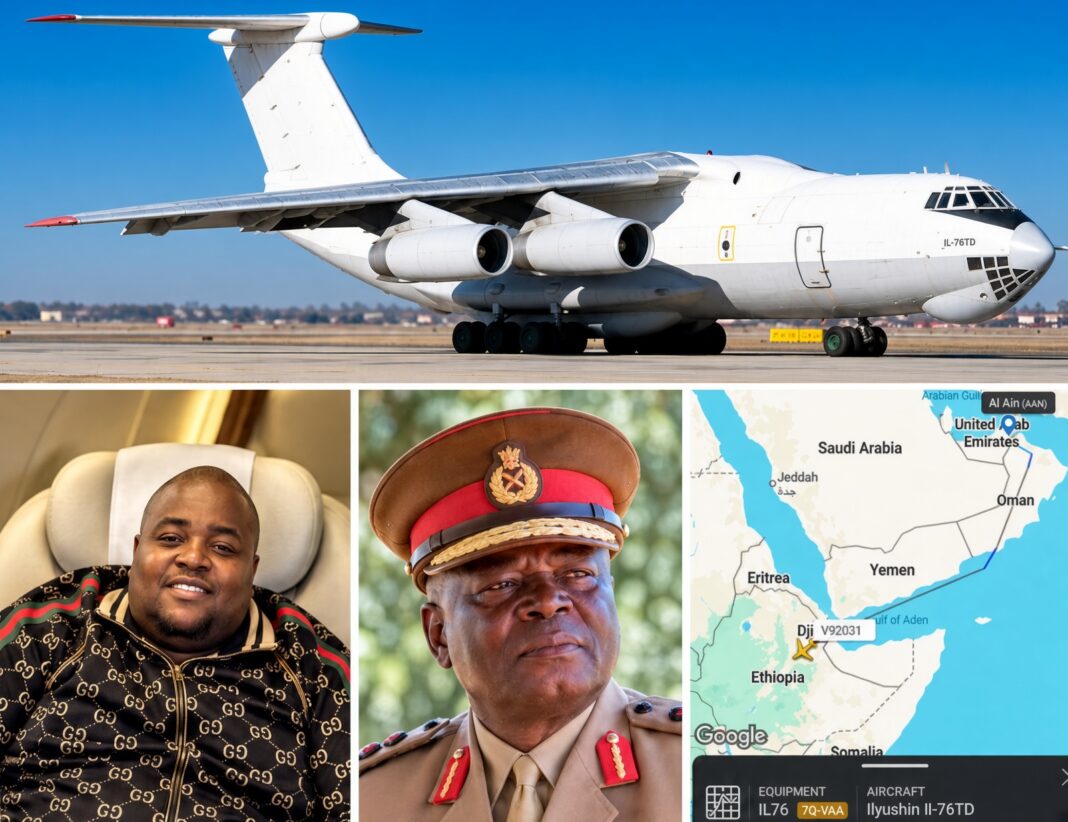
An investigation into alleged arms trafficking to Sudan’s Rapid Support Forces (RSF) has intensified scrutiny of regional cargo flights, military-linked networks and the movement of gold, following the arrest of Malawi’s former army chief and renewed allegations circulating online involving aircraft operators and Chivayo.
Malawi’s Anti-Corruption Bureau arrested former Malawi Defence Force commander General Paul Valentino Phiri over allegations relating to abuse of office and dealing in terrorist property. The charges concern alleged illegal arms trafficking in June and July 2025, with investigators examining claims that weapons were moved through regional logistics networks towards Sudan. Phiri has not been convicted, and the allegations must be tested through the legal process.
The fact that both developments have attracted attention at the same time does not establish a connection. But it has created fertile ground for online theories about whether the helicopter crash, the alleged arms pipeline and the business networks mentioned in circulating claims could intersect.
The unanswered questions behind the speculation
The arms allegations have named Zebu Air and Vise Air, along with aircraft registrations including 7Q-VXX, 7Q-VAA and 7Q-VNN. Posts circulating online have suggested that cargo declared as destined for Malawi may have travelled onward through Ethiopia or Chad before reaching the RSF.
Those claims require independent verification through flight records, aircraft ownership documents, cargo manifests, customs declarations and financial records. The material currently available does not establish that Chivayo owned or controlled the named aircraft, arranged the alleged shipments or financed weapons transfers.
The wider context is nevertheless serious. A United Nations fact-finding mission reported in September that foreign military support, including weapons, equipment, logistics and personnel, was helping sustain Sudan’s war. Reuters reported that the UN mission identified a network involving individuals and entities in several countries, including the United Arab Emirates, Chad, Libya and Somalia, while the countries concerned disputed or denied aspects of the allegations.
This documented international concern about weapons supply networks provides context for investigating the allegations. It does not substantiate the specific claims linking Chivayo to the aircraft or to the RSF.
Dubai’s place in Africa’s gold economy
Gold provides a second, economically significant dimension to the story.
Dubai has become an important international trading and refining centre for gold originating from Africa. The trade includes legitimate commercial transactions, but researchers and international reporting have also documented concerns about undeclared exports, weak origin verification and gold entering formal markets after being moved through informal or illicit channels.

A Financial Times investigation into the UAE’s expanding economic presence in Africa described the country’s growing interests in mining, logistics and commodities. It also noted that substantial quantities of African gold, including gold moved through smuggling channels, pass through Dubai.
The economic attraction is straightforward. Gold is highly valuable relative to its physical weight, can be traded internationally and provides an important source of foreign exchange. Where production, export declarations, ownership and payment records are inadequately verified, the same characteristics can make it attractive to networks seeking to conceal the origin or beneficial ownership of their assets.
For African governments, the consequences can include lost customs revenue, reduced mineral-sector transparency and weaker oversight of foreign-exchange flows. For legitimate exporters, refiners and banks, inadequate controls can create sanctions exposure, money-laundering risks and reputational damage.
However, the existence of gold-smuggling routes between African countries and Dubai does not establish that any particular businessman participated in them. That conclusion requires evidence identifying the gold, the seller, the buyer, the intermediaries, the transportation arrangements and the financial transactions.
Chivayo’s political access attracts scrutiny
Chivayo’s public relationships with African political leaders have made him a prominent figure in debates about private wealth, influence and the relationship between business and political power.
In an August 2026 profile, The Times reported that Kenyan President William Ruto had personally driven Chivayo to his helicopter, that Eswatini’s king had granted him a diplomatic passport, and that Chivayo had relationships with political leaders in Tanzania and Zimbabwe. The newspaper also reported that critics had raised allegations involving influence-peddling, gold smuggling and money laundering, while Chivayo denied wrongdoing.
These publicly reported relationships are relevant to discussions about access and accountability. They do not, on their own, demonstrate that Chivayo received preferential access to customs facilities, used presidential aircraft infrastructure for private cargo, or participated in the movement of illicit gold.
The distinction between political access and operational involvement is particularly important in cross-border investigations. A photograph with a president, a diplomatic document or a visit to an airport may establish a relationship or an event. It does not prove that the individual used that access to evade customs controls or facilitate a criminal transaction.
Any allegation that presidential or diplomatic airport infrastructure was used to move gold between Dubai and African countries would need to be supported by flight manifests, customs records, cargo declarations, official authorisations, communications or financial records. None of the sources cited in this report establishes that Chivayo used such infrastructure for gold smuggling.
Kenya, Tanzania and Eswatini: the questions that remain
The countries named in the allegations occupy important positions in the regional story because of their commercial connections, political relationships and roles in international transport and trade. But each alleged connection requires its own evidence.
In Kenya, reporting on Chivayo’s relationship with President Ruto has prompted questions about the boundaries between private business relationships and public office. Kenya’s transport ministry separately dismissed claims in June 2026 that Chivayo was involved in plans to upgrade Jomo Kenyatta International Airport, saying it had no record of him participating as a bidder or partner.
In Tanzania, Chivayo has been publicly associated with the country’s political leadership, according to The Times. That relationship does not establish involvement in gold exports or illicit cargo movements.
In Eswatini, the reported granting of a diplomatic passport raises questions about the circumstances and official basis of the decision. But possession of a diplomatic passport is not proof that the holder transported gold through diplomatic channels or received immunity from ordinary customs laws.
For investigators, the relevant questions would be specific: Were any named individuals or companies linked to gold shipments? Were the shipments declared accurately? Who owned the cargo? Which aircraft carried it? Were customs exemptions invoked, and, if so, on what legal basis? Were payments made through identifiable accounts or intermediaries?
Those are verifiable questions. They should not be replaced by an assumption that political relationships establish criminal conduct.
How gold, aviation and conflict financing can intersect
The broader concern is that opaque commodity transactions and cross-border logistics can create vulnerabilities that extend beyond individual countries.
In a hypothetical illicit transaction, gold could be acquired in one jurisdiction, moved through another, sold to an overseas buyer and paid for through a separate commercial entity. Aircraft operators, freight agents, brokers, banks and commodity traders could each handle a different part of the transaction. If ownership and end-use checks are weak, the full chain may be difficult to reconstruct.
Where such transactions involve a conflict zone or a sanctioned actor, the risks become more acute. Authorities may need to examine the provenance of commodities, the ultimate beneficiary of payments, the identity of intermediaries and whether any party violated sanctions, customs rules or export-control laws.
This is the type of scrutiny warranted by credible evidence of illicit activity. It is not a basis for asserting that a particular person operated such a network without transaction-level evidence.
The Sudan conflict demonstrates the consequences of external supply networks that sustain armed groups. The UN findings and other investigations have identified foreign support as a factor in the conflict’s continuation. But the separate question of whether African gold networks financed particular weapons shipments must be demonstrated through evidence connecting commodity transactions to the purchasers, suppliers and recipients of military equipment.
A gold trade and an arms pipeline may operate within the same regional commercial environment without being part of the same operation.
The business and economic implications
The implications extend well beyond the reputations of individual businesspeople.
For African governments, illicit gold exports can undermine mineral revenue collection, distort official trade statistics and weaken the ability of central banks and financial regulators to monitor foreign-exchange flows. For businesses, opaque ownership structures and poorly documented shipments can jeopardise access to international banking, insurance and legitimate commodity markets.
For aviation operators, the risks include inadequate cargo documentation, false declarations and the potential use of civilian logistics for prohibited activity. For financial institutions, the challenge is to distinguish legitimate trade from transactions involving concealed beneficial owners, sanctioned counterparties or criminal proceeds.
The policy response requires stronger coordination between customs authorities, aviation regulators, financial-intelligence units and mineral-sector regulators. Gold exporters and traders should be able to demonstrate the origin of their commodities, while freight operators should maintain accurate cargo and flight records. Where official facilities or exemptions are used, the legal basis and documentary trail should be auditable.
Transparency is particularly important when private individuals enjoy close relationships with public officials. Such relationships are not evidence of wrongdoing, but where public resources, state facilities or official privileges are involved, clear records can help establish whether the rules were followed.
The evidence test
The emerging picture is one of an international gold economy in which Dubai plays a major trading role, a Sudanese war sustained in part by alleged external military support, and a wealthy African businessman whose political relationships have attracted considerable public attention.
These developments warrant scrutiny, but they must not be collapsed into a single criminal narrative without evidence.
The documented investigations into alleged UAE-linked support for the RSF provide a basis for examining military supply chains. Research into African gold exports provides a basis for examining commodity provenance and smuggling risks. Public reporting on Chivayo’s political relationships provides context for questions about access, accountability and conflicts of interest.
What remains unproven is the central allegation that Chivayo ran a gold-smuggling syndicate through presidential or diplomatic airport infrastructure across Kenya, Tanzania, Eswatini and other African states, or that his business activities were connected to weapons deliveries to Sudan’s RSF.
Establishing such a claim would require verifiable documents, corroborated witnesses and evidence linking specific transactions to the people alleged to have arranged them.
Until that evidence emerges, the appropriate focus is on the systems that make illicit trade possible—and on ensuring that investigations distinguish documented facts from suspicion.