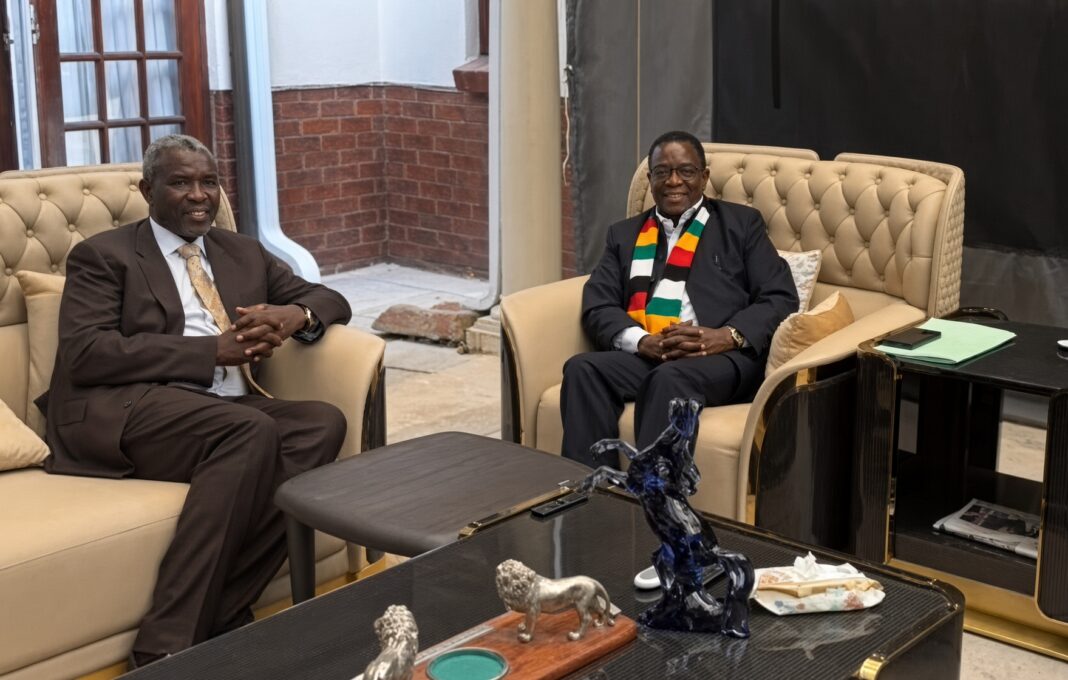
HARARE — President Emmerson Mnangagwa has split Zimbabwe’s Finance and Economic Development portfolio, appointing businessman and close ally Senator Kudakwashe Tagwirei as Minister of Economic Development and Investment Promotion while reassigning Professor Mthuli Ncube to head the Finance Ministry.
The changes, announced on Thursday by Chief Secretary to the President and Cabinet Martin Rushwaya, take immediate effect.
The restructuring separates two functions that have traditionally operated under the same ministry: managing the state’s finances and transforming the productive economy.
Ncube will now concentrate on the Treasury function, including budgeting, public finance management, resource mobilisation, fiscal policy and macroeconomic management. Tagwirei will take responsibility for economic development and investment promotion, with the new portfolio expected to focus more directly on investment, industrialisation, productivity, private-sector development and implementation of national development priorities.
The distinction is economically significant.
Finance asks: “Can we afford it?” Economic Development asks: “Will it make the economy more productive and wealthy?”
Analysts who spoke to The Zimbabwe Financial Mail said the separation could improve accountability if the two ministries develop clearly defined mandates and work against measurable economic outcomes.
They said Zimbabwe has spent much of the past several years concentrating on macroeconomic stabilisation — controlling inflation, managing the exchange rate, rebuilding reserves and strengthening fiscal discipline — but the next challenge is converting that stability into higher investment, productivity, exports and employment.
The split therefore comes at a potentially important point in Zimbabwe’s economic transition.
The country’s National Development Strategy 2 (2026-2030) explicitly separates macro-economic stability and financial-sector deepening from inclusive economic growth and structural transformation among its 10 national priorities.
The IMF has similarly said Zimbabwe’s recent monetary and fiscal measures have helped deliver greater price and exchange-rate stability, while its current reform programme places emphasis on stronger growth, foreign-exchange market reforms, governance and improved economic management.
That creates a different policy challenge from the one facing Treasury.
Zimbabwe now needs to move beyond stabilising the economy towards capital formation and wealth creation — attracting productive investment, expanding industrial capacity, improving infrastructure, deepening domestic capital markets and increasing the productivity of agriculture, mining and manufacturing.
For Tagwirei, the investment portfolio also comes with an unusually broad economic brief. His appointment puts a businessman with extensive experience in Zimbabwe’s corporate and investment environment at the centre of government’s efforts to attract and deploy capital.
Analysts said that experience could be useful in translating government policy into commercially viable projects, particularly in sectors where Zimbabwe is seeking large-scale investment.
But they also said the new ministry will ultimately be judged by outcomes rather than the profile of its minister.
The key tests will include whether Zimbabwe can attract new domestic and foreign capital, accelerate industrial projects, increase value addition in minerals, unlock agricultural finance, improve the business environment and generate more productive employment.
The distinction matters because economic growth does not come simply from government spending.
A government can build a road, provide incentives or allocate resources, but sustainable wealth creation ultimately depends on whether those interventions increase the economy’s productive capacity.
Zimbabwe’s NDS2 identifies structural transformation, infrastructure, agriculture, technology, human capital, job creation and private-sector development as central to that process.
The separation could therefore give Treasury a narrower responsibility for maintaining fiscal and macroeconomic discipline while allowing a dedicated economic-development ministry to concentrate on the more difficult task of making Zimbabwe a more productive investment destination.
That is particularly relevant as the country seeks to consolidate the recent improvement in macroeconomic stability. The Finance Ministry reported that inflation averaged 4.2% during the first half of 2026, while the IMF has described the improved price and exchange-rate environment as supportive of the business climate.
The danger, however, is that a new ministry could simply create another layer of government without materially changing how investment decisions are made.
Analysts said the separation will only be meaningful if it produces clear institutional accountability, faster project execution, stronger investment coordination and measurable improvements in private-sector productivity.
For Zimbabwean businesses, the distinction should ultimately be visible not in the names of ministries but in the cost of capital, availability of foreign currency, infrastructure reliability, access to markets, regulatory certainty and the ability to invest and expand.
The restructuring therefore represents more than a Cabinet reshuffle. It is an attempt to separate the economics of stability from the economics of transformation.
Ncube’s task is to protect the stability of the financial system and public finances. Tagwirei’s task is to help turn that stability into investment, production and wealth.
The success of the new architecture will depend on whether those two functions reinforce each other rather than compete for policy space.