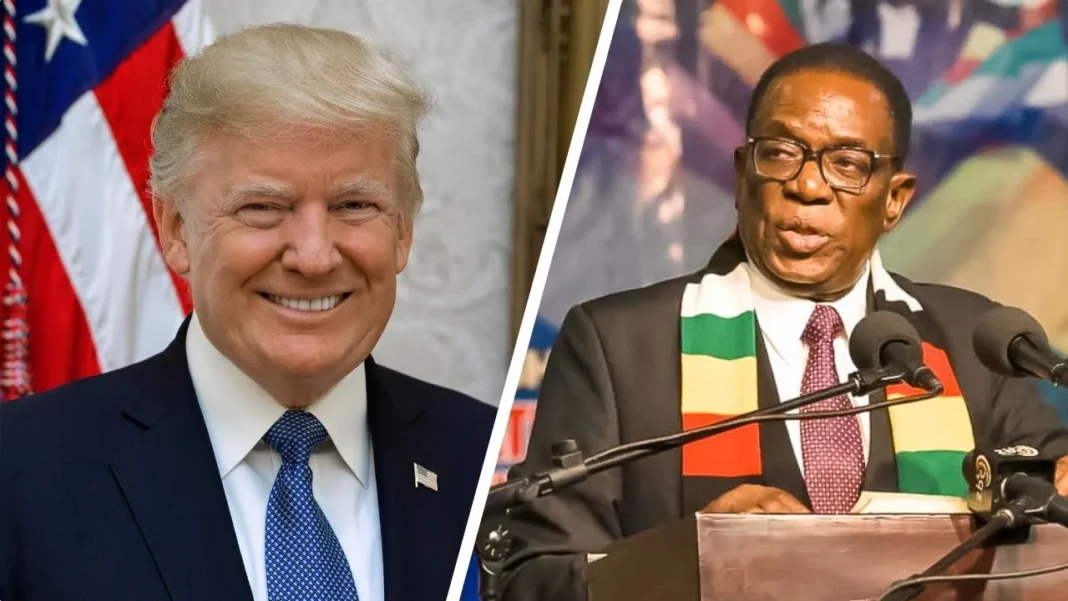
HARARE — The United States is considering a congressional and business delegation to Zimbabwe as Washington and Harare explore a more commercially focused reset in bilateral relations, with critical minerals, investment, trade and access to capital markets emerging as potential pillars of a new economic relationship.
The proposed engagement follows a meeting between President Emmerson Mnangagwa and US Republican Congressman Marlin Stutzman on the sidelines of the United Nations General Assembly in New York, with Zimbabwean officials portraying the encounter as part of a broader effort to rebuild relations with Washington.
Zimbabwean ruling-party spokesperson Ambassador Chris Mutsvangwa said Stutzman met Mnangagwa for more than an hour and subsequently reported the discussions to US President Donald Trump.
“On the sidelines of UNGA, President Mnangagwa met Republican Congressman Marlin Stutzman of Indiana for more than an hour,” Mutsvangwa said, describing the engagement as “eye-opening, cordial and promising”.
The proposed delegation would represent a potentially important shift for Zimbabwe because it could bring US policymakers and private-sector investors directly into discussions about projects rather than limiting engagement to diplomatic exchanges.
For Harare, the stakes are considerably larger than a bilateral trade mission. Zimbabwe is seeking to reduce sovereign risk, attract long-term foreign investment, restructure its external debt and establish a more credible foundation for its ZiG currency reforms.
Critical minerals give Washington a commercial reason to engage
Analysts who spoke to The Zimbabwe Financial Mail said critical minerals provide the strongest commercial rationale for Washington to deepen its engagement with Harare.
Zimbabwe possesses significant deposits of lithium, platinum-group metals, chrome, nickel and other minerals considered strategically important to modern manufacturing and energy technologies.
One investment analyst said the opportunity was to transform the US-Zimbabwe relationship from one centred primarily on political differences into one based on mutually beneficial economic interests.
“The strategic question is no longer simply whether Zimbabwe wants better relations with Washington. It is whether Zimbabwe can demonstrate that its minerals, infrastructure and consumer market provide something sufficiently valuable for American capital to establish a long-term commercial presence,” the analyst said.
Another analyst said the emphasis should be on value chains rather than mineral extraction.
“Zimbabwe should not be negotiating simply to attract another company to dig and export ore. The economic opportunity is processing, refining, power, logistics, technology and manufacturing around the mineral resource. That is where the country can create jobs, exports and a broader domestic industrial base,” the analyst said.
That approach would fit Zimbabwe’s longstanding push for beneficiation and value addition, while aligning with Washington’s growing interest in securing reliable critical-mineral supply chains.
Washington’s new relationship with Harare is increasingly transactional
The potential delegation comes at an important moment in US foreign policy towards Zimbabwe.
Washington recently announced that it would end US global health funding to Zimbabwe following the collapse of negotiations over a proposed bilateral health agreement. US Ambassador Pamela Tremont said the relationship would move from one largely focused on health and humanitarian assistance towards broader economic, trade and investment opportunities.
That development gives the proposed business engagement additional significance.
It suggests that the Trump administration is looking for a relationship in which US interests and commercial opportunities are more explicitly matched with what Washington provides.
For Zimbabwe, that creates both an opportunity and a negotiating challenge.
“The American proposition appears to be much more transactional. Zimbabwe therefore needs to move beyond diplomatic symbolism and put bankable projects on the table — projects where American capital, technology and markets can produce measurable commercial returns,” a Harare-based economic analyst told The Zimbabwe Financial Mail.
Trade access could provide an early test
The first signs of a more commercially functional relationship are already visible in agriculture.
The United States has allocated Zimbabwe 813 metric tonnes of raw cane sugar under its fiscal 2027 tariff-rate quota. The quota allows qualifying sugar to enter the US market within the allocation at the applicable in-quota tariff, subject to origin certification.
The volume is small relative to Zimbabwe’s wider agricultural economy, but analysts said the significance lies in the possibility of expanding market access beyond sugar.
“The immediate value of the sugar allocation is limited by its size, but the strategic value is greater. Zimbabwe needs to use these openings to demonstrate that it can reliably supply the US market with competitive agricultural and manufactured products,” another analyst said.
That could become increasingly important as Zimbabwe seeks to diversify exports away from a narrow concentration in minerals and other commodities.
The bigger prize is capital-market re-entry
For Zimbabwean business, the most consequential outcome of a US reset may not be direct American trade.
It could be re-entry into global capital markets.
Zimbabwe’s financial system remains constrained by high country risk, limited access to long-term external finance and the legacy of arrears and debt distress. A credible improvement in relations with Washington would not automatically resolve those problems, but it could improve investor perceptions and help create the conditions for deeper engagement by international financial institutions.
“Zimbabwe needs a breakthrough with the West, particularly the United States. That could reduce the sovereign-risk premium and improve the environment for the debt negotiations. It would also strengthen the credibility of the country’s currency reform programme,” a financial-market source said.
The potential arrival of major international banks and investment institutions would be particularly significant.
Zimbabwean companies currently operate in a financial environment dominated by domestic banks and regional institutions, while access to deep pools of international capital remains constrained by sovereign risk.
The return of major global institutions would potentially bring not only capital, but also international underwriting capacity, corporate-finance expertise, risk-management systems and access to global investors.
One analyst said Zimbabwe should therefore be actively encouraging major international financial institutions to reconsider the country.
“The objective should not simply be to attract American money. It is to bring American financial institutions, systems and expertise back into the market. That would change how international investors assess Zimbabwe,” the analyst said.
Zimbabwe must convert strategic interest into bankable projects
The emerging US opening comes as Zimbabwe seeks investment across mining, energy, agriculture, manufacturing, infrastructure and technology.
The challenge for Harare will be converting political goodwill into projects capable of attracting institutional capital.
“Zimbabwe should be asking a different question: what does the United States want from Zimbabwe, and how can that strategic interest be converted into investment, technology, market access and financial integration?” one source said.
Critical minerals provide an obvious starting point, but analysts said the opportunity should extend to power generation, mineral processing, logistics, agriculture, telecommunications and digital infrastructure.
For Zimbabwe, this would represent a shift from an aid-dependent relationship towards a commercial relationship in which investment, trade and strategic resources become the principal points of engagement.
That is potentially more durable because commercial relationships are ultimately driven by mutual economic interests.
Debt talks could be the biggest economic beneficiary
A sustained improvement in relations with Washington could also have implications for Zimbabwe’s long-running debt restructuring process.
Zimbabwe owes billions of dollars to external creditors and remains excluded from conventional international capital markets. The country has been working with creditors and international institutions to address its debt overhang, while seeking a pathway back towards normal financing relationships.
A reduction in geopolitical and sovereign risk would not itself restructure the debt, but it could improve the broader environment in which negotiations take place.
The potential US engagement therefore comes at a sensitive point for Zimbabwe’s economic reform programme.
For Harare, the prize is not simply better relations with Washington. It is acceptance back into the international economic system.
If Zimbabwe can convert American strategic interest in minerals and trade into long-term investment, financial-market access and institutional partnerships, the consequences could extend well beyond bilateral commerce.
It could help lower the country’s risk premium, strengthen debt-restructuring prospects, deepen capital markets and provide greater external credibility for the ZiG.
But the opportunity will ultimately depend on Zimbabwe’s ability to offer what international investors require: predictable regulation, secure property rights, transparent institutions, reliable infrastructure, credible monetary policy and projects capable of generating commercial returns.
The proposed US delegation, if confirmed, would therefore be less important for the photographs and diplomatic optics than for what happens when the meetings end.
The real test will be whether Washington’s renewed interest produces capital, contracts, processing plants, export markets and financial institutions — and whether Zimbabwe is prepared to reform sufficiently to make those investments bankable.