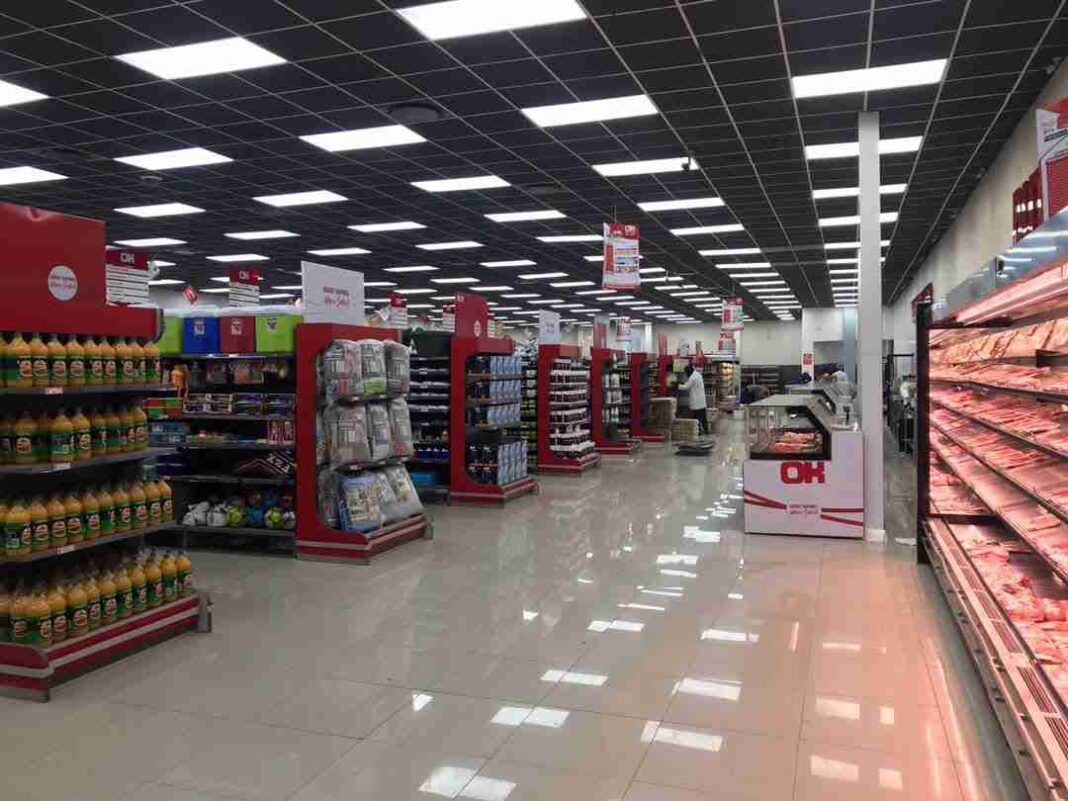
HARARE — OK Zimbabwe is beginning to put merchandise back on its shelves after securing bank guarantees and negotiating a standstill on legacy trade debt, giving the troubled retailer a fresh operational lifeline while raising a more difficult question over whether the underlying balance sheet has actually been repaired.
The Zimbabwe Stock Exchange-listed retailer has secured guarantees from two local banks, allowing major suppliers including Dairibord, ZimGold, Olivine, National Foods and Nestlé to resume deliveries. The company is also reopening branches that were closed during the height of its liquidity crisis as it attempts to rebuild sales and recover its position in Zimbabwe’s increasingly fragmented retail market.
Corporate rescue practitioner Bulisa Mbano has confirmed that agreements with major trade creditors to defer settlement of legacy obligations have provided the business with the breathing space required to restart operations.
The immediate signs of recovery are significant. For a retailer, stock is effectively the operating asset: without inventory, there is little revenue to generate, and without revenue there is little prospect of servicing creditors or restoring the balance sheet.
But the financing structure behind OK Zimbabwe’s latest recovery is more revealing than the restocking itself.
Business analysts speaking to The Zimbabwe Financial Mail said the development should be viewed cautiously because the central issue is not simply whether suppliers are delivering again, but who is ultimately carrying the credit risk.
The distinction is important.
In August 2025, OK Zimbabwe raised US$20 million through a rights issue, with the proceeds partly used to settle legacy supplier obligations. Company disclosures subsequently showed that about half of its supplier debt had been settled, yet suppliers did not return to normal trading terms.
The latest arrangement represents a materially different mechanism.
Rather than relying primarily on OK Zimbabwe’s own balance sheet to persuade suppliers to extend credit, the company is using bank guarantees to provide an additional layer of security. In effect, suppliers are being given greater assurance that their exposure will ultimately be supported by a financial institution.
As one analyst cited by The Zimbabwe Financial Mail put it, the development represents a transfer — rather than necessarily an elimination — of the credit risk that had prevented suppliers from normalising their terms.
That distinction goes to the heart of the rescue.
OK Zimbabwe’s earlier US$20 million capital injection was intended not only to settle part of its legacy obligations but also to restore supplier confidence and unlock fresh credit. Its own financial statements acknowledged that suppliers had received roughly 50% of their legacy debt, but normal trading terms had nevertheless not returned.
The lesson appears to be that settling yesterday’s debt did not automatically create tomorrow’s working capital.
The new guarantees change the architecture of the relationship. Banks are effectively interposed between OK Zimbabwe and its suppliers, allowing suppliers to resume deliveries with a degree of protection against the retailer’s still-fragile credit position.
That may be precisely what is required to get the business operating again.
But it also means the durability of the recovery will depend on what happens when those guarantees mature.
“If suppliers require renewed guarantees when the current facilities expire, then the fundamental credit problem has not disappeared,” one business analyst told The Zimbabwe Financial Mail. “It has simply been intermediated by the banking system.”
That is the central test facing Mbano and the rescue team.
The rescue practitioner deserves credit for finding a mechanism capable of getting suppliers back into the stores after conventional debt settlement failed to restore normal trading terms. OK Zimbabwe’s experience also illustrates how difficult corporate restructuring can become when a retailer’s principal problem is not a lack of physical assets, but a collapse of confidence between the retailer, suppliers and financiers.
Yet several important details surrounding the latest arrangement remain unclear.
The value and tenor of the bank guarantees have not been publicly disclosed, nor have the precise security arrangements between OK Zimbabwe and the banks. Most importantly, questions remain over the company’s ability to restore its payroll after employees agreed in May to continue reporting for work while salaries and wages were suspended. Reports put the workforce at 3,311 employees as of March 2025.
That issue could become critical.
A retailer cannot sustain a recovery simply by filling shelves. It needs functioning stores, paid employees, reliable suppliers, adequate working capital and sufficient customer traffic to convert inventory into cash.
And OK Zimbabwe is attempting this recovery in an exceptionally difficult retail environment.
Formal retailers have been squeezed by the growth of informal commerce, currency distortions, constrained consumer purchasing power and higher operating costs. OK Zimbabwe’s own financial reporting has acknowledged that liquidity constraints disrupted inventory replenishment, while supplier disruptions and the closure of underperforming stores further weakened sales.
The company’s crisis therefore cannot be solved merely by putting more products into stores.
The deeper challenge is to establish a self-sustaining working-capital cycle in which suppliers are paid from operating cash flows, banks are not required indefinitely to underwrite supplier confidence, employees are paid normally and the business generates sufficient margins to service its obligations.
That is why the next phase of the rescue will matter more than the initial restocking.
If the guarantees enable OK Zimbabwe to rebuild sales, generate cash and gradually restore its own creditworthiness, the arrangement could prove to be the bridge between corporate rescue and genuine recovery.
If, however, suppliers remain dependent on bank guarantees every time they deliver merchandise, then the underlying problem will remain unresolved.
The retailer would have regained its inventory but not necessarily its financial independence.
For now, the return of major manufacturers to OK Zimbabwe’s shelves is unquestionably positive. But the more consequential question for investors and creditors is whether the company can turn that renewed supply into cash flow strong enough to replace the guarantees with its own balance sheet.
That will determine whether this is a turnaround — or merely a temporary reopening of the credit tap.