

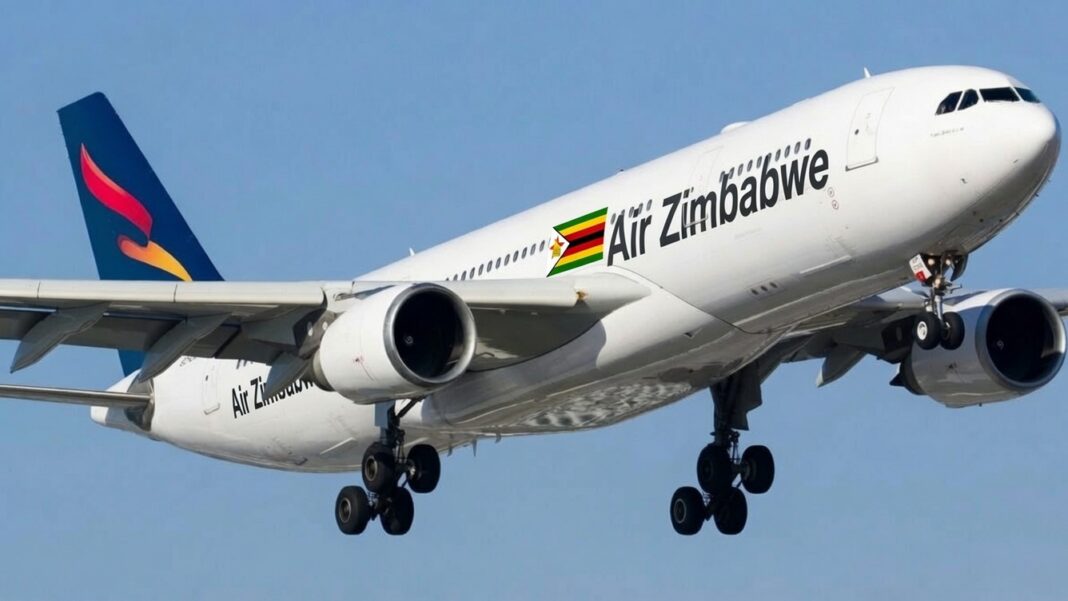
HARARE — Air Zimbabwe’s proposed fleet renewal has entered a more demanding phase as Zimbabwe’s aviation market expands, placing greater pressure on the national carrier to demonstrate that rising passenger numbers can translate into sustainable profits and cash generation.
The airline recorded an US$11.6 million loss before tax in 2024, widening from US$10.4 million a year earlier, while its current liabilities exceeded current assets by US$26 million. The Auditor General consequently warned of a material uncertainty over the carrier’s ability to continue as a going concern, despite issuing an unmodified opinion on its financial statements.
The financial weakness comes against a markedly improving aviation market. Passenger movements through Zimbabwean airports rose 10% to 2.53 million in 2025, from 2.29 million in 2024. International traffic reached 2.17 million, while domestic passenger movements increased 15% to 357,133.
The momentum has continued into 2026, with airports handling 1.19 million passengers in the first half of the year, a 7.1% increase from 1.11 million during the comparable period.
According to analysis published by Equity Axis, these figures fundamentally change the question facing Air Zimbabwe. The issue is no longer simply whether Zimbabwe has sufficient aviation demand, but whether the national carrier can capture that demand at commercially viable yields.
That distinction is critical because the Mutapa Investment Fund is considering a fleet programme valued at approximately US$775.5 million over three years.
The programme envisages six aircraft: two domestic aircraft costing about US$49 million each, two regional aircraft at approximately US$101 million each, and two long-haul aircraft with a combined estimated cost of US$450 million. The objective is to replace ageing equipment while rebuilding domestic, regional and international capacity.
For Equity Axis, the scale of the proposed investment raises the threshold of evidence required before additional capital is committed. Passenger growth alone, it argues, is insufficient. Air Zimbabwe must demonstrate route-level utilisation, passenger yields, cargo revenues and, ultimately, cash generation.
London route becomes an important test
The revived Harare-London service provides perhaps the clearest opportunity to test that commercial proposition.
Air Zimbabwe resumed flights to London Gatwick on July 22 using a 302-seat Airbus A330-300 supplied by Spain’s Plus Ultra under an Aircraft, Crew, Maintenance and Insurance arrangement. Plus Ultra provides the aircraft, crew, maintenance and insurance, while Air Zimbabwe handles ticket sales and the commercial operation.
The airline currently operates three flights a week.
The arrangement effectively allows Air Zimbabwe to test the market without immediately taking on the full balance-sheet burden associated with aircraft ownership.
The first returning flight carried 165 passengers, while the airline reported 1,479 confirmed bookings and more than 30 tonnes of cargo secured during the initial period.
Those figures are encouraging, but Equity Axis cautions that they are not yet sufficient to establish long-term route profitability. What matters will be the accumulation of data across peak and off-peak periods, including load factors, average fares, premium-cabin demand, cargo income, distribution costs and passenger acquisition expenses.
This is where The Zimbabwe Financial Mail would frame the broader investment question: an expanding market does not automatically make an individual airline profitable. The commercial test is whether Air Zimbabwe can convert market growth into recurring operating cash flows without requiring persistent shareholder support.
The London service therefore provides Mutapa with a potential capital gate. If the route performs sustainably under a leased operating model and ownership materially improves its economics, acquiring long-haul aircraft becomes easier to justify.
If the route continues to require substantial financial support before ownership costs are introduced, however, buying the aircraft could simply magnify an existing operating problem.
Domestic expansion also requires discipline
The same logic applies to Air Zimbabwe’s domestic ambitions.
Domestic passenger traffic reached 357,133 in 2025, up 15% year-on-year, demonstrating that internal aviation demand is growing. But domestic passengers remain a relatively small component of Zimbabwe’s total airport traffic.
The proposed US$98 million investment in two domestic aircraft therefore requires careful route selection.
Harare, Victoria Falls and Bulawayo offer relatively strong commercial foundations because of business activity, tourism and connections to international traffic. Thinner routes, however, may not generate comparable financial returns.
That distinction matters because a national airline can simultaneously perform two very different functions: operating commercially viable routes and providing connectivity that government considers strategically or socially necessary.
The two objectives should not be conflated.
Where government requires Air Zimbabwe to serve routes that cannot generate commercial returns, the cost of that public-service obligation should be separately identified. Commercial routes, meanwhile, should be judged against the return that Mutapa could generate by deploying the same capital elsewhere.
Liquidity remains a warning sign
The Auditor General’s findings provide another reason for caution.
Air Zimbabwe had been unable to settle statutory obligations of US$20,498 at the end of 2024, with management attributing the delays to liquidity constraints and promising measures to improve revenue inflows.
While the amount is relatively small in the context of an airline, the underlying signal is more important than the figure itself.
A carrier preparing to deploy hundreds of millions of dollars on aircraft needs sufficient operating liquidity to meet routine obligations. Persistent cash constraints therefore raise legitimate questions about how a much larger fleet would be financed, maintained and operated.
The airline’s audit record also remains incomplete. Of five previous Auditor General findings followed up, only one had been fully addressed, while three were partially addressed and one remained unresolved.
Financial reporting adds another layer of uncertainty. As of June 24, 2026, Air Zimbabwe’s 2025 financial statements had not yet been submitted for audit.
That creates an uncomfortable information gap for an investor considering a US$775.5 million fleet programme.
Mutapa should ideally have current audited financial statements before making major additional commitments, while aircraft acquisition decisions should be informed by several months of actual 2026 operating data.
Competing demands for Mutapa capital
The issue extends beyond Air Zimbabwe.
Mutapa’s portfolio spans strategic sectors including energy, mining, transport and telecommunications, with the Fund indicating that its portfolio requires more than US$10 billion in recapitalisation. It has mobilised approximately US$1 billion while overseeing companies with a gross asset value of roughly US$16 billion.
Air Zimbabwe’s US$775.5 million fleet programme would therefore represent a substantial allocation of scarce capital.
That means the airline must compete for funding on investment merits rather than simply on the basis of national symbolism.
There is undoubtedly a strategic case for a viable national carrier. Air Zimbabwe can support tourism, trade, cargo, diaspora travel and international connectivity while providing Zimbabwe with greater control over strategically important routes.
But those benefits have an economic cost.
The central question for Mutapa is therefore whether Air Zimbabwe can deliver those strategic benefits at a cost that can be justified against alternative uses of public capital.
A market exists. The airline must prove it can monetise it.
Zimbabwe’s aviation market is providing Air Zimbabwe with something it has lacked for years: growing underlying demand.
The country’s airports handled more passengers in 2025, domestic traffic is expanding, international travel remains dominant and the restoration of the London route creates a potentially valuable long-haul market.
But the growth in passengers does not, by itself, solve Air Zimbabwe’s financial problems.
As Equity Axis argues, the carrier now has to demonstrate that it can convert passenger growth into profitable traffic, high aircraft utilisation and sustainable cash flows.
For The Zimbabwe Financial Mail, the broader investment lesson is equally important: fleet renewal should be treated as a staged capital-allocation decision rather than a single US$775.5 million commitment.
The evidence should determine the next aircraft purchase.
If Air Zimbabwe can demonstrate strong route economics, disciplined costs, reliable operations and improving cash generation, the case for progressively owning more of its fleet will strengthen.
If passenger numbers continue rising while losses and liquidity pressures persist, however, the expanding aviation market will expose an uncomfortable reality: Zimbabwe may have a growing airline market without yet having a financially viable national carrier.
The challenge for Air Zimbabwe is no longer proving that Zimbabweans want to fly.
It is proving that the airline can make money from those who do.