





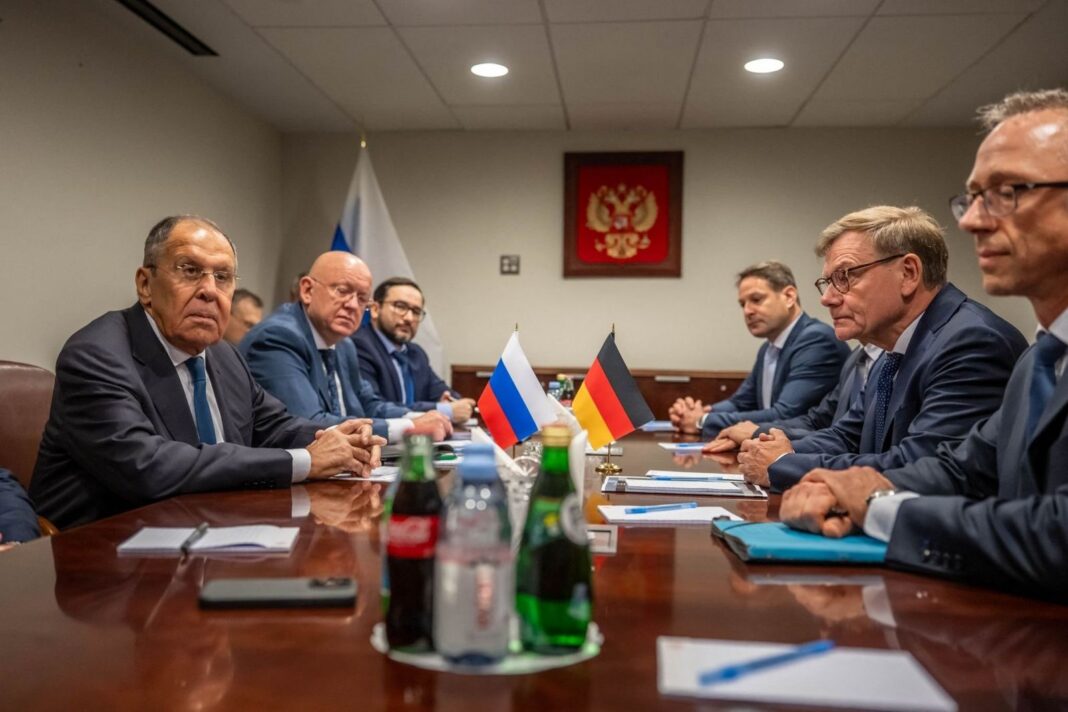
NEW YORK — Germany and Russia have reopened direct ministerial-level dialogue for the first time in more than four years, with Foreign Ministers Johann Wadephul and Sergey Lavrov meeting on the sidelines of the United Nations General Assembly in New York.
The meeting, held on Saturday, was the first encounter between the German and Russian foreign ministers since January 2022, shortly before Russia launched its full-scale invasion of Ukraine. Russian officials said the German side requested the meeting.
The talks do not represent a diplomatic thaw. Rather, they suggest that Berlin is seeking to reopen a channel of communication with Moscow while maintaining its political and strategic opposition to Russia’s war in Ukraine.
Dialogue without normalisation
Wadephul has continued to describe Russia’s military campaign as an illegal war of aggression. Speaking at the UN Security Council earlier this week, he accused Moscow of intensifying the conflict and warned about Russia’s wider hybrid activities against Europe.
Yet the decision to meet Lavrov demonstrates an important principle of diplomacy: communication does not necessarily imply agreement.
International-relations analysts who spoke to sources said the meeting should be viewed as an attempt to create diplomatic optionality rather than evidence of a German policy reversal.
“There is a difference between engaging an adversary and accommodating an adversary. Germany can maintain its support for Ukraine while recognising that eventually there has to be a channel through which difficult issues can be negotiated,” one European affairs analyst said.
The talks reportedly covered bilateral relations and the war in Ukraine, while Wadephul pressed for steps to restore Black Sea grain exports.
Why the meeting matters economically
The diplomatic reopening carries an economic dimension because the Russia-Ukraine war has fundamentally altered Europe’s energy, trade and industrial landscape.
Germany was historically one of Russia’s most important European economic partners, particularly through energy. The rupture following Russia’s invasion forced German industry and policymakers to reconsider energy security, supply chains and strategic dependence.
The economic consequences have extended well beyond Germany. Higher energy costs, shipping disruption, sanctions and commodity-price volatility have reshaped investment decisions across Europe and emerging markets.
“Geopolitical risk has become an economic variable in its own right,” a global markets analyst told sources. “Energy prices, insurance costs, freight rates, exchange rates and sovereign risk premiums all respond to perceptions of geopolitical instability.”
A channel beyond Washington
The United Nations provides a particularly useful setting for the renewed contact.
Berlin can engage Moscow without the political symbolism of a dedicated bilateral visit to Russia, while both sides can use the UN’s diplomatic machinery to maintain communication with multiple governments simultaneously.
Germany’s own foreign ministry has described the annual UN high-level week as one of the few opportunities for intensive international dialogue.
That matters as European governments increasingly confront the reality that any eventual settlement in Ukraine will require engagement with Russia, even while European support for Kyiv remains intact.
Contact before compromise
The Lavrov-Wadephul meeting should therefore not be mistaken for reconciliation.
Berlin remains firmly opposed to Russia’s war in Ukraine, while Moscow and the European Union remain deeply divided over the conflict and Europe’s broader security architecture.
But diplomacy requires contact precisely when political positions are furthest apart.
The more significant development may therefore be the restoration of a channel that had effectively disappeared since early 2022. Whether that channel produces negotiations on Ukraine, humanitarian arrangements, Black Sea trade or wider European security remains uncertain.
For now, Berlin appears to be pursuing a pragmatic calculation: maintain pressure on Moscow, support Ukraine, but keep a diplomatic door open.
That is not a change in Germany’s message. It is a change in method — and, in a war with profound consequences for the global economy, that distinction matters.


