

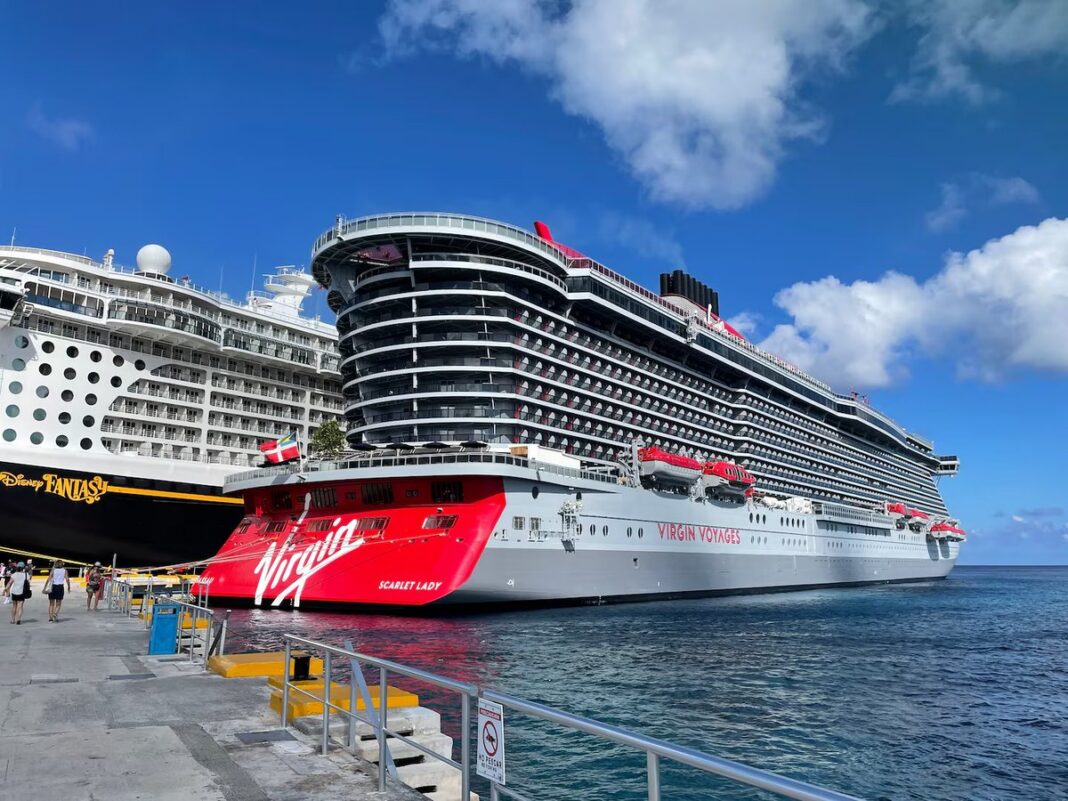
CAIRO, Egypt — Egyptian authorities have refused to let a cruise ship carrying roughly 2,000 mostly LGBTQ+ passengers dock at Alexandria, just days after Turkey blocked the same vessel from two of its ports.
Passengers aboard Virgin Voyages’ Scarlet Lady, chartered by the U.S.-based LGBTQ+ travel company Atlantis Events for a 10-day sailing from Athens to Venice, learned early Thursday that the Alexandria stop had been canceled as organizers scrambled to find an alternative port. Many had reached the eastern Mediterranean overnight, only to find their route altered by the time they woke up.
Atlantis Events CEO Rich Campbell told passengers in a letter that the company had been informed that morning that the ship had been denied entry into Egyptian waters and would not be able to call at Alexandria. He noted that a similar itinerary had sailed without incident the previous year, adding that organizers were surprised by the decision. Around 1,200 shore excursions, including visits to Cairo and the Egyptian Museum, had already been booked through local tour operators.
As with Turkey’s earlier decision, Egyptian officials offered no public explanation for the denial. The ship’s tracking data showed it changing course in the early hours of the morning, and it was ultimately rerouted to Chania, on the Greek island of Crete, before continuing on to Kotor, Montenegro.
The Alexandria stop had only recently been added to the itinerary as a replacement after Turkish authorities in Aydın Province, where the port of Kuşadası is located, canceled planned calls there and in Istanbul, saying the group did not align with “the structure of our society and our moral values.” Campbell called that decision unprecedented, telling CNN that “the reasoning behind it is that it’s a gay group,” and said he was troubled by the idea of a country choosing which tourists it will and won’t admit.
Egypt does not explicitly criminalize same-sex relations, but rights groups and regional commentators note that LGBTQ+ individuals are frequently prosecuted there under public morality and sex-work statutes, with police known to search for targets through social media and dating apps. That legal structure allows authorities to act against LGBTQ+ visitors without ever having to state a reason on the record — as appears to have been the case with the Scarlet Lady.
Legal experts note passengers have little recourse. Cruise contracts typically give operators broad discretion to alter itineraries, and foreign governments generally hold wide authority over who may enter their ports and territorial waters, regardless of how discriminatory the underlying motive may be.
The ship, carrying roughly 1,860 passengers and 1,139 crew members, including Broadway star Patti LuPone, reached the port of Souda in Crete on Friday morning, where passengers were given the chance to take shore excursions before continuing toward Montenegro.
Neither the Egyptian nor Turkish government has issued a formal statement addressing the LGBTQ+ makeup of the charter as a factor in either port denial.