

HARARE – The Mutapa Investment Fund (MIF), Zimbabwe’s sovereign wealth fund now overseeing all state-owned enterprises, has announced a sweeping restructuring of its mining portfolio, beginning with the creation of a standalone gold business that will anchor a new commodity-focused operating model.
MIF chief investment officer Simbarashe Chinyemba told journalists at a briefing hosted by Kuvimba Mining House (KMH) in Harare on Thursday that the overhaul marks “a strategic shift for the Mutapa Investment Fund” as the entity abandons its previous multi-layered holding structure in favour of separate companies for each mineral group.
“We are unveiling a comprehensive restructuring that transitions us from a broad holding model to specialised mineral companies,” he said.
Under the new model, assets will be grouped into companies covering gold, platinum group metals, energy minerals including lithium and nickel, and base metals.
The new structure creates five mining units.
They include Mutapa Gold Resources under Trevor Barnard, Mutapa Base Metals under Godwin Gambiza, Mutapa Energy Minerals under Innocent Rukweza, Mutapa Platinum Group under Munashe Shava, and Mutapa Frontier, which will focus on new acquisitions.
Chinyemba described the old system, where assets were held through entities such as KMH and various minority shareholdings, as “a spiderweb” that hindered efficiency.
“We are rationalising this structure to create a more streamlined and efficient ownership model,” he said.
“What we are doing is neither unique nor experimental; it reflects how the world’s leading mining houses organise themselves.”
He said internal assessments highlighted the risks of remaining a diversified conglomerate.
“The global data to us is very clear. Diversified conglomerates often suffer from a conglomerate discount where value is lost due to diluted focus,” he said.
Moving to mineral-specific companies, he added, will remove administrative layers and ensure technical expertise is focused on the unique fundamentals of each mineral.
Chinyemba said the restructure aligns MIF with industry precedents.
“This is the direction the industry is pursuing to sharpen focus and improve returns.”
KMH chief executive Trevor Barnard confirmed that the gold business will be the first to be operationalised under the new model.
“It’s now about absolute operational focus and efficiencies, and also to be able to access funding,” Barnard said.
He said separating gold from other minerals would immediately improve the portfolio’s attractiveness to financiers.
“Some of the other minerals would dilute the value in the bigger groups,” he said. “When you have a gold company sitting on its own, people are much more willing to invest specifically in a gold company.”
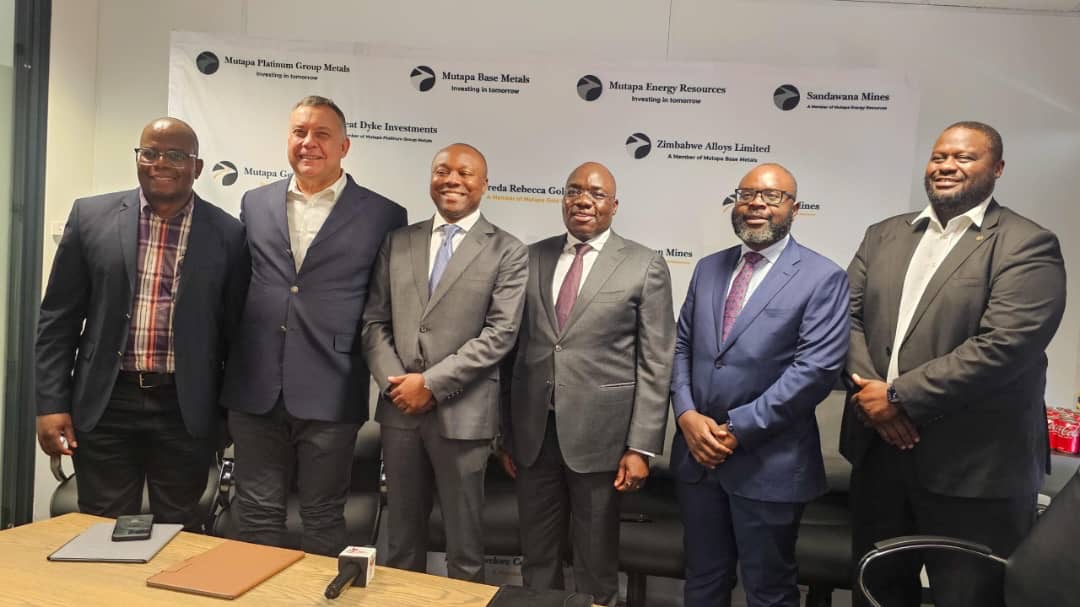
Mutapa Investment Fund chief investment officer Simbarashe Chinyemba (second from left) with the new heads of the sovereign fund’s mineral-specific divisions during a news conference in Harare on February 5, 2026
Barnard unveiled an aggressive expansion plan anchored by the Shamva project.
“We envisage establishing a large open-cast mine at Shamva… close to 2.5 million tonnes of throughput per annum, which would yield in the region of about 80,000 ounces of gold per annum,” he said.
A second mine, Jena Mine, will follow through a similar development cycle, with planning already under way.
“In general, our plan is to double our production in the next three to four years on the gold side, and then once we do that, the opportunities are there to build it even further,” Barnard said.
As part of the broader restructuring, Barnard also identified leaders for other emerging units, introducing Godwin Gambiza as head of the bulk metals business.
“Godwin will specifically look after the bulk metals side of the business, currently incorporating Zim Alloys,” he said.
MIF officials said the restructuring remains subject to regulatory approval, but its direction is now firmly set.
“Clarity of purpose is our most important tool,” Chinyemba said. “This structure ensures our mining portfolio remains a resilient and efficient engine for Zimbabwe’s economic development.” – ZimLive

